

Learn why controlled deceleration and braking mechanics are essential for pickleball players to maintain balance and move safely on the court as they age.




Why am I struggling to stop and stay balanced when recovering from wide pickleball shots?
You are likely losing your center of gravity because rapid deceleration on a small court demands specific lower-body control rather than just quick reaction time.
The quick exchanges in modern racquet sports certainly demand fast footwork from players of all levels. When looking closely at injuries treated in emergency departments, falls are consistently a leading cause of harm. A 2025 paper in the Orthopaedic Journal of Sports Medicine analyzed United States emergency department data from 2013 to 2022. The published research reported 1,110 recorded cases, estimating a total of 66,350 pickleball injuries over the decade.
According to a summary provided by Pickleball Insiders, falls accounted for a significant 65.5 percent of those documented cases. The same data summary noted that 61.1 percent of injured patients were between the ages of 65 and 80. When evaluating the medical outcomes, fractures were the most common diagnosis at 32.7 percent. Sprains were also reported frequently, making up 30.8 percent of the injuries.
It is highly important to remember that this 66,350 figure is merely an estimate derived from sampled emergency department cases. It is not a direct count of all pickleball injuries sustained by players across the country. Minor scrapes, sore muscles, or mild joint tweaks that players manage at home do not appear in this specific surveillance data. However, the prominent role of falls in the clinical data makes balance and recovery highly relevant topics.
Focusing on your off-court strength and balance routines can help you prepare for the sudden stops required during a match. The available injury statistics clearly show that maintaining your center of gravity is an important part of playing safely. Understanding this context prevents unnecessary fear while highlighting the real need for better footwork. As players age, preserving that physical stability becomes even more essential for athletic longevity.
Falls being a leading injury mechanism does not prove that balance training alone prevents falls during a pickleball match. The science regarding sports injury prevention is rarely that straightforward. A 2024 study by Jones and Hammig used the United States National Electronic Injury Surveillance System to examine age-related injury patterns and mechanisms. A University of Arkansas repository record describes how this study distinguishes the specific injury patterns among younger, middle-aged and older players.
The 2024 age-risk study abstract clearly cautions against treating players of different ages as one uniform group. The authors identified a distinct need for age-group-specific injury countermeasures to address these varying risks. At the same time, they explicitly described pickleball as a beneficial form of physical activity. There is no universal readiness test or one-size-fits-all injury prevention program that guarantees perfect safety.
Instead of looking for guaranteed injury prevention, Evercourts suggests focusing your efforts on general physical control. You can practice simple, low-risk movements like supported weight shifts and controlled step-and-stop repetitions at home. Start with very small movements, and always keep a stable support nearby. If you experience any joint symptoms or general instability, you should stop the movement immediately.
Players with prior falls, joint pain, or significant balance concerns should always seek individualized advice from a qualified clinician. Working on building strength and movement capacity is a gradual process that requires patience. Incorporating these gentle stability exercises into your weekly routine takes very little time. Consistent practice allows your nervous system to adapt slowly to the specific demands of sudden movement.
Different racquet sports place highly unique demands on your lower body during the deceleration phase of movement. In tennis, players typically have significantly more space to slow down after sprinting for a wide ball. You can often take several smaller, softer steps to bleed off your running speed before you need to change direction. The larger court surface provides a longer runway for braking.
As a result, the tennis deceleration phase often feels less abrupt than stopping on a smaller playing surface. Tennis players often slide on clay or hard courts to manage their momentum, which requires a completely different technique. Sliding distributes the braking force over a longer distance, reducing the immediate impact on the knees and ankles.
Pickleball demands incredibly sharp and sudden stops because the tight court boundaries leave very little room for error. You frequently have to hit a wide dink shot and immediately halt your lateral momentum to defend the non-volley zone line. This extremely fast transition forces your lower body joints to absorb a lot of force very quickly. Players must be able to brake efficiently to stay balanced in the point and avoid losing their footing completely.
In contrast, pickleball is typically played on high-friction surfaces where sliding is nearly impossible for the average recreational player. Padel introduces yet another layer of movement complexity because of the fully enclosed court structure. Padel players frequently decelerate rapidly to avoid crashing into the heavy glass walls during intense rallies. They must also manage their dynamic balance while turning sharply to track balls bouncing unpredictably off the back fencing.
While all three sports require good balance, pickleball uniquely demands immediate stopping power in very confined spaces. Understanding these structural differences helps you tailor your physical preparation to the specific sport you play. A tennis player might focus more on long deceleration strides, while a pickleball player needs to master the sudden stop.
You should always practice your stopping mechanics cautiously off the court before you try them during a fast match. Begin your practice with simple weight shifts while holding securely onto a sturdy chair or a fence. Shift your body weight slowly from one leg to the other, making sure you feel completely stable before moving back. This basic practice helps you understand exactly where your center of gravity sits over your feet.
Next, you can try controlled step-and-stop repetitions at a very slow, deliberate walking pace. Take a moderate step to the side, plant your outside foot firmly, and hold that balanced position for two seconds. You can gradually change your step and reach distance only when you can stay completely controlled throughout the movement. Implementing a well-designed progressive warm-up routine before play also helps prepare your legs for these dynamic demands.
Make sure you practice these movements in supportive athletic shoes on a flat, even surface. Avoid practicing on slippery floors or uneven grass to minimize any accidental slipping. Never force yourself through a practice drill if you feel sharp pain or sudden dizziness. The primary goal is to build confidence in your footing, not to test your absolute physical limits.
Takeaway action: Before your next match begins, try three slow, controlled side-step and stop repetitions while keeping one hand on the fence for safety.
Building better braking mechanics allows you to enjoy the fast pace of racquet sports with a renewed sense of physical control. Consistent, small improvements to your balance will support your athletic longevity and keep you competing confidently for years to come.
Follow Evercourts for practical insights on tennis, pickleball and padel performance, movement, recovery and healthy ageing. Stay connected for new articles, research-led guidance and ideas to help you play well and keep playing for years.


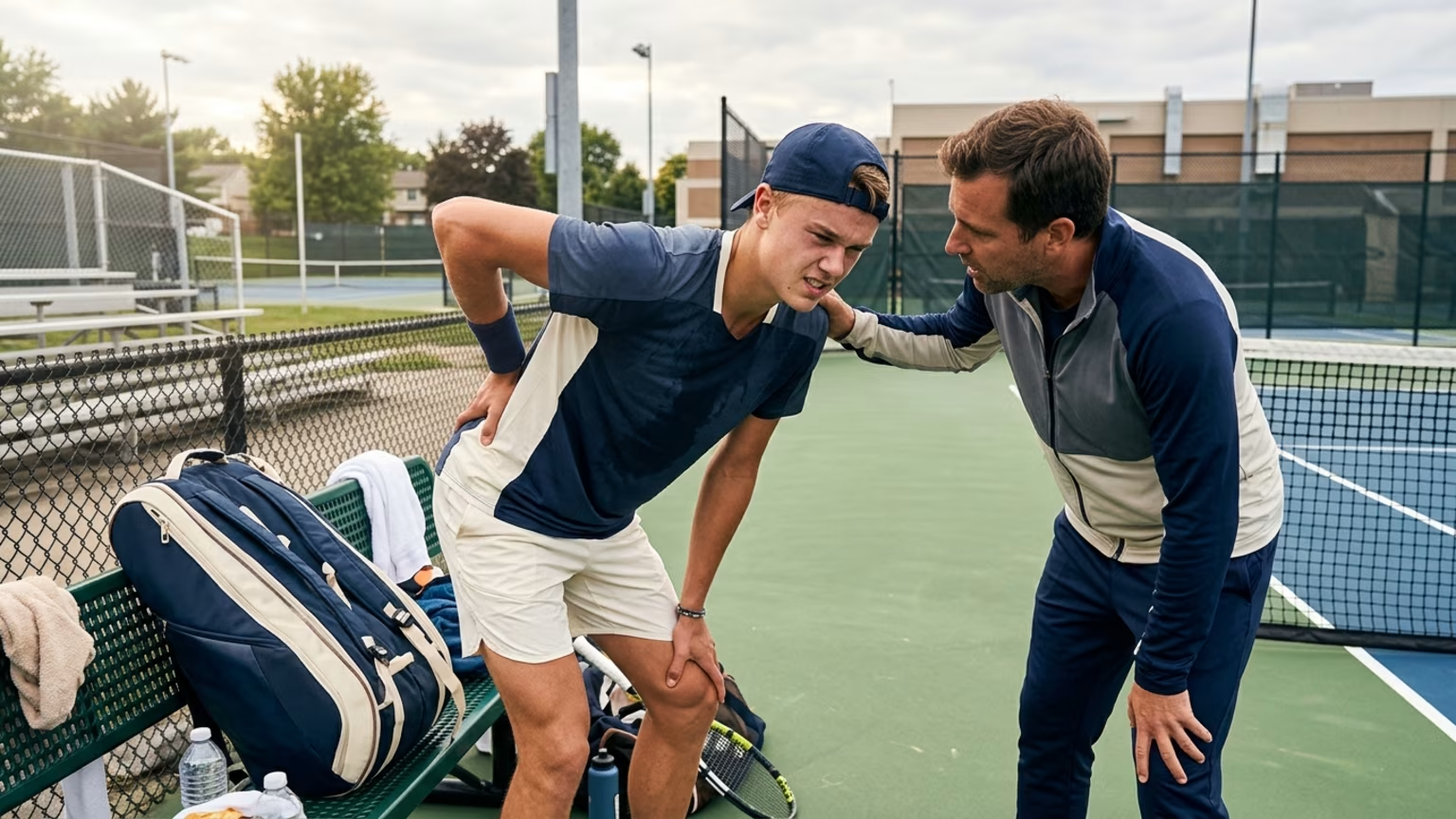
Holger Rune withdrew from the European Open with a back problem. The facts behind his decision and a grounded perspective for recreational players.

The Dink’s October 17 guide emphasizes deep returns, ball-height decisions and positioning against faster pickleball opponents.

A new report outlines padel and tennis gear trends. Learn how to assess adjustable rackets, sensor feedback and smart-court claims.
Read practical guidance for better movement, smarter preparation and a game that keeps working for you.
explore the Blog
