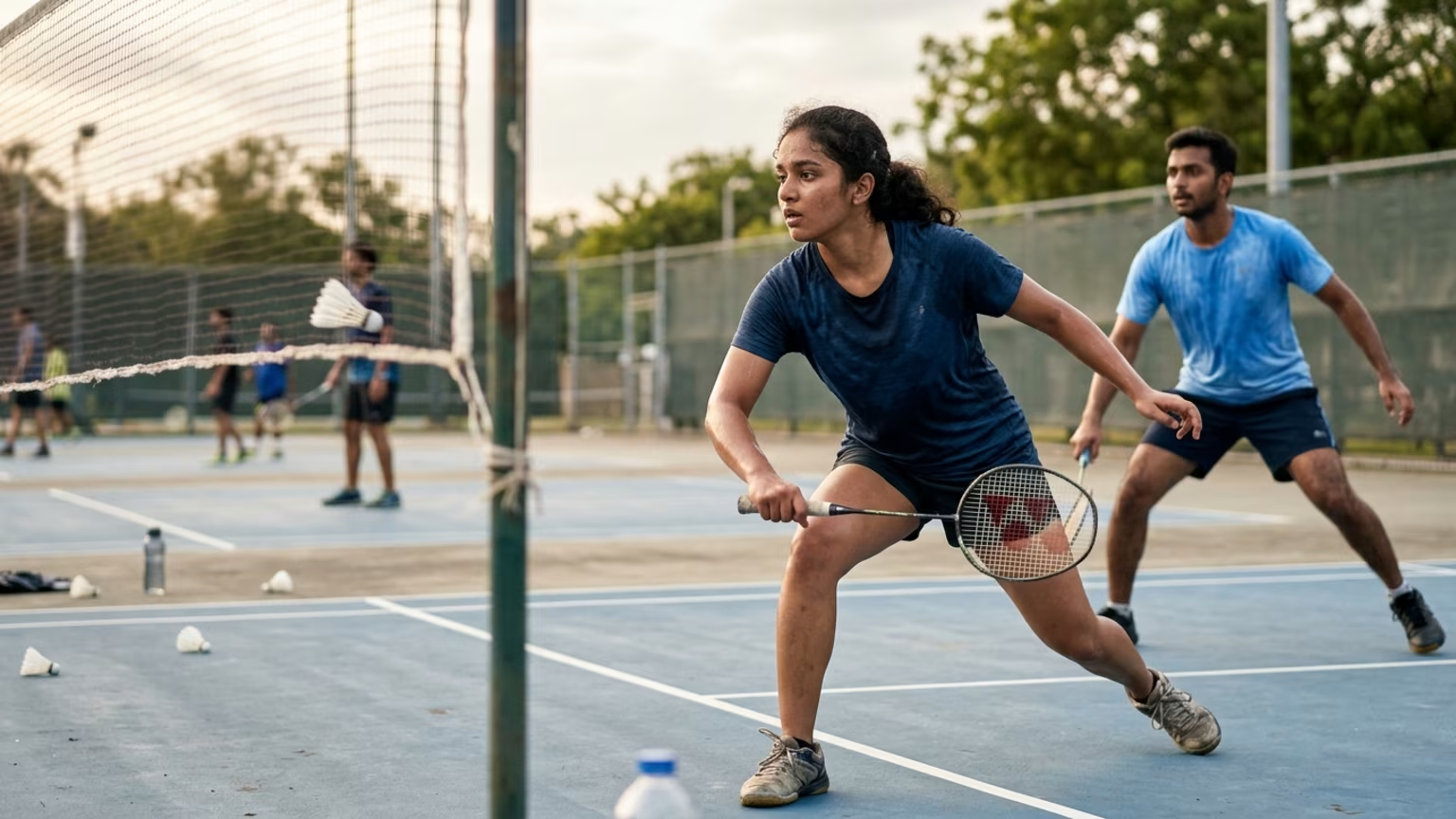

Improve your on-court reaction times by training the perceptual read in tennis, pickleball, and padel rather than relying solely on raw physical hand speed.




Fast hands will not save you on the court, especially since general aerobic conditioning yields only a modest 0.392 pooled effect size for working memory and a 0.343 effect on cognitive flexibility. The common wisdom assumes that raw physical reflexes dictate your ultimate reaction time. In reality, your ability to return a fast ball relies entirely on how early you process visual information before your opponent even swings.
In racquet sports, a player’s response is never simply seeing a ball and moving a hand. The body is constantly enduring a demanding cycle of visual processing, decision-making, and explosive movement execution. During these repeated maximal efforts, the central nervous system must instantly read the opponent's body alignment, shoulder rotation, and racket path.
Once the visual cortex processes these pre-contact cues, the muscular system commits to a rapid split step and an aggressive directional lunge. If the initial perceptual read is incorrect, the physical toll multiplies rapidly. The player must then scramble to abruptly brake, change their momentum, and execute a compromised stroke.
This sequence highlights why handling pace safely requires efficient perceptual skills. A recent racket-sport editorial reports that expert athletes show more efficient visual search, faster reactions, and more effective information processing than novices. They do not necessarily possess faster twitch muscle fibers, but they consistently initiate their movement earlier by anticipating the shot correctly.
The practical implication is that reaction time is actually a combination of anticipation, choice reaction, movement initiation, and stroke execution. Training only the physical end of this spectrum ignores the massive cognitive workload required to trigger the correct movement.
Representative practice is designed to resemble the actual information and action demands of competition. This means retaining an unpredictable opponent, a live ball, variable pace, and genuine tactical consequences during training. A drill that isolates movement from its normal context fundamentally removes the perceptual problem that players must solve.
For example, a coach can restrict the available targets or limit the player to a defensive block while still requiring them to read an incoming ball. This preserves the cognitive workload without overwhelming the player with chaotic variables. The central nervous system learns to recognize vital movement patterns through this deliberate exposure to realistic constraints.
The underlying numbers reveal exactly how physical fitness intersects with cognitive performance in older adults. A meta-analytic summary found small positive pooled effects of aerobic exercise on cognitive functions, reporting Hedges' g values of 0.392 for working memory, 0.343 for cognitive flexibility, and 0.229 for inhibitory control. While these figures support maintaining broad physical capacity, they do not prove that generic fitness alone improves match reactions.
To isolate the impact of specific agility training, a 2026 study examined a six-week, twice-weekly tennis-specific reactive-agility program. The intervention was associated with improved hitting accuracy under randomized ball-feed conditions in primary-school tennis players. Because this specific study focused on children, adult recreational players should view it as an informative framework rather than a guaranteed outcome.
Furthermore, a review of tennis training methods rates real-opponent anticipation work and compressed-time live drilling as having moderate evidence for transfer. The reviewed tennis research specifically links higher spatial working-memory capacity with more advanced gaze behavior during tactical-anticipation tasks. This confirms that superior visual-search strategies are a measurable skill that dictates court positioning.
However, faster performance in a laboratory reaction test does not automatically demonstrate better decision-making under ecologically valid conditions. No reliable source in the reviewed results established that visual-reaction devices, strobe eyewear, or generic ball-machine work transfer to match performance in adult racquet sports. To adapt training safely for athletic longevity, players must pair physical conditioning with realistic perceptual challenges.
Reaction time generally slows with age, which makes anticipation, positioning, and decision quality increasingly valuable. Reviews suggest that sustained exercise can improve cognitive flexibility, task switching, and attentional control in older adults. However, transfer to real-world competitive decisions remains insufficiently tested in fully ecologically valid conditions.
This distinction is critical for aging athletes looking to maintain their court coverage and overall match effectiveness. A player can successfully improve their reaction speed on a simplified button-press test without improving their actual return quality or positioning. True skill transfer requires drills that force the brain to update its initial prediction using the ball's direction, pace, spin, and bounce.
The specific physical and cognitive toll varies noticeably across tennis, pickleball, and padel. The available sources highlight that tennis requires extensive spatial working memory due to the large court dimensions and longer ball flight times. Players have slightly more time to process the trajectory, but the physical distance covered demands excellent deceleration control during recovery.
In tennis, the baseline distance allows a player to verify their initial read over a longer flight path. The athlete can observe the opponent's body position, racket movement, and contact point to constrain the range of realistic shots. If the opponent prepares for a heavy topspin drive, the receiver can immediately initiate a deeper defensive recovery.
In contrast, pickleball players face a highly compressed perceptual timeline at the kitchen line. The physical toll involves less absolute distance but requires intense, rapid-fire block and punch decisions from a stationary crouch. However, sport-specific anticipation research for pickleball is currently much less developed than the corresponding tennis literature.
Padel introduces an entirely different cognitive workload by incorporating the glass walls. This requires a secondary trajectory read, forcing players to calculate spin, bounce angles, and wall rebounds while managing their court positioning. Currently, the available sources do not identify a direct study proving that padel is cognitively superior to tennis.
In all three environments, players can gather useful information from an opponent’s preparation before contact. Coaching guidance recommends treating these pre-contact cues as an initial read that is updated from the ball’s flight, pace, and bounce. A receiver who commits too soon to a predicted direction may be wrong-footed by clever disguise or altered tempo.
Translate these perceptual metrics into court performance by adopting a specific readiness framework. Players should consciously focus on reading the opponent, making a decision, executing the response, and recovering quickly. The most practical training step is the contact-timed split step drill. Have a practice partner feed live or semi-live balls while you execute a split step timed exactly to their racket contact.
Instead of waiting for the ball to cross the net, watch their shoulder rotation and racket path to predict the likely direction. Alternate the pace and placement so you must actively read the visual information rather than jumping on a fixed rhythm. You can even combine this with concurrent conditioning work to challenge your decision-making under physical fatigue.
To structure your mental approach during play, adopt a simple internal sequence before every single point. First, establish a balanced ready position and prepare to initiate your split step. Second, read the opponent’s preparation while focusing intensely on their balance and racket path. Third, make a provisional prediction regarding the ball's likely direction and depth.
Fourth, immediately confirm this estimate using the ball’s early flight characteristics. Fifth, select the most appropriate physical response based on your court positioning. Finally, recover your balance and return to a neutral location to prepare for the next exchange.
Give yourself two permitted responses, such as a soft block or a firm punch, and require an active choice based on the incoming trajectory. This constrained approach reduces technical complexity while preserving the essential perception and decision problem. Athletic longevity is ultimately about anticipating the flow of play with quiet efficiency, rather than racing to correct a delayed reaction.
Follow Evercourts for practical insights on tennis, pickleball and padel performance, movement, recovery and healthy ageing. Stay connected for new articles, research-led guidance and ideas to help you play well and keep playing for years.


Holger Rune withdrew from the European Open with a back problem. The facts behind his decision and a grounded perspective for recreational players.

The Dink’s October 17 guide emphasizes deep returns, ball-height decisions and positioning against faster pickleball opponents.

A new report outlines padel and tennis gear trends. Learn how to assess adjustable rackets, sensor feedback and smart-court claims.
Read practical guidance for better movement, smarter preparation and a game that keeps working for you.
explore the Blog
