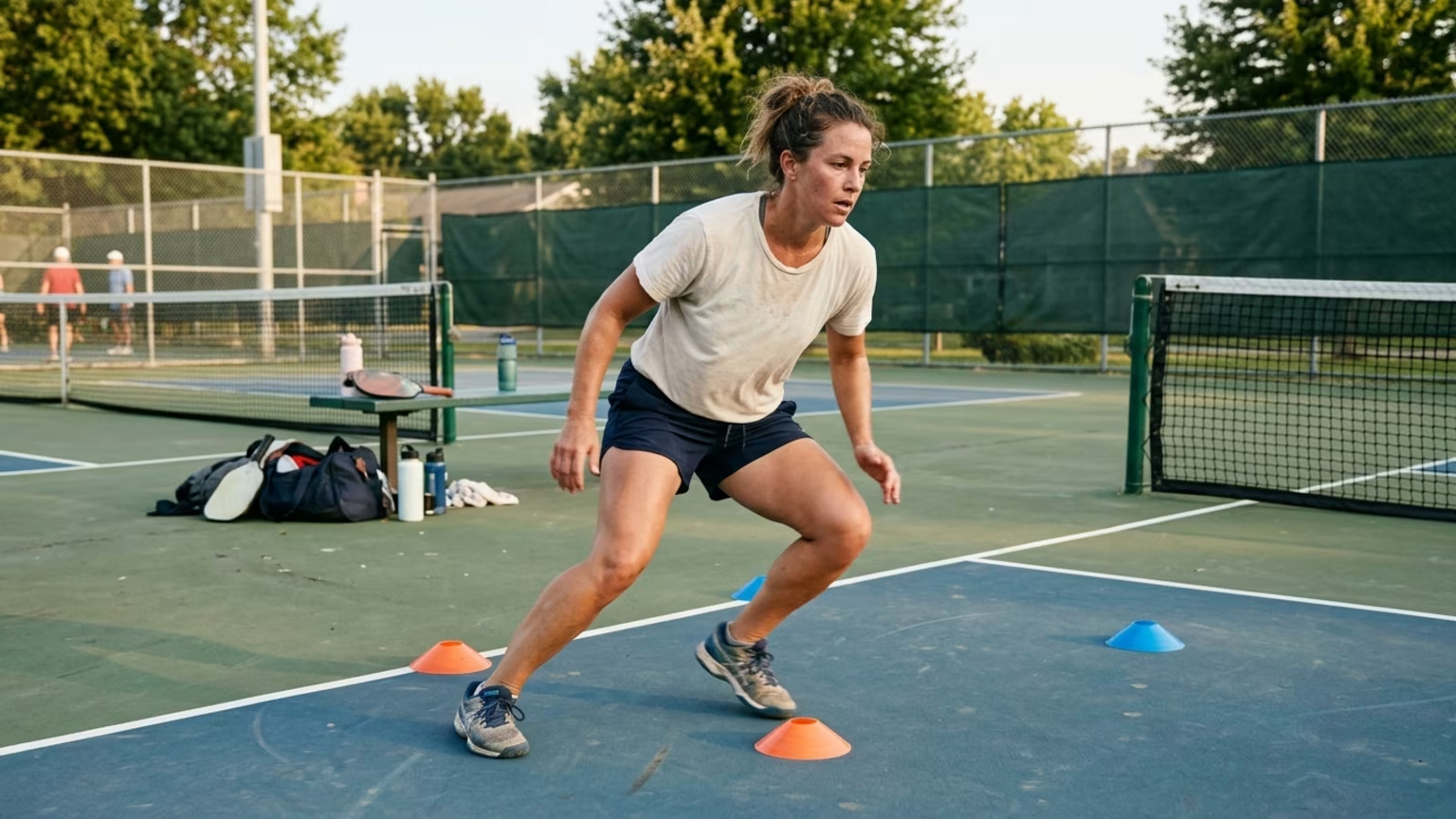

Learn how to build pickleball kitchen-line strength with a practical, off-court routine. Review scaled exercises for athletic longevity and court readiness.




Kitchen-line strength is the coordinated hip, leg and trunk control required to support the short, frequent lateral movements of pickleball. The physical requirements of the sport center heavily on the non-volley zone, where rallies are won and lost through subtle shifts in position. Players spend a significant portion of a match holding their ground, defending rapid volleys and reacting to low dinks. An off-court training routine helps build a reliable physical base so you can play your shots with balance and confidence.
Racquet sports require players to manage their body weight during rapid and unpredictable changes of direction. Tennis, pickleball and padel all tax the lower body through constant stopping and starting. While tennis often involves longer sprints across a larger baseline, pickleball compacts the physical work into a much smaller space. Padel players experience a mix of both dynamics, dealing with glass rebounds, tight corners and quick net approaches.
At the pickleball kitchen line, the action is uniquely compressed and demands constant readiness. You are forced to lunge sideways, recover your center of gravity and reach for the ball simultaneously. A recent practitioner article from MyNovaPT describes pickleball as involving repeated acceleration, stopping and lunging. The same source notes the sport demands constant lateral movement, reaching and rotation.
These mechanical demands place specific stress on the hips, legs and trunk. When a player transitions from a baseline drive to a delicate drop shot, the lower body acts as the braking system. The trunk must remain rigid enough to transfer power into the paddle, even when the feet are stretched wide.
The non-volley zone requires a unique blend of patience and explosive reaction. Players must maintain a wide stance to defend against attacks, meaning their leg muscles are under constant tension. When an opponent speeds up the ball, you must drop your center of gravity instantly to block the shot. Preparing these muscles off the court ensures they can handle the sudden physical demands of competitive play.
This repetitive stopping and starting tests the tissues of the lower body repeatedly over the course of a match. If the muscles and joints lack the capacity to absorb these forces, movement quality begins to drop rapidly. Players may find themselves reaching out of position, bending at the waist or stepping awkwardly to the ball. Strengthening the body to handle these specific physical demands is a highly practical step for court athletes.
The current research offers a clear but cautious picture of the sport's demands and the associated risks. In a 2024 analysis of U.S. emergency-department data, researchers Jones and Hammig reported age-related differences in pickleball injury patterns. Their abstract notes that overuse concerns were more prominent among middle-aged players between 26 and 50 years old. Meanwhile, more serious cardiovascular concerns were reported among players over the age of 50.
This data highlights the need for sensible physical preparation, but it is not a reason to panic about stepping on the court. A secondary report on a 2024 scoping review describes pickleball health research as promising but still developing. The literature suggests clear benefits for adult participants, particularly older adults who are seeking engaging ways to stay active. However, the available research does not provide direct evidence that off-court strength training guarantees completely safe kitchen-line movement.
Strength training should be viewed as sensible capacity building rather than an absolute promise of injury prevention. It is meant to prepare the body for the physical forces experienced during a match. Performing a structured off-court plan helps players build a sustainable training routine over time. Expecting a few weekly exercises to act as a magical shield against all court injuries is a misunderstanding of what strength work actually does.
Understanding and training these specific capacities helps adult players maintain their physical readiness and enjoy athletic longevity on the court. A cautious off-court plan translates the stop-start nature of pickleball into a highly manageable routine. One clinician-authored article from Dynamic Body Chiropractic proposes strength training two to three times weekly. This frequency serves as helpful practitioner guidance rather than a universally proven formula for injury prevention.
To address the demands of the court, Dynamic Body Chiropractic suggests a specific list of practical exercises. For the hips and legs, they recommend bridges, step-ups, side steps and controlled split squats. These movements mimic the mechanics required to drop low for a volley and push back to a ready position. A hip bridge strengthens the glutes to help support the lower back during long rallies, while step-ups build specific unilateral leg strength.
To support the trunk, the same practitioner article suggests bird-dogs, dead bugs or planks. These core exercises challenge your trunk to resist unwanted rotation, which is exactly what happens when you lunge for a wide dink. The goal is to perform these movements with strict control rather than rushing through high repetitions.
Consistent preparation off the court is the foundation of healthy aging for racquet sport athletes. The physical adaptations gained from simple resistance exercises translate directly to more stable movement during competitive play. When the hips and trunk are strong, players can maintain their balance while reaching for difficult shots out wide. This stability helps you stay on the court, enjoy your matches and continue improving your game without constant interruptions.
Progression is a vital part of staying healthy and extending your playing years. The practitioner guide advises beginning with double-leg exercises and progressing gradually toward single-leg variations. You must scale the exercise to your current abilities, not the other way around. For instance, if getting out of a chair is difficult, you might begin with simple sit-to-stands or supported mini-squats holding onto a stable surface.
Once those movements become comfortable and controlled, you can safely advance to unassisted bodyweight squats or standard step-ups onto a low box. This gradual progression is particularly important after periods of inactivity or a recent increase in court time. If you decide to play four times a week after a long winter break, your tissues need time to catch up to the new workload. Moving carefully from double-leg to single-leg work ensures your body adapts without becoming overwhelmed by the new stimulus.
Taking a conservative approach to progression builds usable range of motion and stability where players need it most. Treating your strength plan as a long-term investment helps keep you on the court month after month. The exercises do not need to be exhausting or excessively heavy to be effective. Balancing match play with a sensible physical routine keeps players moving confidently at the kitchen line.
Even with a cautious and well-planned strength routine in place, some situations require professional guidance. You should consult a qualified physiotherapist or healthcare provider if you experience sharp joint pain during any off-court exercise. Prolonged stiffness that lasts for multiple days after a match is another clear sign to seek an expert opinion. Attempting to push through nagging joint pain at the kitchen line will only limit your long-term court time and hinder your overall performance.
The 2024 age-risk study by Jones and Hammig specifically recommends medical approval for people at risk of heart conditions. Older adults returning to intense physical activity should take this precaution seriously. If you have prior injuries, cardiovascular health concerns or simply feel uncertainty about which exercises suit your body, individual medical advice is always the safest route. A medical professional or qualified physio can tailor a movement approach to your exact history, ensuring your preparation matches your physical needs perfectly.
To start building your capacity for the court today, choose one basic double-leg exercise like a bridge or step-up, and practice it with slow control for a single set before your next match.
Follow Evercourts for practical insights on tennis, pickleball and padel performance, movement, recovery and healthy ageing. Stay connected for new articles, research-led guidance and ideas to help you play well and keep playing for years.



Holger Rune withdrew from the European Open with a back problem. The facts behind his decision and a grounded perspective for recreational players.

The Dink’s October 17 guide emphasizes deep returns, ball-height decisions and positioning against faster pickleball opponents.

A new report outlines padel and tennis gear trends. Learn how to assess adjustable rackets, sensor feedback and smart-court claims.
Read practical guidance for better movement, smarter preparation and a game that keeps working for you.
explore the Blog
