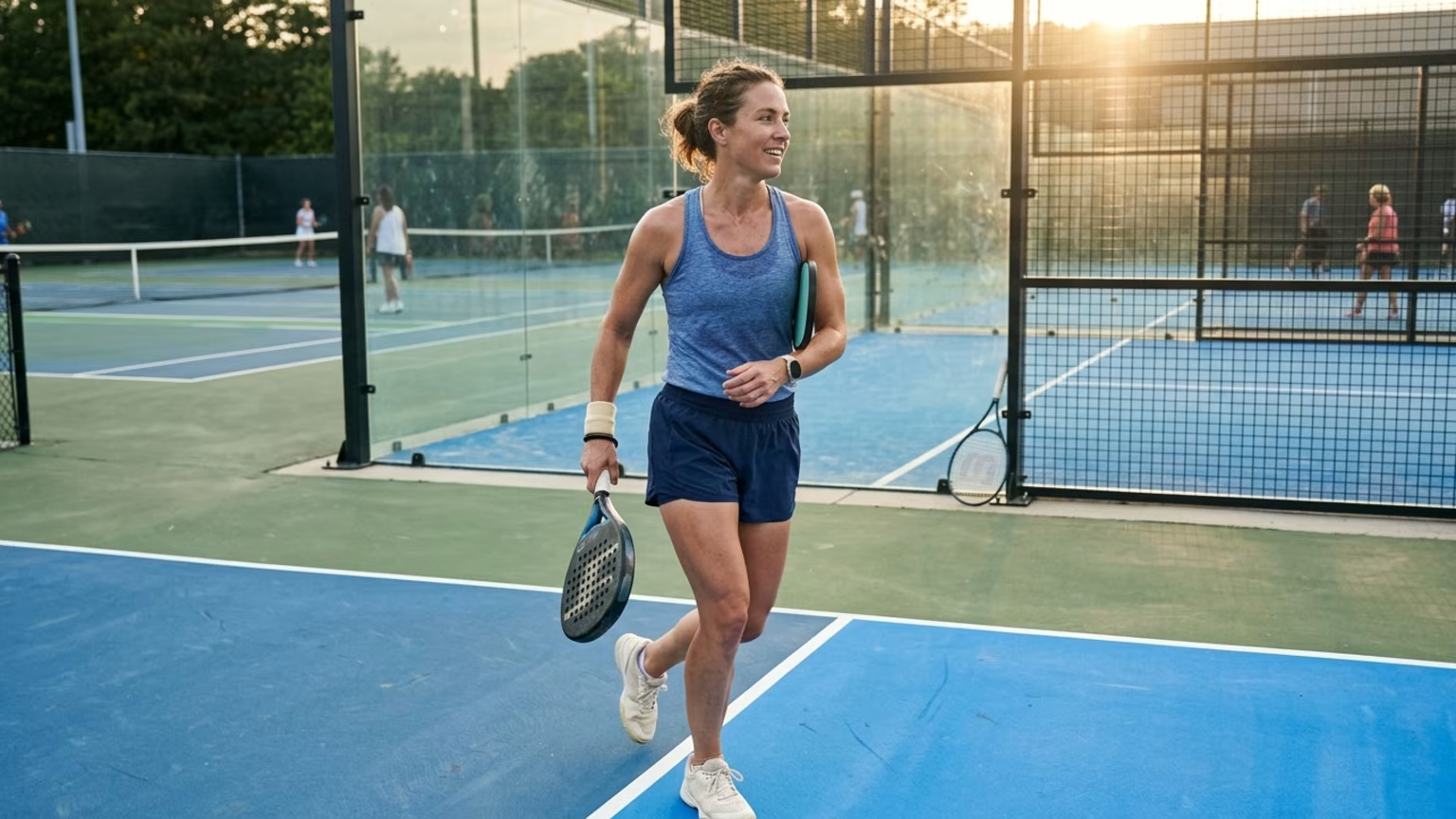

Learn how tennis, pickleball and padel each impact your body differently. Get practical tips for adapting your movement and building athletic longevity.




Players are spending their weekends switching between completely different courts. They might step off a sprawling baseline one day and onto a compact kitchen line the next. This constant shifting creates confusion about how to train effectively. You might wonder if playing multiple racket sports is helping your fitness.
Can you safely play tennis, pickleball and padel in the same week without wrecking your body? Yes, you can play all three safely if you understand the unique movement demands of each court.
This mailbag addresses how your body responds to changing court dimensions. We will look at how you can manage the physical transition between these popular sports. You can build incredible physical resilience by treating each sport as a distinct movement puzzle. Learning to adapt your movement keeps you healthy and competitive.
Many players assume that a smaller playing surface means an easier physical workout. They are surprised when their knees and ankles ache after a seemingly relaxed doubles game. The reality is that court geometry fundamentally changes how your muscles work. Your body has to solve a completely different mechanical problem on every court.
A tennis court is 23.77 metres long, with a singles width of 8.23 metres and a doubles width of 10.97 metres. This generous space means you spend significant time in open-court sprints. You accelerate over long distances to chase down a cross-court forehand. The physical load is distributed across larger, sweeping movements that use your entire kinetic chain.
Pickleball forces your joints to handle a completely different mathematical reality. A regulation pickleball court is 20 feet wide by 44 feet long, or approximately 6.10 by 13.41 metres, and the same footprint is used for singles and doubles. You do not cover massive distances to reach the ball. Instead, you constantly start and stop in extremely tight quarters.
The seven-foot non-volley zone on each side of the net, the kitchen, creates a distinctive front-court environment in which players must control balance and positioning while making quick exchanges. You are often holding a low, crouched posture for extended periods. This constant isometric tension tires out your quadriceps and glutes very quickly. Those rapid lateral stops place concentrated stress on your lower body.
The constant stopping and starting required in pickleball heavily targets your calves and Achilles tendons. You are rarely running at full speed, but you are always under tension. This means your lower leg muscles are working overtime to keep you upright. Understanding this difference helps explain why your legs feel heavy after a kitchen battle.
Many multi-sport athletes find padel uniquely exhausting for their lower back and hips. A padel court measures 10 by 20 metres internally and is enclosed by walls and mesh, with service lines 6.95 metres from the net. The walls keep the ball alive much longer than in open-court sports. You are forced to bend, twist and react to unpredictable rebounds constantly.
I remember finishing a tough two hour padel match on a cold Tuesday night and waking up the next morning feeling like my lower back was locked in concrete. For a long time, I just accepted this as the price of playing hard in my forties. But once I started spending just ten minutes on targeted hip mobility before heading to the club, the stiffness almost completely vanished. It taught me that we do not have to accept pain as a default state of aging.
The key to comfortable padel is preparing your joints for repeated rotational strain. Your hips need the freedom to pivot quickly when tracking a lob over your shoulder. If your hips are tight, your lower back takes the brunt of the rotation. This compensational movement is what leads to lingering morning soreness.
Adding a dedicated functional strength routine to your weekly schedule makes a massive difference. You need to focus on strengthening your core and mobilizing your thoracic spine. A supple upper body allows you to execute overheads without arching your lower back aggressively. Proper preparation ensures you can handle the unpredictable nature of the enclosed court.
Each racket sport demands a highly specific approach to your lower body mechanics. You cannot use the same movement patterns across all three surfaces without compromising your performance. Adapting your steps is crucial for athletic longevity and injury prevention. The way you plant your feet dictates how safely you can change direction.
In tennis, your priority is long acceleration and deliberate deceleration. You need to build strong single-leg control to brake safely after a baseline sprint. Tennis players must absorb heavy forces when planting their feet to hit heavy groundstrokes. Good tennis footwork requires patience, dynamic balance and wide recovery steps.
Padel requires constant repositioning and synchronized movement with your partner. You are frequently retreating to the back glass and adjusting your stance to read the wall. This means mastering the art of the backward shuffle and the rotational pivot. You have to stay incredibly light on your feet to react to the unpredictable angles.
Pickleball relies almost entirely on compact movement and rapid split steps. You stay low to react to quick kitchen exchanges and strategic dink rallies. The focus is on fast lateral shifts rather than long forward sprints. Focusing on essential footwork skills tailored to the kitchen line will vastly improve your balance.
Many multi-sport players make the mistake of using tennis footwork on a pickleball court. They take large, sweeping steps that leave them off balance and vulnerable to quick attacks. By shortening your stride, you maintain a better center of gravity. This small adjustment protects your knees and keeps you in the point longer.
The secret to enjoying all three sports is strategic scheduling and intelligent workload management. You should not play three intense matches in three consecutive days. Your nervous system needs time to process the varying spatial and reactive demands. Space your matches out with active recovery days in between.
Use each sport to develop a completely different physical capacity. Let tennis build your aerobic endurance and top-end sprinting speed. Allow padel to improve your rotational agility and tactical reaction time. Rely on pickleball to sharpen your static balance and hand-eye coordination.
Treating these activities as complementary disciplines prevents stubborn overuse injuries. Cross-training across courts effectively requires intentional strength work off the court. Focus heavily on calf strength, hip mobility and shoulder stability outside of your match times. This comprehensive approach ensures you stay resilient and court-ready all year long.
Always spend ten minutes warming up before picking up your racket or paddle. A quick routine of lunges, gentle rotations and lateral shuffles prepares your nervous system. Skipping the warm-up is the fastest way to pull a muscle when transitioning between sports. Proper preparation is the best tool for sustaining your performance.
Your body is fully capable of adapting to the distinct challenges of tennis, padel and pickleball. By respecting the unique physical demands of each court, you can build a resilient foundation for years of athletic longevity.
Follow Evercourts for practical insights on tennis, pickleball and padel performance, movement, recovery and healthy ageing. Stay connected for new articles, research-led guidance and ideas to help you play well and keep playing for years.


Holger Rune withdrew from the European Open with a back problem. The facts behind his decision and a grounded perspective for recreational players.

The Dink’s October 17 guide emphasizes deep returns, ball-height decisions and positioning against faster pickleball opponents.

A new report outlines padel and tennis gear trends. Learn how to assess adjustable rackets, sensor feedback and smart-court claims.
Read practical guidance for better movement, smarter preparation and a game that keeps working for you.
explore the Blog
