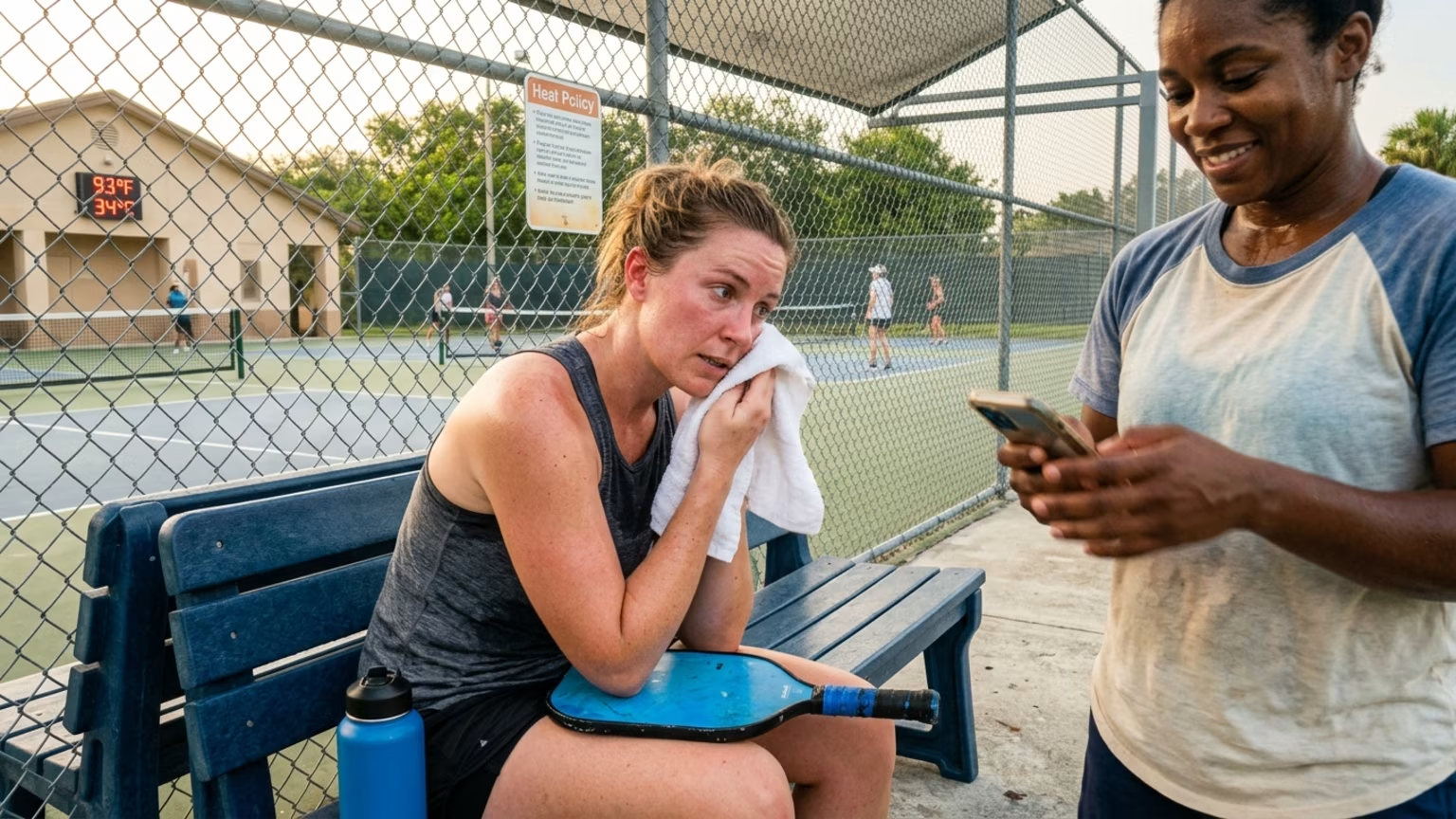

Discover how adult players can translate professional WBGT heat policies to modify play, plan cooling breaks, and recognize when summer conditions are unsafe.




Professional tennis mandates an immediate halt to outdoor competition when the Wet Bulb Globe Temperature reaches exactly 32.2°C. This number is not just a casual weather update for fans sitting in the stands. It represents the explicit limit where pushing through the heat stops being tough and starts becoming dangerous.
Recreational players routinely try to outlast conditions that would legally force professional matches to stop. We often treat extreme heat as a simple mental hurdle to overcome. The badge of honor earned by grinding through a sweltering summer match often masks a dangerous reality. Ignoring physical boundaries in extreme heat is a clear sign of poor preparation.
The prevailing culture in racquet sports glorifies suffering on the court. Weekend warriors watch elite athletes battle through summer tournaments on television. They then assume that pushing past their own heat exhaustion is a necessary part of getting better. This mindset completely ignores the reality of elite athletic competition.
Professionals do not rely solely on grit to survive hot conditions. They have scheduled breaks, medical staff, and strict environmental policies protecting them. Recreational players usually have a plastic water bottle and an isolated local court. Believing that you can safely replicate a professional workload without professional safeguards is a recipe for disaster.
I remember finishing a tough two hour padel match on a cold Tuesday night and waking up the next morning feeling like my lower back was locked in concrete. For a long time, I just accepted this as the price of playing hard in my forties. But once I started spending just ten minutes on targeted hip mobility before heading to the club, the stiffness almost completely vanished. It taught me that we do not have to accept pain as a default state of aging.
We can apply this exact same logic to our heat management strategies. Just as proper movement routines prevent joint pain, intelligent scheduling prevents heat illness. Suffering through a miserable summer match is entirely optional. Adult athletes must prioritize athletic longevity and sustainable performance over stubborn pride.
Professional tennis introduced more explicit heat management rules during the 2026 season. The central change is the use of Wet Bulb Globe Temperature to determine outdoor safety. This system replaces the traditional reliance on air temperature alone. WBGT combines temperature, humidity, wind, and radiant heat to estimate environmental heat stress accurately.
This makes it entirely different from a standard heat index. A heat index only measures temperature and humidity in the shade. Direct sunlight and physical exertion add massive heat stress beyond the number shown by a basic weather app. The reported 2026 ATP and WTA framework establishes two critical thresholds for professional players.
At 30.1°C WBGT, a 10-minute cooling break can be taken after the second set in singles. This break is allowed provided the threshold was reached during the opening sets. According to Tennis Up To Date, this break applies to both competitors. When the relevant threshold is reached, either singles player can request the break.
Coverage of Grand Slam best-of-five matches describes this 10-minute break as occurring between the second and third sets. The rules change drastically when conditions worsen. At more than 32.2°C WBGT, play is suspended completely. The primary explainer presents ATP and WTA rules alongside specific approaches for major tournaments.
These events include major tournaments like Roland-Garros and Wimbledon alongside the US Open and the Australian Open. The framework applies to events including Indian Wells and Miami. The practical details differ according to court location and tournament format. A single WBGT threshold does not activate equally at every single venue.
A Trainlytix analysis of historical Grand Slam weather data suggests an important nuance. The same WBGT thresholds may activate differently in dry Melbourne and more humid New York. A hot but dry environment might record very high air temperatures without reaching the 32.2°C WBGT suspension threshold. Conversely, humid conditions can produce higher WBGT readings at lower air temperatures.
This explains why two courts with identical air temperatures feel completely different to the body. A simple weather application does not tell the whole story. You must account for sun exposure and local airflow.
Adult players must translate this professional framework into sensible daily habits. The 30.1°C threshold is a trigger for a professional competition procedure. It is not a universal point at which every player can safely continue. You must evaluate your own fitness level before stepping onto the court.
Age and previous acclimatization levels heavily dictate your personal safety limits. Medical guidance recommends gradually building heat exposure over roughly one to two weeks. You should not immediately resume full intensity sessions after a long winter break. Shifting your exercise toward cooler parts of the day is a critical first step.
You should also take regular fluid breaks and monitor changes in your body weight. You can use the professional 10-minute break as inspiration for your own matches. The break is intended for practical cooling measures. Players may hydrate or shower before changing clothing.
They can also use cooling measures and receive medical advice under tournament supervision. The Smithsonian reporting illustrates how elite players use changeovers for hydration, electrolytes, shade, and ice-based cooling. Recreational players should build these cooling opportunities directly into their practice routines. Do not wait until the end of a long session to lower your body temperature.
Plan short pauses in the shade or an air conditioned area. Bring sufficient fluids and use cooling towels when appropriate. Managing your workload is just as important as managing your hydration. Pickleball and padel often involve hard outdoor surfaces and limited natural shade.
These enclosed environments trap heat easily. Players may experience substantial heat load even when matches appear less physically demanding than elite tennis. Reducing your match length is a smart way to protect your physical health during peak summer hours. Adult athletes should always utilize the buddy system during summer months.
Players should watch one another for unusual fatigue, confusion, or dizziness. A person who is becoming faint should never be encouraged to push through the discomfort. Stopping early can preserve future training continuity better than forcing a dangerous finish. You should also rethink how you manage your recovery away from the court.
Proper preparation includes understanding the demands of managing environmental stress and recovery. Incorporating consistent stretching and mobility keeps your body resilient between hot weather matches. Players traveling for competition should also review their tournament recovery protocols to stay fresh. Never ignore the warning signs of serious heat illness.
A club player should not wait for an official suspension threshold if they feel unwell. Symptoms like confusion, unusual weakness, nausea, and dizziness warrant immediate stoppage. Finding medical help is always more important than finishing a friendly match.
Professional stoppage limits at exactly 32.2°C WBGT prove that extreme heat is a firm biological boundary rather than a simple mental test.
Follow Evercourts for practical insights on tennis, pickleball and padel performance, movement, recovery and healthy ageing. Stay connected for new articles, research-led guidance and ideas to help you play well and keep playing for years.


Holger Rune withdrew from the European Open with a back problem. The facts behind his decision and a grounded perspective for recreational players.

The Dink’s October 17 guide emphasizes deep returns, ball-height decisions and positioning against faster pickleball opponents.

A new report outlines padel and tennis gear trends. Learn how to assess adjustable rackets, sensor feedback and smart-court claims.
Read practical guidance for better movement, smarter preparation and a game that keeps working for you.
explore the Blog
