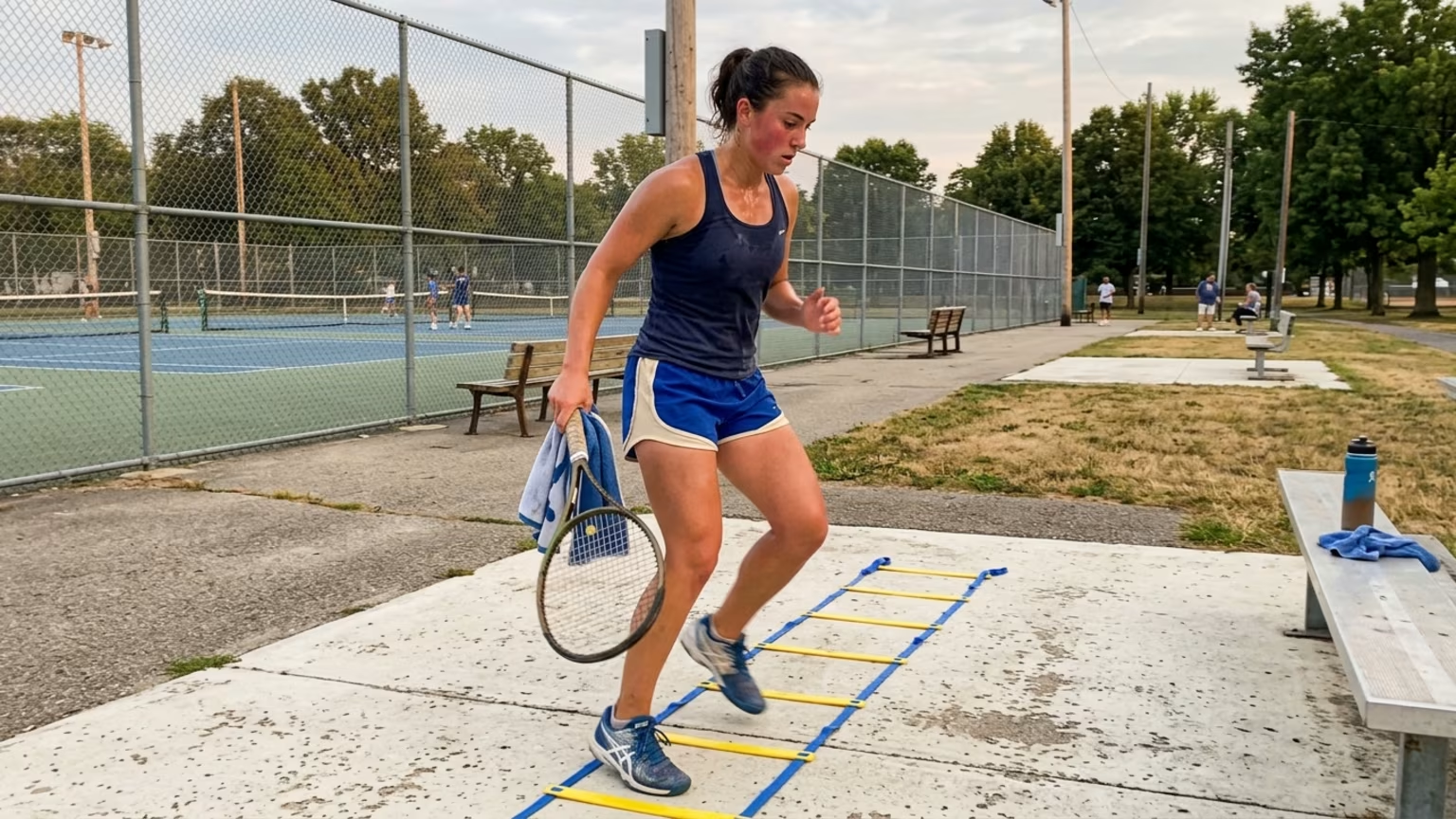

An inside look at how high-performance tennis players structure their off-court physical training, and how adult recreational players can adapt these methods.




Playing more matches is rarely the most effective way to improve court performance. The most durable players actually dedicate a significant portion of their schedule to targeted physical preparation outside the lines. In August 2026, an updated practitioner guide from Tennis Fitness and two major research analyses detailed exactly how elite athletes structure their off-court work. These documents outline a clear shift away from random workouts toward highly specific tennis conditioning.
Tennis Fitness presents its framework as practitioner guidance based on more than 20 years of working with tennis players. The organization emphasizes that high-performance training must be structured, progressive, and highly specific to the sport. Its system is built around eight connected elements. These elements include foundation strength, power, and tennis-specific speed.
Players also focus on conditioning, mobility, and recovery. Testing and periodization complete the structured system. The framework prioritizes lower-body strength and trunk stability to help players produce and absorb force. Strength provides the foundation, while power converts that base into usable tennis speed for rapid directional changes.
Tennis Fitness explicitly distinguishes tennis-specific agility from simply running quickly in a straight line. Court movement requires accelerating, stopping abruptly, reacting to an opponent, and recovering balance for the next shot. Conditioning protocols in this model support repeated explosive efforts rather than just basic cardiovascular endurance. Long jogs might build a general aerobic base, but they fail to replicate the distinct stop-and-start rhythms of competitive rallies.
Mobility work should connect directly to useful tennis movement rather than acting as a detached stretching routine. Activation drills help players safely reach the extreme physical positions required during intense match play. Proper dynamic movement preparation becomes increasingly crucial as overall training loads rise throughout the season. Planned recovery is equally important to ensure players adapt to these physical stresses.
The Tennis Fitness guidelines advise against stacking hard matches and intense strength sessions without adequate rest. An exhausted player cannot maintain the technical quality needed to improve their game. Without scheduled downtime, the entire physical development process stalls or regresses. Consistent recovery practices are the hidden engine behind long-term athletic progress.
High-performance competitors benefit from extensive medical support, dedicated coaching, and generous recovery windows. Adult league players usually lack these advantages and must scale professional methods to fit their own lives. Copying an elite athlete's weekly volume will likely introduce excessive fatigue rather than a noticeable performance boost. Instead, recreational players should borrow the underlying structure while managing their total weekly workload.
I remember finishing a tough two hour padel match on a cold Tuesday night and waking up the next morning feeling like my lower back was locked in concrete. For a long time, I just accepted this as the price of playing hard in my forties. But once I started spending just ten minutes on targeted hip mobility before heading to the club, the stiffness almost completely vanished. It taught our team that we do not have to accept pain as a default state of aging.
A practical adult plan should focus on targeted athletic longevity rather than maximum output. Players might complete two focused strength sessions early in the week and keep mobility work closer to match days. By prioritizing consistent load management, adult athletes can safely build resilience. The central scheduling principle is that strength, speed, and recovery should never all be trained maximally at the exact same time.
Tennis Fitness summarizes its evaluation approach as a continuous cycle of testing, training, and retesting. This specific feedback loop allows athletes to identify their physical priorities rather than guessing. A proper testing protocol might include a timed short sprint or a lateral movement assessment. Elite coaches do not use these numbers to judge a player but to guide their daily programming.
The process ensures that physical work actually addresses a relevant court problem. A weak first step during match play might justify prioritizing lower-body power and split-step practice. Conversely, late-match technical breakdown points toward a need for targeted repeat-effort conditioning. Consistent testing prevents players from wasting time on physical qualities they have already mastered.
A 2026 systematic review and meta-analysis published in PLoS One provides recent data on targeted neuromuscular training. The researchers reviewed 18 studies involving 670 healthy male youth and young-adult tennis players. They found varied but positive results across several physical and technical testing categories. The pooled effect for stroke velocity was Hedges' g = 0.95.
Improvements were also noted in broader athletic testing markers. The pooled effects were -0.58 for sprint performance and 0.73 for countermovement jump. Researchers also noted -0.89 for agility time and 0.47 for serve accuracy. Despite these promising numbers, the evidence is not universally strong across all metrics.
Shot-placement accuracy did not show a statistically significant pooled improvement. Its estimate was g = -0.41 with a 95 percent confidence interval from -0.92 to 0.11. The authors of the review cautioned that certainty ranged from low to very low for the main outcomes. The review also reported that 87.5% of its randomized trials raised some risk-of-bias concerns.
Specifically, 14 of its 16 randomized trials showed methodological limitations. The review also identified possible small-study effects for countermovement jump and agility outcomes. The neuromuscular review included healthy male players with reported mean ages from 9.6 to 26.9 years. The separate network meta-analysis also included a substantial proportion of teenagers in its data.
A separate network meta-analysis evaluated serve velocity improvements across different training protocols. The standardized mean differences were 0.91 for plyometric training and 0.85 for resistance training. Core-stability training measured at 0.82, and multimodal training reached 0.77. Plyometric training received the highest SUCRA ranking for serve velocity at 72.6%, followed by resistance training at 63.2%.
Even with these high rankings, direct comparisons did not establish a statistically significant winner among the specialized training methods. This demographic concentration means the evidence has limited direct relevance to many adult recreational players. Older athletes should view these specific study findings as general concepts rather than guaranteed outcomes. The goal is building a capable body for healthy aging rather than chasing elite metrics.
The training models emerging for the next season treat physical preparation as an integrated system rather than isolated parts. Players will likely move away from isolated bodybuilding routines and focus on multicomponent sessions that blend force production, postural control, and footwork. Coaches are already organizing schedules to ensure that strength work and match play do not compete for the same energy resources.
As the research continues to shift toward tennis-relevant outcome measures, the gap between gym metrics and actual match success will narrow. General endurance will continue taking a backseat to repeat-effort capacity and controlled braking skills. Ultimately, the best physical preparation is the kind that silently disappears into the background of a well played match.
Follow Evercourts for practical insights on tennis, pickleball and padel performance, movement, recovery and healthy ageing. Stay connected for new articles, research-led guidance and ideas to help you play well and keep playing for years.


Holger Rune withdrew from the European Open with a back problem. The facts behind his decision and a grounded perspective for recreational players.

The Dink’s October 17 guide emphasizes deep returns, ball-height decisions and positioning against faster pickleball opponents.

A new report outlines padel and tennis gear trends. Learn how to assess adjustable rackets, sensor feedback and smart-court claims.
Read practical guidance for better movement, smarter preparation and a game that keeps working for you.
explore the Blog
