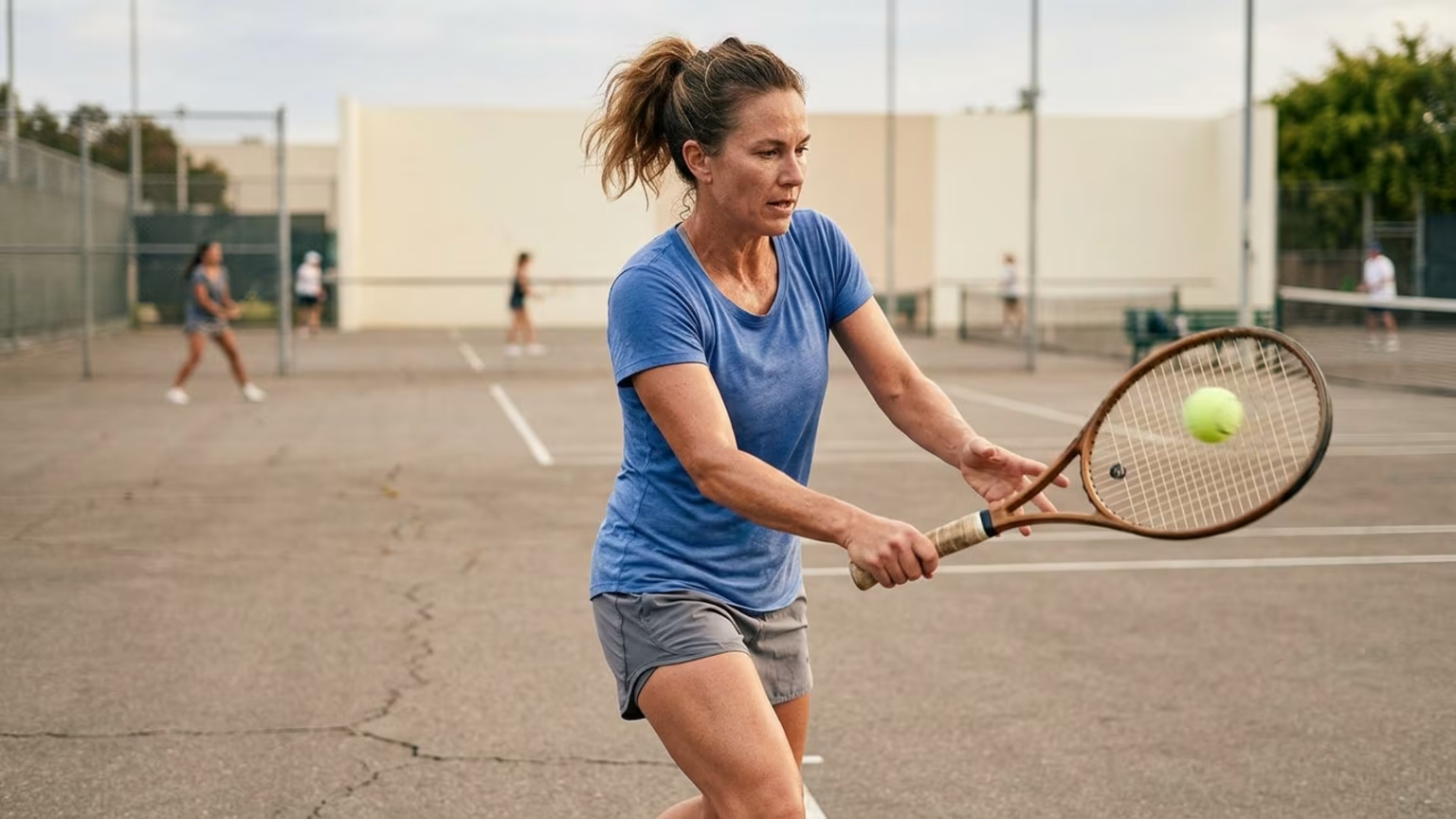

Learn how court sports load the lower body. Build a practical strength plan focused on braking, rotation and single-leg stability for healthy aging.




In a recent study of Korean recreational pickleball players, lower-extremity issues represented 44.0% of reported injuries. Within that group, the knee accounted for 21.4% of reported injuries, while the ankle or foot made up 15.8%. This data highlights exactly where racquet sports place the highest physical demands. It proves that surviving long matches requires legs built for stopping just as much as for running.
You have heard it a million times: the best way to get stronger for court sports is to load up the squat rack and push heavy weights. Here is why that is outdated. The court rarely asks you to stand still and push straight up on two feet. Your training should instead focus on the specific forces you actually encounter during a competitive point. True athletic preparation requires you to practice absorbing force, controlling your position and producing force again.
The classic approach to lower-body training was borrowed heavily from sports where athletes move in a straight line. Coaches and fitness magazines often promote the heavy back squat as the ultimate athletic foundation. It is easy to see why players believe this advice. When your legs feel tired in the third set, you logically assume you need raw strength to keep moving. The simplest answer is usually to push more weight in the gym.
This well-meaning advice fails to account for the unique demands of tennis, padel and pickleball. These sports require athletes to move laterally, rotate their trunk and absorb heavy braking forces on a single leg. Squatting heavily on two feet does build general muscle, but it ignores the complex mechanics of court movement. Athletes who only train bilateral movements often struggle when forced into wide, awkward lunges. They might have strong legs, but they lack the specific control required for long-term health.
A typical point involves rapid approach steps, sudden deceleration and explosive reacceleration. Research links effective horizontal deceleration with greater hip and knee flexion, a lower centre of mass and anterior foot placement. The ankle and calf must manage the foot as it contacts the court. The knee bends to absorb force, and the hip helps lower and redirect the body. You then have to reverse that action and push back toward the next position. Sharper cuts generally require more braking because more momentum must be absorbed.
A few years ago, I realized my tennis serve speed was dropping, and my shoulder was constantly throbbing after matches. Instead of pushing through the pain, I took a month to rebuild my mechanics and focus on rotator cuff endurance. I stopped trying to hit flat aces and developed a much heavier kick serve. My win rate actually went up, and my shoulder stopped hurting. Sometimes longevity means outsmarting your own ego on the court. We must take the same mindful approach to lower-body mechanics.
According to peer-reviewed research, pickleball places a heavy premium on rapid directional changes and lunging. The sport also requires repeated acceleration, deceleration and lateral movement. Padel and tennis doubles show different movement profiles, with padel demanding longer rallies and more volleys. A comparative analysis shows that tennis doubles relies on more high-speed actions and aggressive baseline play. Across all these variations, athletes must decelerate effectively and control their trunk under pressure. Racquet-sport movement is rarely a symmetrical, two-foot stance. Players commonly load one leg while reaching away from the body, placing a premium on single-leg strength.
Rotation is another critical factor that links the legs to the trunk. A player does not merely run to the ball and stop. The lower body must create a stable base while the pelvis, rib cage and trunk rotate to position the racquet. The trunk should neither collapse during a cut nor rotate uncontrollably when the feet are planted. Strengthening the hips and legs helps establish the base. Anti-rotation work teaches the trunk to resist unwanted movement while the athlete moves, reaches or strikes.
A smart conditioning routine targets the exact movements you use repeatedly during a match. Start by implementing a sustainable strength routine that challenges single-leg stability and rotational control. Perform this plan on two nonconsecutive days per week to allow for proper recovery. Keep at least one full day of rest between a demanding gym session and your most important match. You should begin with a short warm-up of split squats, calf raises and lateral steps.
Your first session of the week should prioritize braking strength and ankle capacity. You can build this session around split squats to train unilateral leg force in a stance resembling a recovery step. Single-leg calf raises and controlled step-downs will help you train controlled braking efficiently. Add the Pallof press to develop anti-rotation capacity. This exercise keeps your trunk stable while your hips and limbs move dynamically. Progress these movements slowly by adding light weight only when you have perfect control.
Your second session should focus on lateral strength and hip rotation. Lateral lunges train the frontal-plane strength required to accept lateral force and push away from wide shots. Single-leg Romanian deadlifts improve posterior-chain control for reaching and recovery. You should also incorporate seated hip rotations and side planks to round out the session. Seated hip rotations train controlled range of motion without forcing the lower back to compensate. Side planks challenge lateral trunk endurance, helping you keep your pelvis organized during aggressive lateral movement.
As you implement this routine, you must manage your overall workload carefully. The study of Korean recreational pickleball players found that greater weekly playing volume was independently associated with injury occurrence. Progress one variable at a time, such as load, repetitions or range of motion. Do not abruptly increase your court time and your gym sessions in the same week. For older adults, balance training for racquet sports should be paired with functional movement exercises to support healthy aging.
The New Golden Rule: Your strength training must mirror the specific directional demands of your sport. We replace the old myth of raw, heavy lifting with a practical approach that prioritizes braking, single-leg stability and rotational control. True resilience on the court comes from preparing your muscles to absorb force efficiently and change direction safely. The goal is to improve the physical qualities that evercourts players repeatedly demand.
A thoughtful routine respects the complexity of racquet sports and allows you to keep playing for decades. Moving well is not just about raw speed or explosive power. True capability is found in the quiet moments of control, long before the racquet ever meets the ball.
Follow Evercourts for practical insights on tennis, pickleball and padel performance, movement, recovery and healthy ageing. Stay connected for new articles, research-led guidance and ideas to help you play well and keep playing for years.


Holger Rune withdrew from the European Open with a back problem. The facts behind his decision and a grounded perspective for recreational players.

The Dink’s October 17 guide emphasizes deep returns, ball-height decisions and positioning against faster pickleball opponents.

A new report outlines padel and tennis gear trends. Learn how to assess adjustable rackets, sensor feedback and smart-court claims.
Read practical guidance for better movement, smarter preparation and a game that keeps working for you.
explore the Blog
