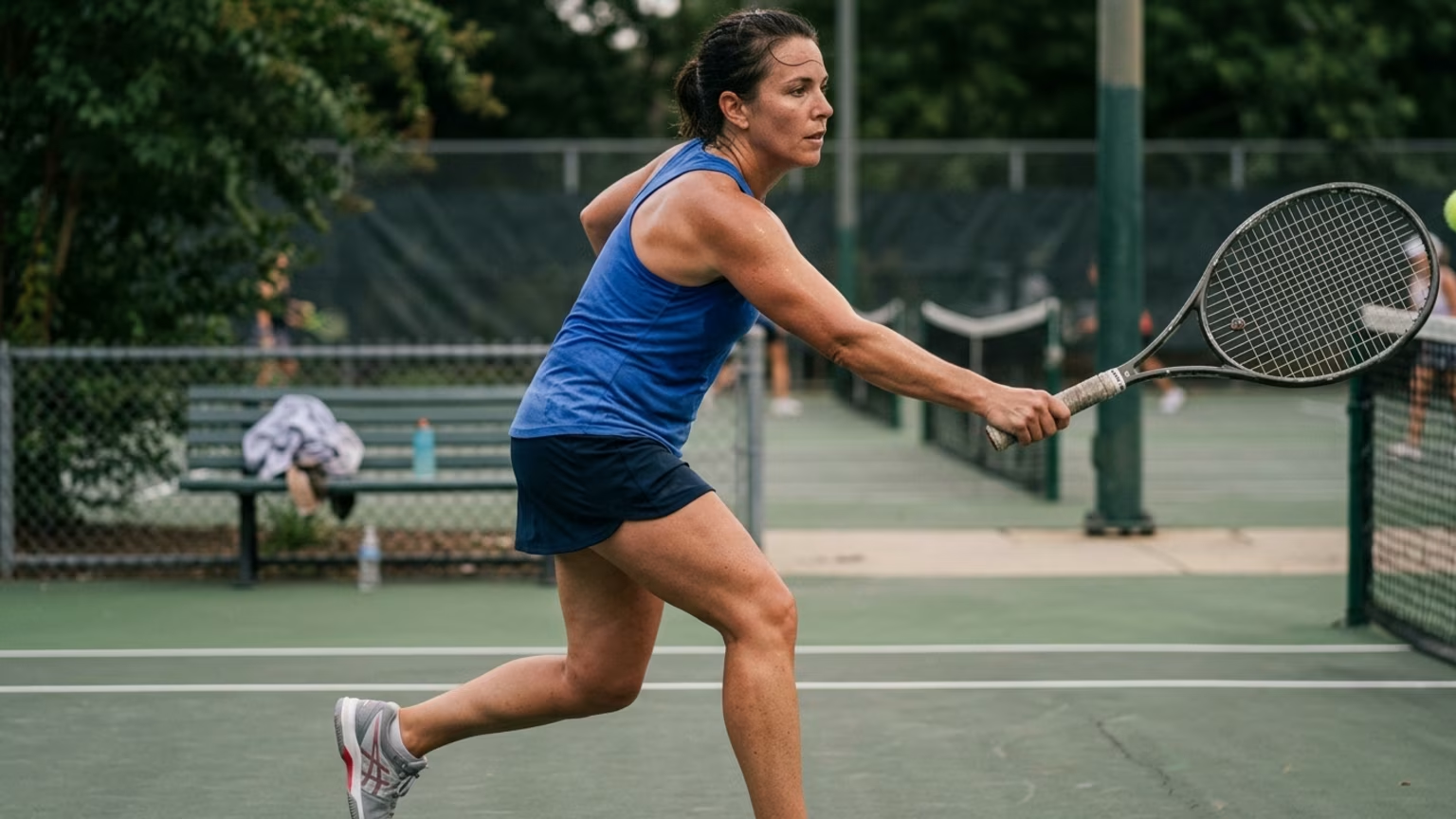

Discover why 38.1% of recreational pickleball players report injuries, and learn how to build a practical racquet-sport strength base for athletic longevity.




Among 383 middle-aged recreational pickleball players in a recent study, 38.1% reported at least one injury during the previous 12 months. This high rate of physical setback highlights a critical gap in how adult athletes prepare for the court. A racquet-sport strength base is the physical capacity to produce and absorb force repeatedly while maintaining joint control. It provides the essential neuromuscular foundation needed for safe acceleration, rapid deceleration, and sudden changes of direction.
Building this physical base requires moving beyond traditional isolated bodybuilding exercises. Players must train single-leg stability, rotational control, and basic pushing or pulling movements to match court demands. The goal is controlled force production while the pelvis, knee, and foot remain properly organized. This approach prioritizes movement quality over maximum weight lifted.
Racquet sports repeatedly demand rapid acceleration, heavy lunging, jumping, and aggressive lateral movement. These multidirectional efforts place substantial demands on the lower limbs and trunk during every single point. Players must brake abruptly to hit a groundstroke and then immediately recover back to the center. This constant cycle of forceful loading and rapid redirection stresses the structural limits of muscles and tendons.
Different disciplines have distinct movement profiles that share these core challenges. One recent editorial characterized padel as involving longer rallies and more frequent volleys. In contrast, tennis doubles involved more high-speed actions and aggressive baseline play. This variance strongly argues for a shared general strength base that players can adjust for their specific sport.
Current data offers a clear picture of how court play affects the body over time. In the study of 383 recreational players, lower-extremity issues represented 44.0% of reported injuries. The knee accounted for 21.4% of reported injuries, while the ankle and foot accounted for 15.8%. Among injured participants, 35.9% reported missing at least two weeks of play, based on the study’s valid time-loss responses.
Evidence from tennis suggests that targeted neuromuscular training can support overall court performance. A systematic review of 18 studies involving 670 healthy male tennis players found favorable pooled results. Neuromuscular interventions improved agility times, stroke velocity, sprint performance, and countermovement jump metrics. However, the review found no significant pooled effect for shot-placement accuracy, and its authors noted that different interventions and outcome measures could not establish the effectiveness of one specific training modality.
Programs lasted six to 12 weeks, with eight weeks the most common duration, and training frequency was generally two to three sessions per week. The tennis review included resistance, plyometric, isometric, and flywheel training. It also evaluated medicine-ball, core, agility, footwork, and multicomponent programs. Importantly, the authors concluded that their pooled findings did not establish the superiority of any particular training method.
Players must train the ability to produce and absorb force efficiently on one leg. Court movement commonly involves split steps, deep lunges, one-leg braking positions, and explosive push-offs. A player who cannot control a slow step-down is not ready to make high-speed lateral bounds their primary focus. You can start with support from a wall or countertop and then reduce assistance as your control improves.
Effective single-leg options include the split squat, reverse lunge, step-up, and lateral step-down. A supported single-leg squat or single-leg Romanian deadlift also builds excellent structural tolerance. Players should also integrate single-leg landing-and-hold drills to practice force absorption. These basic movements directly build a more resilient lower body.
Groundstrokes and overhead actions involve force moving through the legs, pelvis, trunk, and shoulder. A useful strength base therefore needs the ability to resist unwanted trunk motion and rotate deliberately. The emphasis should be on controlled sequencing rather than aggressively twisting through the lower back. This control helps players maintain their movement options during long matches.
Anti-rotation and trunk-control choices include the side plank, dead bug, and front plank. You can also use a Pallof press with a band or a heavy suitcase carry. Rotation can be trained with a medicine-ball rotational throw or a band-resisted rotation. A standing bodyweight rotation with a slow tempo also provides excellent control practice.
The calf and foot help absorb and return force during split steps, repeated small accelerations, and braking. The high rate of ankle and foot problems in the pickleball study highlights the need for targeted lower-leg capacity. Treat this region as a mandatory part of a complete program rather than as an optional add-on. Use a slow lowering phase and progress gradually from two legs to one leg.
A compact progression should include the straight-knee calf raise and the bent-knee calf raise. You can also incorporate slow heel-lowering exercises, tibialis raises, and single-leg balance drills. Toe spreading and controlled foot contact drills build crucial arch strength for lateral movement. Do not add substantial external load until you master these basic bodyweight variations.
Pulling work supports the upper back and balances the frequent pushing and overhead demands of racquet sports. Equipment-flexible options include the one-arm dumbbell row, resistance-band row, or an inverted row. A one-arm row also introduces an opportunity to train your trunk position under an offset load. Keep the rib cage and pelvis controlled rather than rotating toward the pulling arm.
Pushing strength contributes to general upper-body capacity and helps players tolerate repeated racquet actions. Sensible options include the incline push-up, floor push-up, and dumbbell bench press. You do not need to make every gym session a heavy shoulder-isolation workout. Keep your pushing movements within a comfortable and entirely pain-free range of motion.
Recreational players can build a solid foundation by performing two nonconsecutive strength sessions per week. This frequency aligns with the range commonly used in the tennis neuromuscular training studies. Session A could focus on split squats, one-arm rows, straight-knee calf raises, and anti-rotation work. Session B might include reverse lunges, pushing exercises, bent-knee calf raises, and controlled rotation.
For players with limited equipment, a backpack loaded with books, resistance bands, and stairs can cover most needs. The exact exercise is less important than preserving the fundamental movement category. Use a load that leaves approximately two or three technically sound repetitions in reserve. You should finish most sets feeling challenged but not completely depleted.
Progressive overload is vital for ensuring your body continues to adapt over time. Instead of aggressively adding heavy weights, you should progress one variable at a time. You can add one repetition per set, slow down the lowering phase, or add a brief pause. Do not increase your gym volume and your court volume aggressively in the exact same week.
A consistent physical conditioning routine directly supports healthy aging and athletic longevity for adult racquet players. The study population was predominantly middle-aged recreational players, with a mean age of 47.0 years. Participants reported approximately 9.0 hours of pickleball per week on average. The pickleball study also found that greater weekly playing time was associated with injury occurrence, with an odds ratio of 1.06 per additional weekly playing hour.
The study was cross-sectional, and the overall regression model had a p-value of 0.060. This means players should interpret the association between playing time and injury cautiously. A solid physical base helps adults recover faster, maintain their balance, and determine the right progression strategy. It prevents minor muscle soreness from becoming a major barrier to ongoing participation.
Even with a sensible conditioning plan, players must monitor their bodies for signs of abnormal stress. Persistent joint pain, a sudden loss of strength, or night pain warrants immediate assessment by a qualified clinician. If the Achilles tendon, plantar fascia, or calf is painful, reduce your training volume rather than forcing progression. Seeking professional guidance early helps players avoid long-term layoffs and manage safe returns to play.
That initial statistic of 38.1% of pickleball players experiencing a setback does not have to be a permanent reality. By dedicating two days a week to targeted movement, adults can change the trajectory of their physical health. A racquet-sport strength base builds the resilience needed to absorb the chaotic demands of the game. You step onto the court not just hoping to avoid trouble, but genuinely prepared to move well and compete safely.
Follow Evercourts for practical insights on tennis, pickleball and padel performance, movement, recovery and healthy ageing. Stay connected for new articles, research-led guidance and ideas to help you play well and keep playing for years.


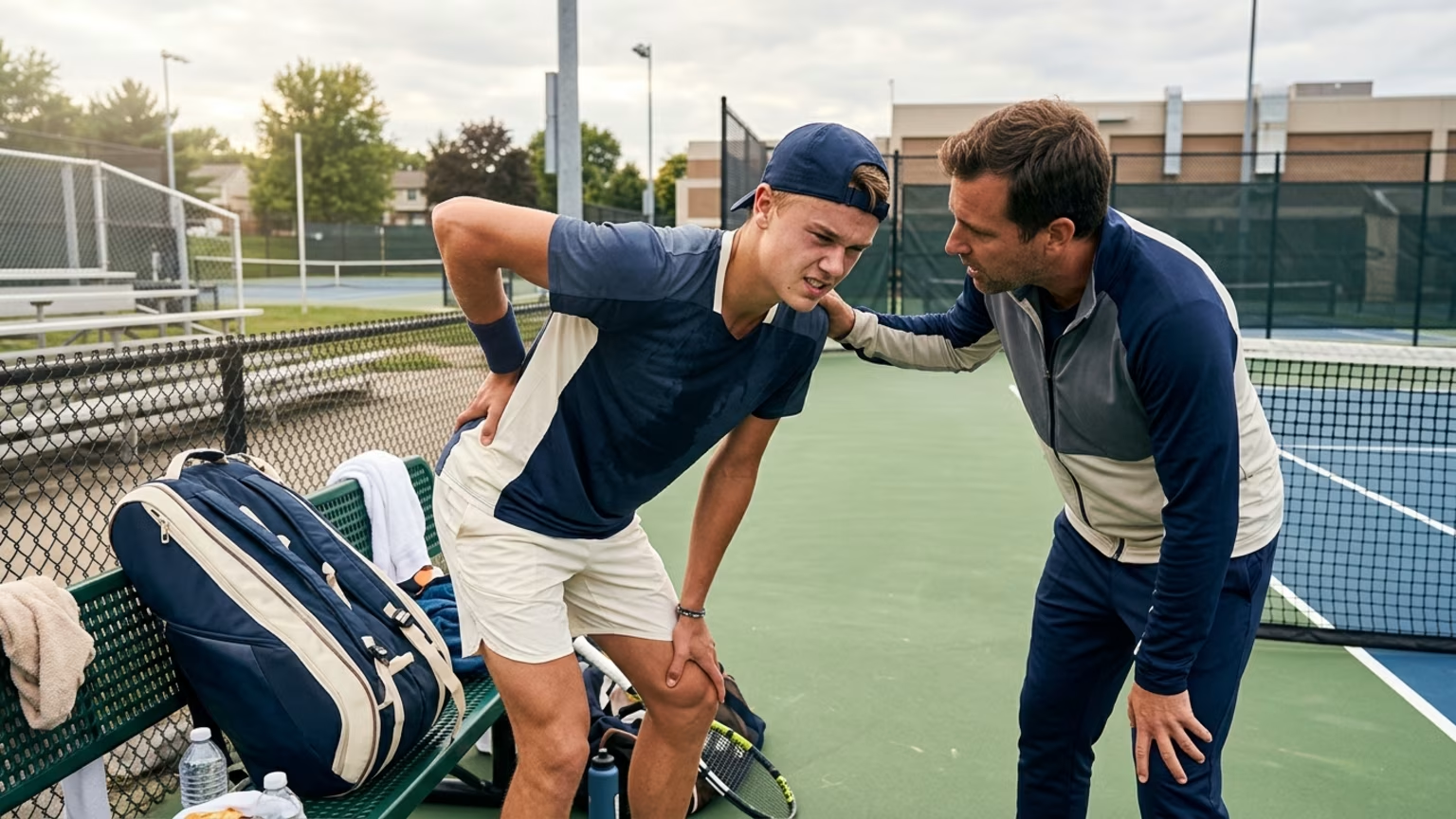
Holger Rune withdrew from the European Open with a back problem. The facts behind his decision and a grounded perspective for recreational players.

The Dink’s October 17 guide emphasizes deep returns, ball-height decisions and positioning against faster pickleball opponents.

A new report outlines padel and tennis gear trends. Learn how to assess adjustable rackets, sensor feedback and smart-court claims.
Read practical guidance for better movement, smarter preparation and a game that keeps working for you.
explore the Blog
