

Learn how racquet sport tournament formats impact physical workload. Discover how to evaluate single-elimination, round-robin, and pool play for healthy aging.




You have heard it a million times: single-elimination tournament draws are the safest choice for athletic longevity because they guarantee fewer matches. Here is why that is outdated. The reality is that event formats dictate your physical workload in highly unpredictable and sometimes dangerous ways. A knockout bracket might protect a player who loses early, but it routinely pushes successful finalists into consecutive, exhausting rounds.
It is easy to understand why players gravitate toward elimination brackets. We look at a standard draw and assume that fewer guaranteed matches will naturally protect our bodies. When a tournament organizer uses a single-elimination format, they only need a small court capacity to run the event. We often confuse that administrative efficiency with biological safety.
Players register assuming they will get a light weekend workout. They completely ignore the cumulative physical stress of winning multiple rounds in one afternoon. This assumption happens because we focus on the average competitor rather than the champion. The player who loses in the first round goes home fresh. The player who makes a deep run absorbs massive physical punishment.
Historically, racquet sports emphasized finding a single champion as quickly as possible. This created a culture that valued survival over sustainable play. We learned to accept back-to-back matches as a necessary evil of competition. Today, adult players prioritize healthy aging, meaning this outdated survival mindset no longer serves our physical goals.
Players often misunderstand how rapidly match volume scales when tournament directors change event structures. The mathematical reality of racquet sports determines your baseline physical stress before you ever step onto the court. It is critical to look past the marketing language of an event and examine the underlying math. Only then can you predict how much physical load you are actually signing up to absorb.
The physical demands of tournament scheduling rely on strict mathematical realities. A single-elimination bracket requires n minus one matches to produce a champion. A 32-player draw requires 31 matches, while the winner plays five matches at most. A finalist in a 32-player bracket may play five matches, while an early loser plays one. This creates a severe physical workload spike for the most successful competitors.
Round robin structures completely change this dynamic. In a round robin, every participant plays every other participant in the group, producing n times n minus one divided by two matches. Round robin creates the most predictable competition schedule for each participant, but it can also produce the highest total number of matches and the greatest risk of repeated same-day play in small events.
An eight-player round robin therefore creates 28 matches, with each player scheduled for seven matches. The scale of this difference is staggering when you compare large events. A 32-player single-elimination event needs 31 matches, whereas a 32-player round robin would require 496 matches. Condensing that many matches into a short window creates intense physical density.
The United States Tennis Association offers useful guidance for these non-elimination structures. USTA describes round robin as a non-elimination format that can be designed for a single event lasting only half a day, particularly for junior or adult players with limited time. Pool play offers a structural compromise between guaranteed participation and competitive efficiency. A 16-team event with four pools of four would generate 24 pool matches, because each pool requires six matches.
A subsequent eight-team knockout bracket would add seven matches, creating 31 total matches before any additional consolation or bronze-medal contests. A published tournament-format guide recommends inserting an empty slot between the final group match and the quarter-finals when possible, both as a recovery buffer and as protection against scheduling delays. Court availability directly influences your physical rest periods during these critical playoff transitions. Tournament-planning guidance commonly adds five to 10 minutes for changeover, although the appropriate buffer should be increased when players must retrieve balls, report scores, warm up or move between courts.
Understanding these structural math differences helps you properly manage match load during competitions. You should ask tournament directors specific questions about court time and guaranteed recovery windows before registering. If you enter a pool play event, verify how much time exists before the knockout stage begins. You must advocate for your own rest periods instead of blindly following the event schedule.
I used to think a tough conditioning block was the only way to improve my court endurance. Then I started tracking my sleep.
I noticed that on days I slept less than six hours, my reaction time at the net was noticeably sluggish, and I felt gassed by the second set. Prioritizing consistent rest did more for my late match stamina than any extra sprints ever did. Recovery is the true foundation of performance.
When evaluating an upcoming weekend, you must look beyond the simple match count. USTA adult tournaments likewise include individual, team, elimination and non-elimination formats, showing that adult competition is not limited to a conventional single-elimination draw. You should actively avoid events that force you to play intense brackets without adequate breaks. It is crucial to build a sustainable tournament calendar that prioritizes rest over maximum participation.
Flexible league formats offer a fundamentally different approach to competitive volume. Instead of packing all matches into one exhausting weekend, these leagues distribute your workload across an extended season. This steady spacing makes it easier to practice a reliable post-match recovery routine. Your muscles and joints require adequate time to repair microscopic tissue damage between competitive efforts.
The New Golden Rule: The healthiest tournament format is not the one with the lowest total match count, but the one whose scheduling density matches your current physical capacity. Stop treating every weekend event as an absolute endurance test. Start viewing your competitive calendar as a carefully managed variable in your healthy aging strategy. Play the long game, choose your structures wisely, and you will stay on the court for years to come.
Follow Evercourts for practical insights on tennis, pickleball and padel performance, movement, recovery and healthy ageing. Stay connected for new articles, research-led guidance and ideas to help you play well and keep playing for years.


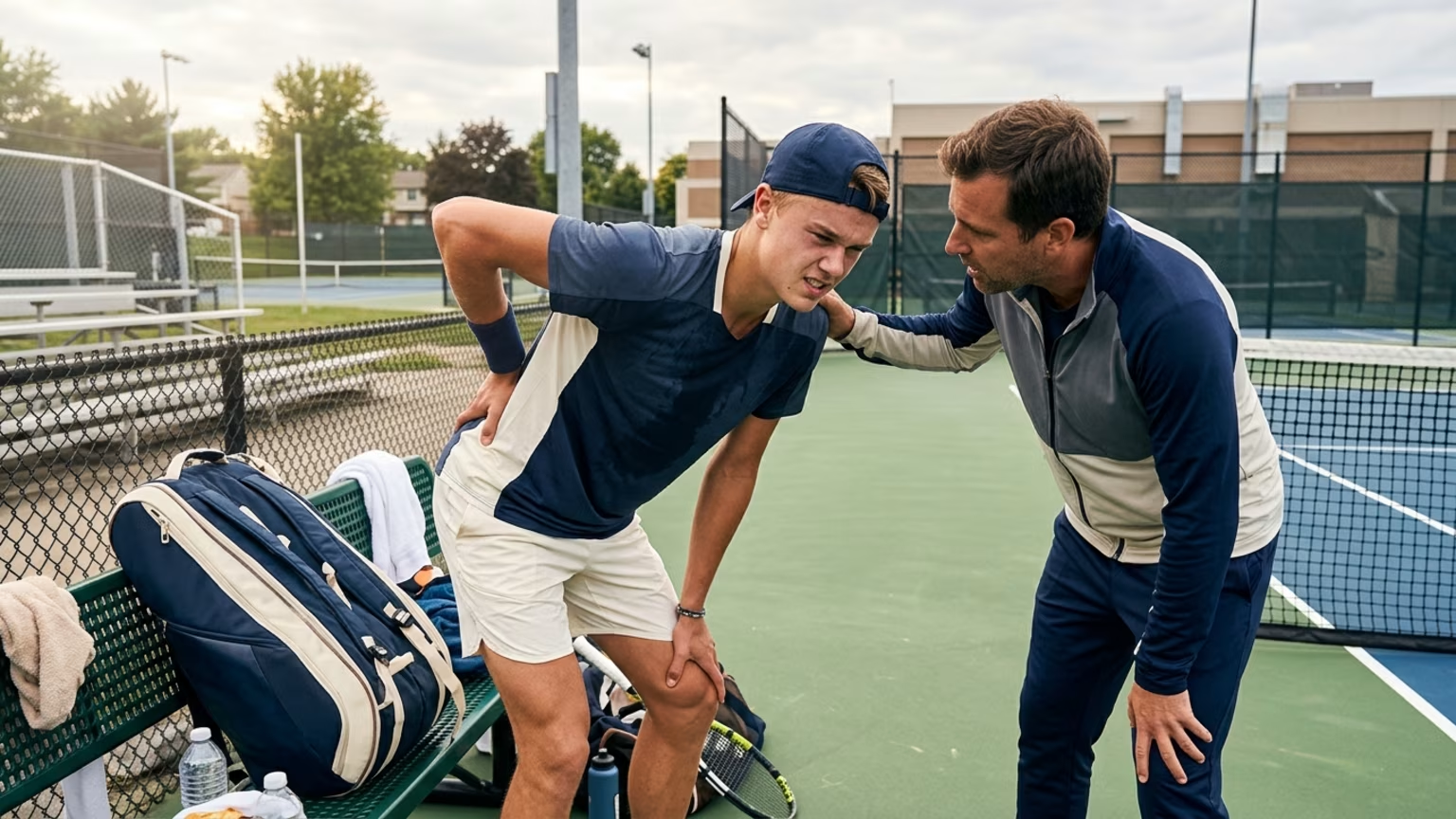
Holger Rune withdrew from the European Open with a back problem. The facts behind his decision and a grounded perspective for recreational players.

The Dink’s October 17 guide emphasizes deep returns, ball-height decisions and positioning against faster pickleball opponents.

A new report outlines padel and tennis gear trends. Learn how to assess adjustable rackets, sensor feedback and smart-court claims.
Read practical guidance for better movement, smarter preparation and a game that keeps working for you.
explore the Blog
