

Learn how efficient court coverage depends on reading the play early, choosing economical routes, and smart recovery, rather than just running faster.




You are staring down a heavy crosscourt drive, your legs feel stuck in mud, and the ball is past you before you can even react.
Many adult players assume that better court coverage requires endless sprint training. They think raw speed is the only way to reach difficult shots. This protocol focuses instead on reading the play early, taking economical routes, and finding smarter recovery positions. These habits improve your capability without asking you to run faster.
The goal is to support healthy aging and keep you playing well for years. By organizing your movement effectively, you protect your body from unnecessary strain. Good positioning reduces the need for desperate lunges. This approach prioritizes technique and timing over sheer physical output.
I used to think a tough conditioning block was the only way to improve my court endurance. Then I started tracking my sleep. I noticed that on days I slept less than six hours, my reaction time at the net was noticeably sluggish, and I felt gassed by the second set.
Prioritizing consistent rest did more for my late match stamina than any extra sprints ever did. Recovery is the true foundation of performance. A well-rested body responds better to efficient movement techniques. When you pair adequate rest with smart court positioning, you preserve your energy.
Relying on constant maximum effort increases physical fatigue and limits your court time. Older players should prioritize repeatable control over explosive speed. Maintaining your functional balance and strength matters deeply for athletic longevity. According to research on sports performance, efficient positioning requires fewer rapid directional changes.
This mindful approach reduces wear on your joints and muscles. You preserve your physical capabilities by moving with clear intent. It also allows you to enjoy your time on the court with less stiffness the next day. Efficient court coverage is a sustainable skill you can refine continuously.
Covering the court efficiently depends on a clear sequence of preparation. The steps below reflect consistent coaching guidance for adult players. They help you arrive at the ball balanced and ready. Learning this sequence builds a strong foundation for any racquet sport.
A split step is a small preparatory hop that places you in a balanced position. Coaching guidance commonly places the landing at, or immediately before, the opponent’s contact. This timing allows you to push in any direction as soon as you recognize the shot. The purpose is not to jump high but to create immediate readiness.
It simply removes the delay of being flat-footed. Practicing a timed split step helps you move effectively without needing maximum speed. A late split step leaves you reacting from an unstable position. An early one leaves you stationary before you know the shot direction.
Court coverage is largely a geometry problem. Taking the shortest effective path matters more than moving your feet frantically. Crossover steps may cover larger distances with fewer steps. Shuffles often suit smaller lateral adjustments.
By choosing the right footwork for the distance, you arrive at the ball with better balance. This is more useful than trying to sprint wildly across the baseline. You can train this by using footwork patterns designed for court sports. Good route selection keeps your body square to the play when necessary.
Your work is not done after you hit the ball. You must recover to a location that protects the next likely angle. Recovering to the exact physical middle of the court is rarely the right choice. The court’s effective center shifts with the ball.
You must angle your body toward the play rather than remaining parallel to the net. Good positioning guidance recommends using your outside leg to push back toward the center after a wide ball. This pushing action initiates a strong recovery sequence. It puts you in the right spot before the next shot arrives.
Applying these concepts requires focused practice sessions. You can improve your timing with a simple contact-cue drill. Have a partner tap their racket frame to create a sound cue. Begin your small split step just before the cue sounds.
Aim to land exactly as the sound occurs. You can also practice route selection with targeted cone drills. Place one cone close to your starting position and another farther wide. Have a partner feed short balls and wide balls at random.
Use compact adjustment steps for the short balls. Choose a crossover step for the wider feeds to cover more ground efficiently. Always finish these practice movements with a controlled deceleration. A good drill rewards arriving balanced and ready for the next shot.
It is never just a race to touch a distant target. Quality movement practice builds reliable court habits over time.
It is helpful to separate your direction recognition from your first physical movement. You can practice this with a point-and-go first step drill. Begin in a comfortable ready stance while facing a partner. Have the partner point left or right immediately after you land your split step.
Push off powerfully with the leg that sends your body toward the target direction. Take only two or three steps before stopping completely under control. This teaches you to make a decisive first move only after the direction is clear. Reset fully before beginning the next repetition.
Every racquet sport demands different movement patterns. You must tailor your footwork to the specific geometry of your playing area. The basic movement principles remain similar across disciplines. However, the spatial requirements change significantly from one court to another.
Tennis singles requires covering large distances along the baseline. You should use crossover steps when defending deep, wide balls. You must adjust your recovery position based on where your previous shot landed. Shuffling back to the exact center mark can leave you exposed.
Training better split-step timing helps you defend these large spaces effectively. You must recognize the opponent's swing path early to gain an advantage. Anticipation allows you to start your movement sequence sooner. This early recognition is vital for covering the entire tennis court.
Pickleball demands precise transition movement and coordinated partner coverage. In pickleball, the split step is recommended during transition toward the non-volley line. It is also useful on returns of serve and at the kitchen line. Doubles guidance recommends that the player nearest the sideline move toward the line while their partner shifts toward the middle.
This preserves coverage of both the down-the-line and central angles. A common positioning framework recommends a two-step movement toward the sideline for the covering player and a one-step shift for the partner. Building coordinated spacing and early communication keeps both partners balanced. You do not need to sprint continuously through the transition zone.
Moving under control is much more effective.
Padel requires complex reactions due to the surrounding walls and unique tactical interactions. Padel is also being studied through the combined lens of court movement, temporal structure, and tactical interaction. A 2026 systematic review is listed as examining those relationships. Because padel research is still developing, you should focus on controlled deceleration and balanced stops.
These foundational skills apply perfectly to managing shots off the back glass. You must maintain a strong base when waiting for the ball to rebound. Quick adjustment steps help you find the right hitting position near the walls. Efficient court coverage in padel relies heavily on spatial awareness.
Follow Evercourts for practical insights on tennis, pickleball and padel performance, movement, recovery and healthy ageing. Stay connected for new articles, research-led guidance and ideas to help you play well and keep playing for years.


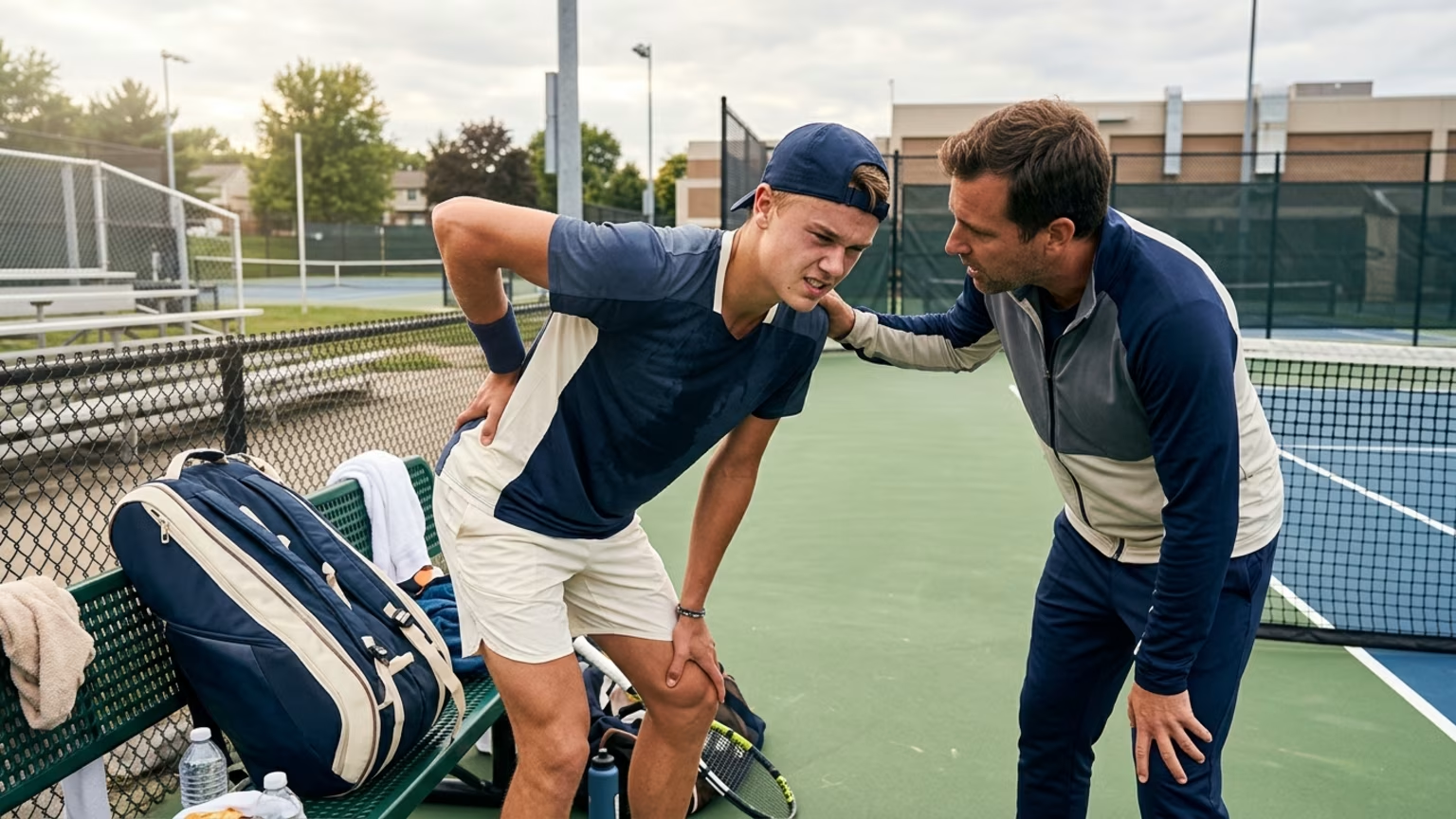
Holger Rune withdrew from the European Open with a back problem. The facts behind his decision and a grounded perspective for recreational players.

The Dink’s October 17 guide emphasizes deep returns, ball-height decisions and positioning against faster pickleball opponents.

A new report outlines padel and tennis gear trends. Learn how to assess adjustable rackets, sensor feedback and smart-court claims.
Read practical guidance for better movement, smarter preparation and a game that keeps working for you.
explore the Blog
