
Learn how to build a sustainable weekly racquet sports routine that balances court time, strength training, and recovery for true athletic longevity.




Question: Shouldn't I be playing my sport every single day if I want to maintain my skills and fitness as I age?
The most durable athletes actually spend fewer days on the court and actively reject the common wisdom that more practice always guarantees better results. Stacking intense court sessions without adequate rest simply accelerates physical decline and invites chronic joint pain. True athletic longevity comes from building a sustainable weekly routine instead of chasing an idealized daily grind.
Many players assume that joint pain is simply the unavoidable price of getting older. The reality is that rapid spikes in playing volume cause the vast majority of joint issues. A 2026 study published in Frontiers in Sports and Active Living found that 38.1% of Korean recreational pickleball players reported at least one injury during the previous 12 months. The same study cited a 2024 survey of 232 recreational pickleball players, which reported a 12-month injury prevalence of 34.2%.
These numbers show exactly why progressive loading is completely non-negotiable for adult athletes. Researchers recommend deliberate load management instead of simply telling players to quit entirely. This means you should always schedule planned recovery periods alongside your active matches. You should also increase your weekly court hours very gradually to allow your connective tissues to adapt.
Classifying your court sessions by their physical cost is a highly effective strategy for injury prevention. A relaxed doubles match is a low-cost session. A heavy singles tournament demands a much higher physical toll. You can easily avoid stacking high-cost days back to back by recognizing these basic differences in intensity.
Taking rest days does not mean you are losing your competitive edge. Planned time away from the court actually allows your muscles to repair and grow stronger. This deliberate spacing keeps your joints fresh for the moments when you truly want to compete.
The best weekly schedule is the one you can actually maintain through busy periods. You should build your routine around a minimum baseline rather than a perfect vacation week. For example, two steady court sessions and two short strength workouts fit into almost any work schedule. This minimum repeatable structure keeps your body prepared for random spikes in physical activity.
A few years ago, I realized my tennis serve speed was dropping, and my shoulder was constantly throbbing after matches. Instead of pushing through the pain, I took a month to rebuild my mechanics and focus on rotator cuff endurance.
I stopped trying to hit flat aces and developed a much heavier kick serve. My win rate actually went up, and my shoulder stopped hurting. Sometimes longevity means outsmarting your own ego on the court.
You must plan your recovery days before the week even begins. A simple traffic-light system works perfectly for adult athletes looking to manage their physical workload. Green means you can safely proceed with your planned matches. Yellow means you should downgrade to a hitting session, and red means you must rest completely.
Building this kind of adaptability into your schedule is absolutely essential for long-term health. Players who invest in a consistent weekly racquet sports routine generally experience far fewer painful interruptions. You will play much better when you finally accept that rest is a required training variable. Overtraining only accelerates the physical wear and tear that keeps you off the court.
These sports share many movement patterns, but they place completely different demands on your body. Tennis requires explosive lateral sprints and heavy overhead rotational forces. Pickleball demands relentless acceleration, sharp deceleration, and repetitive bending. Padel involves unique rotational movements off the glass and significant psychological demands.
The injury profiles clearly reflect these distinct structural challenges. Adults aged 50 and older accounted for an estimated 125,000 pickleball-related emergency-room visits from 2018 through 2025. Approximately half of those visits involved people aged 65 or older. Meanwhile, a 2018 Copenhagen City Heart Study analysis followed 8,577 Danish residents aged 20 to 93 from 1991 to 2017.
That research found that tennis participation was associated with an estimated 9.7-year greater life expectancy than a sedentary lifestyle. You cannot treat a heavy tennis week exactly like a heavy pickleball week. Pickleball players often suffer from Achilles tendon issues and lower back stiffness due to the short court dimensions. Tennis players more frequently deal with shoulder fatigue and knee pain from high-impact serves.
Understanding how different court surfaces impact movement will also help you adjust your weekly recovery. Proper planning requires you to respect the specific physical requirements of your chosen game. A standardized recovery plan often ignores the unique stresses placed on your joints by different racquet sports.
Court play alone is simply not enough to maintain your long-term physical capacity. Public-health guidance commonly recommends that adults accumulate 150 to 300 minutes of moderate-intensity aerobic activity per week. You can also meet this target with 75 to 150 minutes of vigorous activity. Crucially, the guidelines add that you need muscle-strengthening work on at least two days per week.
These requirements become even more specific as we age. For adults aged 65 and older, the guidance adds multicomponent activity emphasizing functional balance and strength on three or more days per week. You should treat balance, single-leg control, and deceleration practice as mandatory performance skills. This approach to healthy aging and mobility keeps you resilient against sudden awkward movements.
Your off-court workouts do not need to be exhausting or excessively long. A simple twenty-minute session of squats, calf raises, and rotational core exercises is highly effective. Consistency always matters much more than absolute workout intensity. A steady strength routine builds the foundational durability that keeps you playing happily for decades.
Off-court conditioning also allows you to enjoy the social benefits of your sport without constant anxiety about injury. A review summarized in a 2026 editorial found that pickleball participation was associated with positive well-being outcomes, especially among older adults. You can preserve this valuable social connection by investing just a few hours a week into basic physical maintenance.
Your weekly routine should be a flexible framework that adapts to your life, rather than a rigid schedule that eventually breaks your body down. True athletic longevity is simply the quiet reward for listening to your physical limits and respecting the natural rhythms of effort and rest.
Follow Evercourts for practical insights on tennis, pickleball and padel performance, movement, recovery and healthy ageing. Stay connected for new articles, research-led guidance and ideas to help you play well and keep playing for years.


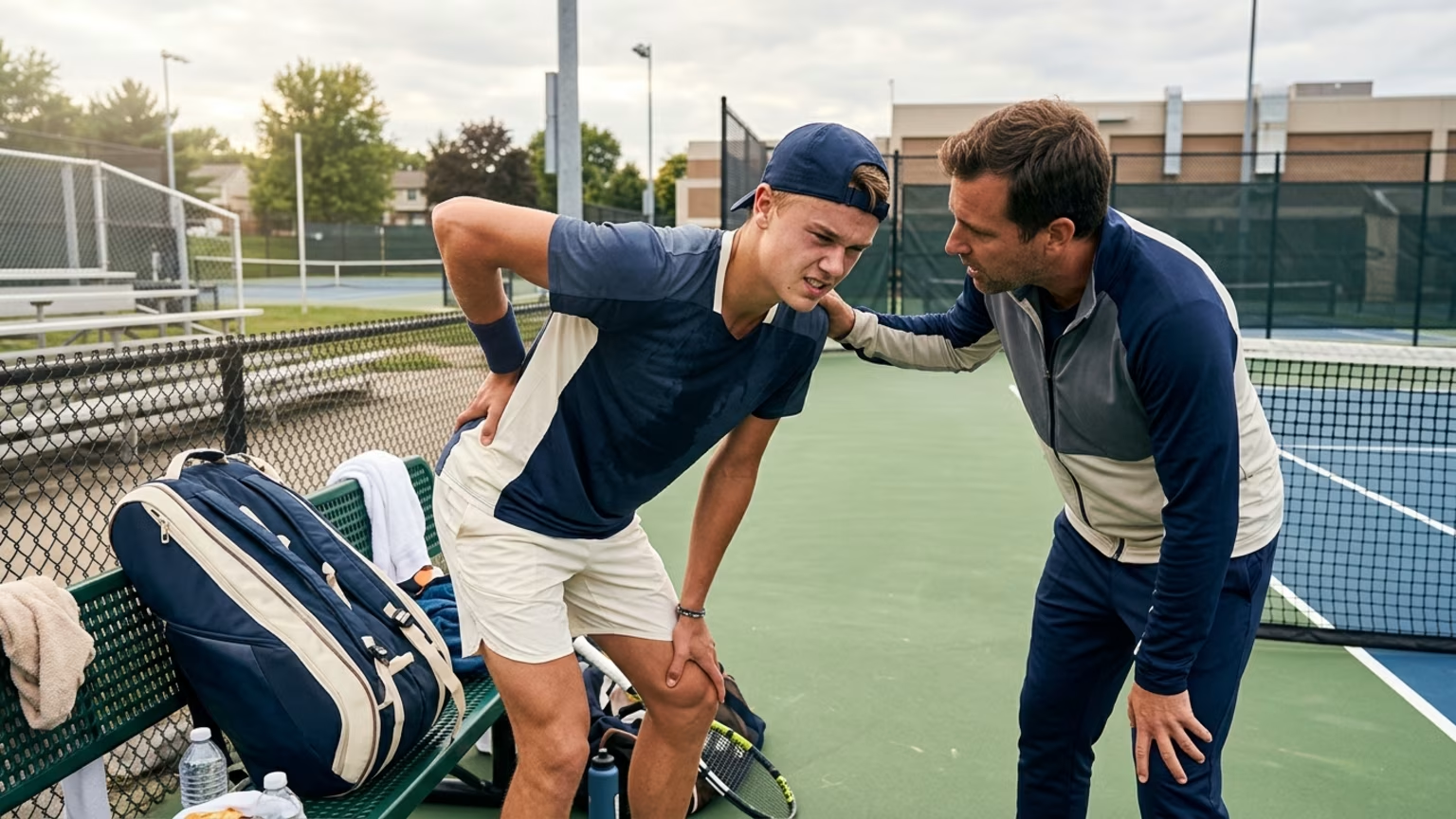
Holger Rune withdrew from the European Open with a back problem. The facts behind his decision and a grounded perspective for recreational players.

The Dink’s October 17 guide emphasizes deep returns, ball-height decisions and positioning against faster pickleball opponents.

A new report outlines padel and tennis gear trends. Learn how to assess adjustable rackets, sensor feedback and smart-court claims.
Read practical guidance for better movement, smarter preparation and a game that keeps working for you.
explore the Blog
