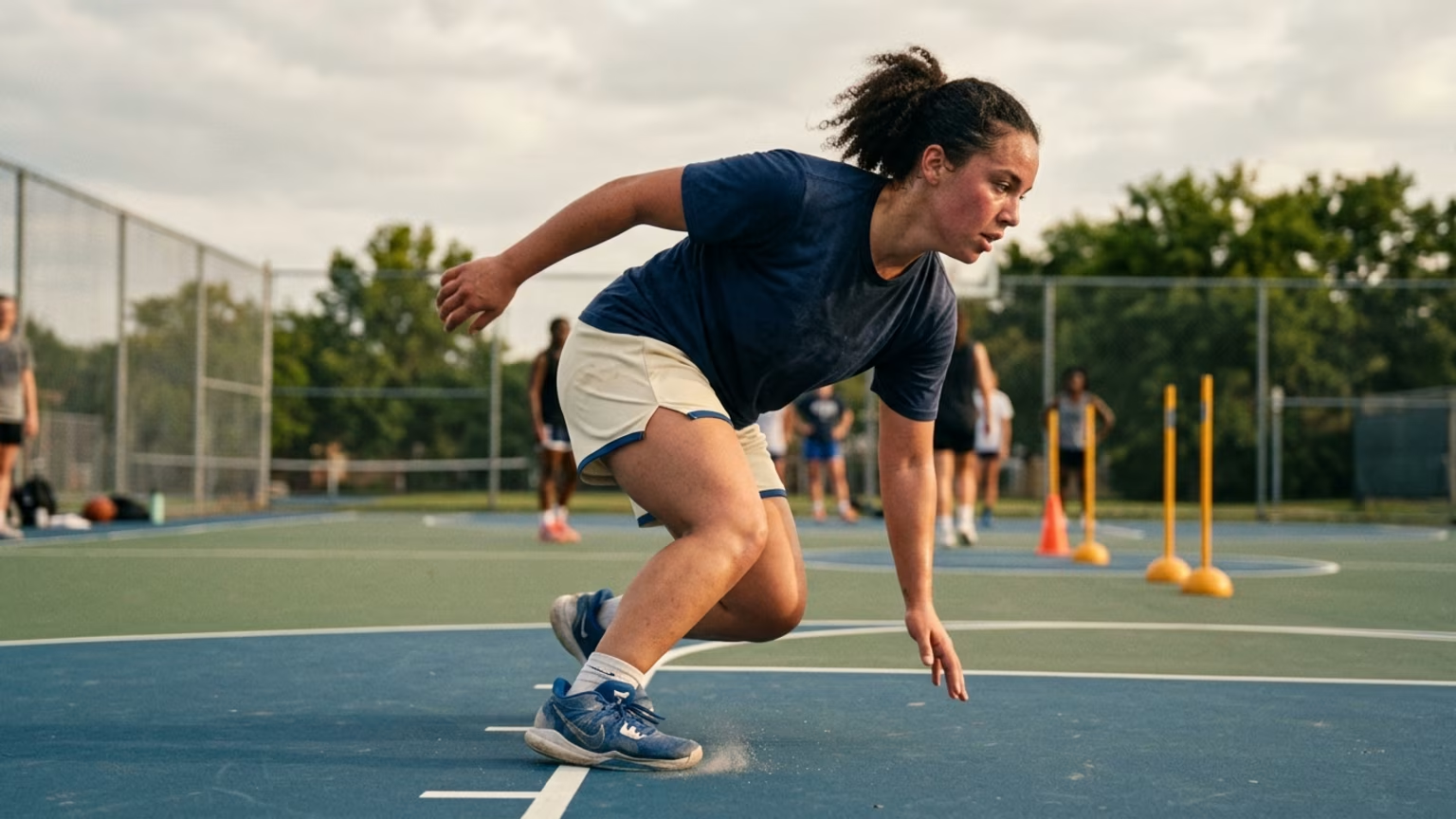

Improve your tennis, pickleball, and padel movement. Learn why deceleration and stopping skills are vital for athletic longevity, speed, and court control.




The opponent hits a clean passing shot down the line. You sprint out wide to track it down. Your racquet finds the ball, but your momentum carries you three steps out of bounds. The point is already over before you even finish stopping.
You have heard it a million times: faster footwork is all about explosive speed. Here is why that is outdated. True court speed relies heavily on your ability to slow down. Stopping and changing direction is often treated as a by-product of pure speed.
For racquet-sport players, it is better understood as a completely separate athletic skill. It requires the ability to absorb momentum, control your center of mass, and create lateral force. A player who cannot slow down efficiently simply cannot use speed effectively. Every aggressive movement toward a short ball ends with some form of braking.
If you only practice running fast, you are missing half of the movement equation. Improving your stopping ability makes you safer and much harder to beat. This is exactly why faster braking skills protect racquet players on court. You cannot change direction until you successfully control your initial momentum.
For decades, physical preparation for tennis and padel focused heavily on forward sprinting. Coaches emphasized running times, jump heights, and simple agility ladders. Players learned to associate athletic performance strictly with acceleration. This created an understandable misconception that stronger legs automatically improve court movement.
It is easy to see why players believe this. Acceleration feels athletic, looks impressive, and provides clear metrics to measure. Braking is completely different. It is an invisible skill that you only notice when it suddenly fails.
Players try to stop quickly, lose their balance, and wonder why their footwork feels clumsy. The problem is not a lack of effort on the court. The issue is that standard fitness routines rarely teach athletes how to hit the brakes properly. They skip the vital steps required to transition from moving fast to standing completely still.
The science behind court movement paints a very clear picture. Change of direction actually involves reorienting the whole-body center of mass toward a new path of travel, according to movement research from Sci of Multispeed. It is a complex sequence of physical events.
A 2025 systematic review summarized by DJP Athlete linked change-of-direction performance with several specific factors. These include braking and propulsive ground-reaction forces alongside trunk position. Researchers also highlighted center-of-mass height, ground-contact time, and lower-limb mechanics. The practical implication is that faster movement requires the ability to absorb force safely.
You cannot simply produce more force to accelerate without paying a price on the other end. The angle and entry speed of a cut dramatically change its physical demands. A shallow change of direction relies on maintaining velocity and reusing elastic energy. Sharper cuts require significantly more braking power and force absorption.
For adults prioritizing healthy aging, this means a low-speed lateral step is entirely different from a hard 90-degree recovery. They should not be treated as interchangeable drills. A smarter approach uses a "traffic-light" method. This concept uses angle and entry velocity to regulate training intensity, starting with shallow changes of direction before progressing to sharper cuts.
Now that the science is clear, the next step is applying it to your weekly routine. The most useful sports-performance explanation of deceleration uses a three-phase model: brake, plant, and project. A player first reduces speed, establishes a stable base, and finally projects the body toward the next ball.
Spectrum SP recommends progressing from simple sprint-to-stop actions toward forward-to-lateral movements. From there, players can advance to angled cuts, sharper cuts, and reactive drills. The order of these exercises matters tremendously. A progression published by the rehabilitation-focused source Chirurgiefix begins with foundational body control and alignment.
It then moves to slow deceleration, controlled 45-degree cuts, and 90-degree cuts. Only after mastering those steps does it progress to faster and finally reactive changes of direction. This sequence follows a sensible risk-management principle for anyone playing racquet sports. You should only increase speed and decision-making after you can control the simpler version.
Recreational players should always start with basic balance. Balance for tennis, pickleball, and padel is highly dynamic. It includes controlling the body while stepping, braking, reaching, and recovering.
Try standing near a wall in a two-leg athletic stance. Progress to a single-leg stand with light fingertip support. Only add a small forward or lateral reach when the position is completely steady. For best results, change only one difficulty variable at a time.
Next, focus on your braking control in linear movements. Try walking forward for several steps and stopping smoothly. Progress to a light jog and try to stick the finish for two seconds.
Focus on lowering your body gradually and keeping your feet under your hips. Having strong ankle and foot mobility makes this phase much easier to control. Rather than relying on one rigid leg, use several short steps to absorb the impact.
For regular recreational players, try adding a 45-degree cut at half speed. Progress to a 90-degree cut only after your form is consistent. Including a visual cue that directs your recovery path can make the drill feel like real play.
Finally, train lateral force production. Stopping requires more than simply bending your knees. You must create force against the ground in a direction that redirects your center of mass. This allows you to push off smoothly toward the next shot.
Practice controlled lateral lunges or side steps. Once you build confidence, try a split squat with a slow lowering phase to build eccentric strength. You can then incorporate reaction and anticipation training to match real game scenarios.
More advanced players can challenge themselves with a crossover step into a controlled plant. Unilateral strength work combined with deceleration drills is highly recommended by sports performance experts. Following the complete guide to braking, stopping, and changing direction on court will ensure you progress safely.
The New Golden Rule is simple: do not train only to arrive at the ball. Train to arrive under control and leave in the next direction.
Instead of sprinting until you lose balance, focus on preserving your ability to lower your body. Absorb your momentum, place your foot confidently, push laterally, and recover. Those capabilities support both your court performance and your athletic longevity.
The goal is not to look like a professional sprinter. It is to move safely and efficiently across the court for years to come. To start applying this concept today, practice jogging forward five meters and stopping completely before taking a lateral step.
Follow Evercourts for practical insights on tennis, pickleball and padel performance, movement, recovery and healthy ageing. Stay connected for new articles, research-led guidance and ideas to help you play well and keep playing for years.


Holger Rune withdrew from the European Open with a back problem. The facts behind his decision and a grounded perspective for recreational players.

The Dink’s October 17 guide emphasizes deep returns, ball-height decisions and positioning against faster pickleball opponents.

A new report outlines padel and tennis gear trends. Learn how to assess adjustable rackets, sensor feedback and smart-court claims.
Read practical guidance for better movement, smarter preparation and a game that keeps working for you.
explore the Blog
