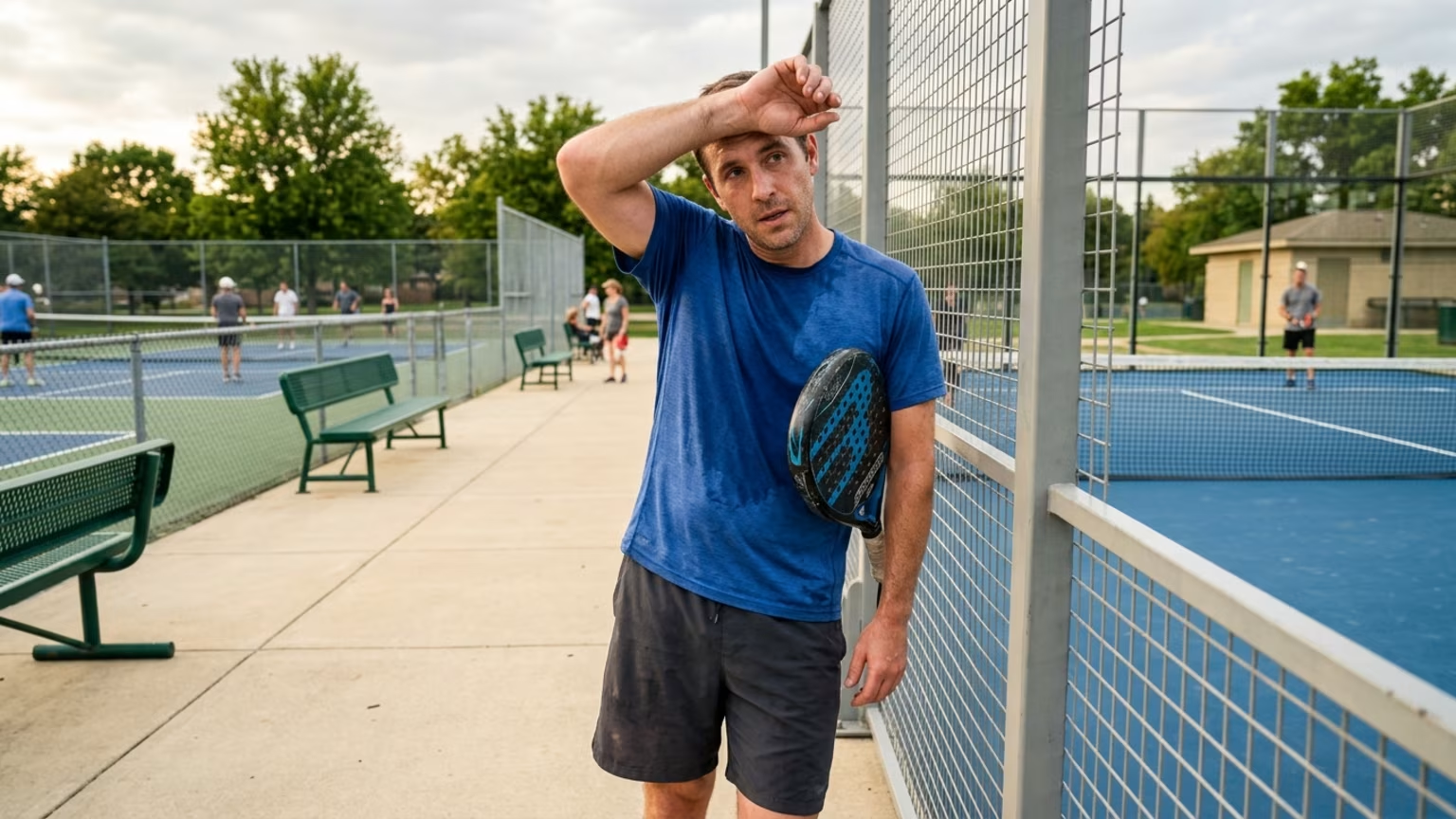

Learn how to build a sustainable padel training week. Compare high-volume playing schedules against a balanced approach to stay on the court without burning out.




This approach revolves around playing as often as possible. Players using this method treat every open hour as an opportunity for match play. The primary focus is repetition on the court rather than structured physical preparation. This schedule builds specific sport skills rapidly but leaves little room for deliberate recovery.
Beginners often fall into the trap of the high-volume schedule when they first start the sport. They might play four or five days a week without building foundational strength. This approach ignores the reality that a competitive match involves repeated accelerations, lunges, and trunk rotation. Players returning after time away also struggle when they try to match a regular league player.
Their first priority should be rebuilding tolerance to movement rather than maximizing court hours. A high-volume schedule skips this vital rebuilding phase entirely. The result is often an early plateau or a frustrating physical setback. Simply playing more does not automatically build the resilience needed to manage the court.
The impact on physical capabilities becomes clear as fatigue accumulates over time. A 2026 cross-sectional study of amateur padel players showed that playing exposure was the primary factor associated with ankle-sprain risk. A separate study examined training load and muscle fatigue in 15 amateur padel players in South Tangerang, Indonesia. That study found no statistically significant relationship between training load and muscle fatigue, reporting r = -0.200 with p = 0.475.
It also found no significant link between recovery scores and fatigue, noting r = 0.280 with p = 0.312. Its regression model produced R = 0.453 with p = 0.253. The authors noted that substantial individual variation among amateur players likely influenced these results. This individual variation means that treating workload metrics as universal limits is deeply flawed.
A 2026 systematic review of wearable technology concluded that associations between wearable-derived workload metrics and injuries are inconsistent. The review confirmed that current evidence does not support universal risk thresholds. Direct evidence that wearable-guided interventions reduce injuries remains limited across the sport. A high-volume routine forces players to rely entirely on feelings rather than a structured training load management plan.
The balanced schedule organizes the week by alternating demanding court exposure with strength and mobility work. This approach treats matches as heavy training sessions rather than casual activity. It restricts players from stacking a hard gym session immediately before a competitive match. This structure contrasts sharply with the high-volume method by prioritizing physical readiness over maximum court hours.
It ensures that players keep at least one genuinely low-load or rest day each week. Easy walking and normal daily movement can remain, but the day should not become a disguised conditioning session. I remember finishing a tough two hour padel match on a cold Tuesday night and waking up the next morning feeling like my lower back was locked in concrete. For a long time, I just accepted this as the price of playing hard in my forties.
But once I started spending just ten minutes on targeted hip mobility before heading to the club, the stiffness almost completely vanished. It taught me that we do not have to accept pain as a default state of aging. A balanced routine actively incorporates these types of preventive behaviors. The 2026 ankle-sprain study reported that preventive behaviors were associated with better functional recovery.
Building a complete weekly training blueprint requires managing the acute to chronic workload ratio. A 2026 review of this ratio found a small to moderate association between elevated workload and greater injury risk. That review reported g = 0.35 with a 95% confidence interval of 0.16 to 0.54. That same workload review noted very high heterogeneity, showing I² = 95.8%.
This variation means players must individualize their training rather than copying a professional routine. Incorporating other racquet sports into a balanced week can also support healthy aging goals. An 8-week pickleball intervention in older adults reported physical quality of life improvements with a coefficient of β = 2.37 and p = 0.040. The pickleball study also noted mental quality of life improvements with β = 4.83 and p = 0.001.
Participants experienced less sedentary time, shown by β = -37.19 and p = 0.028. They also showed increased light physical activity at β = 17.43 with p = 0.033. These metrics demonstrate the value of structured athletic activity without overtraining. A balanced week ensures that players progress gradually and maintain their physical performance.
Different racquet sports impose distinct physical demands on the human body. Tennis requires explosive lateral speed and heavy rotational power during every single serve. The high-volume schedule often fails tennis players because the intense muscular demand requires adequate recovery between matches. A balanced schedule allows tennis players to rebuild power before their next heavy serving session.
It prioritizes the rest needed to maintain high velocity on the court. Without proper scheduling, tennis players often experience a sharp drop in their serving speed by the end of the week. Pickleball relies heavily on a stop and start nature at the kitchen line. The court is smaller, but the rapid directional changes still place immense stress on the lower body.
High-volume play is incredibly common in pickleball because the immediate cardiovascular demand feels slightly lower. However, a balanced schedule better prepares the joints for sudden stops and protects against repetitive strain over time. Managing this specific exposure keeps recreational pickleball players active for a longer portion of the year. Padel features multidirectional movement and constant strategic interaction with the glass walls.
Players frequently transition from the back of the court to the net under high defensive pressure. The balanced schedule perfectly matches padel because it allows for dedicated lower body strength work. Stronger legs help padel players absorb the impact of constant lunges and sudden decelerations. Building strength consistently ensures that players can handle long, grinding rallies without form breakdown.
The balanced recovery schedule is the clear winner for staying on the court for years. It acknowledges that physical preparation is just as important as technical practice. Playing every single day eventually breaks down the tissues that support complex joint movements. By spacing out intense matches, players give their bodies the time needed to repair and adapt.
This deliberate spacing is what ultimately builds true athletic durability. Monitoring individual responses remains a vital part of this winning strategy. Subjective tools like perceived exertion and sleep quality help athletes adjust their weekly plans before severe fatigue sets in. If sleep quality drops and joint pain increases, athletes can comfortably scale back their intensity for a few days.
The evidence shows that preventive habits and manageable workloads lead to better long term health. Evercourts stands by the balanced approach as the most sustainable path for recreational and competitive players alike.
Follow Evercourts for practical insights on tennis, pickleball and padel performance, movement, recovery and healthy ageing. Stay connected for new articles, research-led guidance and ideas to help you play well and keep playing for years.


Jilly B challenges five pickleball rules of thumb, with a focus on ball pace, reaction space, paddle readiness and purposeful positioning.

Zheng Qinwen’s early finish to 2026 puts fatigue and recovery in focus. Here is the practical lesson for adult racquet-sport players.

Build toward pickleball match pace with easy movement, court footwork and controlled hitting, plus a short-format option and guidance after a break.
Read practical guidance for better movement, smarter preparation and a game that keeps working for you.
explore the Blog
