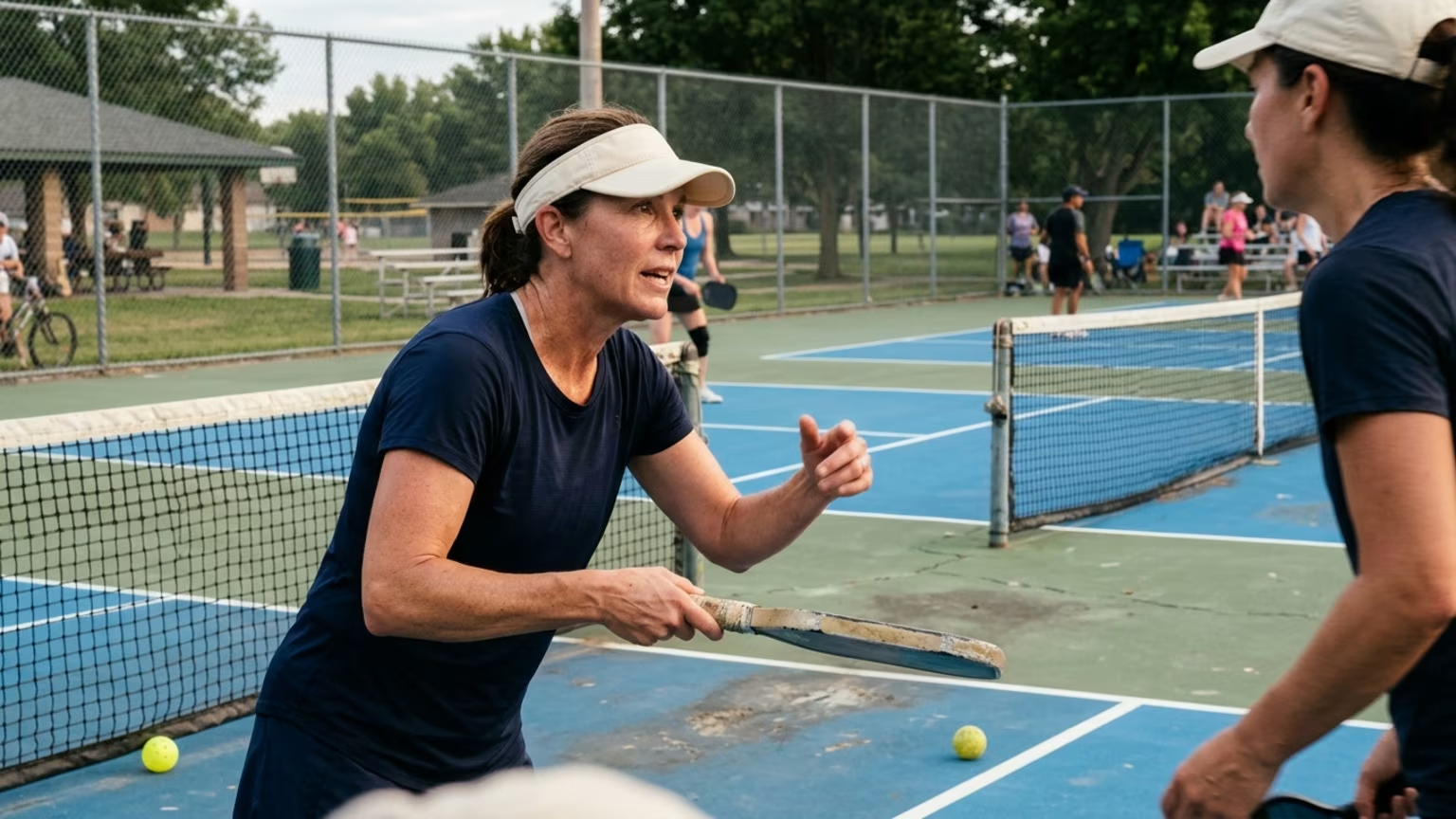

Jilly B challenges five pickleball rules of thumb, with a focus on ball pace, reaction space, paddle readiness and purposeful positioning.




On October 19, 2026, The Dink published Alex E. Weaver’s “5 Pieces of Bad Pickleball Advice to Stop Following,” presenting coaching advice from Jilly B.
The article describes Jilly B as a top APP pro and coach. Her argument is that familiar instructions can miss important details about the incoming ball and the player’s position. This is an instructional piece, not a match report or an announcement of changes to official pickleball rules.
The Dink connects her advice to modern foam-core paddles and more aggressive exchanges at the kitchen. It says those paddles can produce more pop with a shorter swing. That is the article’s explanation for reconsidering older cues, rather than a reason to abandon every familiar tactic.
The article offers a coaching perspective without comparative performance data or independent paddle testing. The article does not establish that the recommendations work equally across player levels, paddle types or situations.
Jilly B’s professional perspective makes the advice worth considering. It does not make professional aggression the right goal for every adult league player. The practical value is in the questions she asks before a shot: What is the ball doing, and is the player in position to respond?
For a weekend player, that shifts the emphasis from copying a striking shot to recognizing the conditions behind it. It also fits a broader discussion of assessing progress beyond match results. The point is to assess the choice, not simply celebrate that one attempt landed.
“It’s not so much the height of the ball, it’s the deadness of the ball,” Jilly B says in The Dink’s article.
In that account, a ball below net height may be attackable when it is soft and sits up with little pace or spin. The player must also be balanced or moving forward with room to step into the shot. Those details are part of the recommendation, not optional extras.
For recreational players, the useful reading is not “attack low balls.” It is “look beyond height before deciding.” A low ball that arrives with little pace presents a different decision from one that leaves the player reaching or unable to set their feet.
The article’s case is for a more complete read of the situation. Height remains part of the picture without deciding the shot by itself.
The article also challenges the absolute behind “hit it high, you die.” Jilly B’s proposed response is to step back, bring the paddle up in front of the chest and keep weight forward in preparation for a counter.
She describes recreational opponents as sometimes hitting high balls hard and directly at the defender. Against that response, her emphasis is on making room and getting ready rather than trying to win a power contest.
For the weekend player, the takeaway is a preparation cue: create reaction space and have the paddle up before the counter. The Dink summarizes the hitting principle as “hitting down, not hard.” Neither point requires treating a high ball as harmless.
Jilly B’s objection is to crosscourt as an automatic answer. In her explanation, the shot should help open the middle. The next positioning decision is to close the middle afterward.
The article also questions the difficult “panic crosscourt” and offers the middle or just off-middle as an alternative when under pressure. That makes the advice particularly relevant to recreational players tempted to copy a shot without its tactical context.
The distinction is between choosing crosscourt for a reason and sending the ball there because a slogan says to. Her recommendation keeps the shot available while asking the player to account for what comes next. It is not a ban on crosscourt dinking.
Another target is tracking the ball with the paddle rather than moving the lower body. The alternative in The Dink’s account is to keep the paddle centered while the lower body handles the movement.
For adult players, the practical emphasis is on positioning before the exchange becomes a last-second reach. That connects this advice with the wider subject of using footwork to organize court movement.
The coaching point is that a ready paddle and an adjusted position belong together. A paddle-only response misses part of what Jilly B is asking players to consider.
The final objection concerns aiming for the lines on putaways. Jilly B’s suggested alternative is to target through the middle rather than the sidelines.
The recreational application is direct: the opportunity to finish a point does not automatically require a line target. In this coaching framework, direction is a deliberate choice rather than a test of how close the ball can land to the edge.
That belongs with the other ideas. Each challenges an automatic response and replaces it with attention to the situation. The advice is not simply to hit harder or attempt a more difficult shot.
The useful development to watch next season is whether this discussion moves beyond replacing old slogans with new ones. Simply telling players to attack dead balls would be just as incomplete if it dropped Jilly B’s conditions about balance and room to step in.
Clearer examples across playing levels would make the conversation more useful. The important comparison would be between the incoming ball, the player’s position and the decision that followed. A spectacular counter alone would not answer those questions.
For adult recreational players, the editorial takeaway is already clear: read the ball and your position before choosing the response. As this coaching discussion continues, the most useful advice will retain those details rather than turn a professional’s perspective into another absolute.
Follow Evercourts for practical insights on tennis, pickleball and padel performance, movement, recovery and healthy ageing. Stay connected for new articles, research-led guidance and ideas to help you play well and keep playing for years.


Zheng Qinwen’s early finish to 2026 puts fatigue and recovery in focus. Here is the practical lesson for adult racquet-sport players.
Build toward pickleball match pace with easy movement, court footwork and controlled hitting, plus a short-format option and guidance after a break.
Understand single-leg control, lateral movement, rotation and braking in tennis strength training, with an illustrative week and clear evidence limits.
Read practical guidance for better movement, smarter preparation and a game that keeps working for you.
explore the Blog
