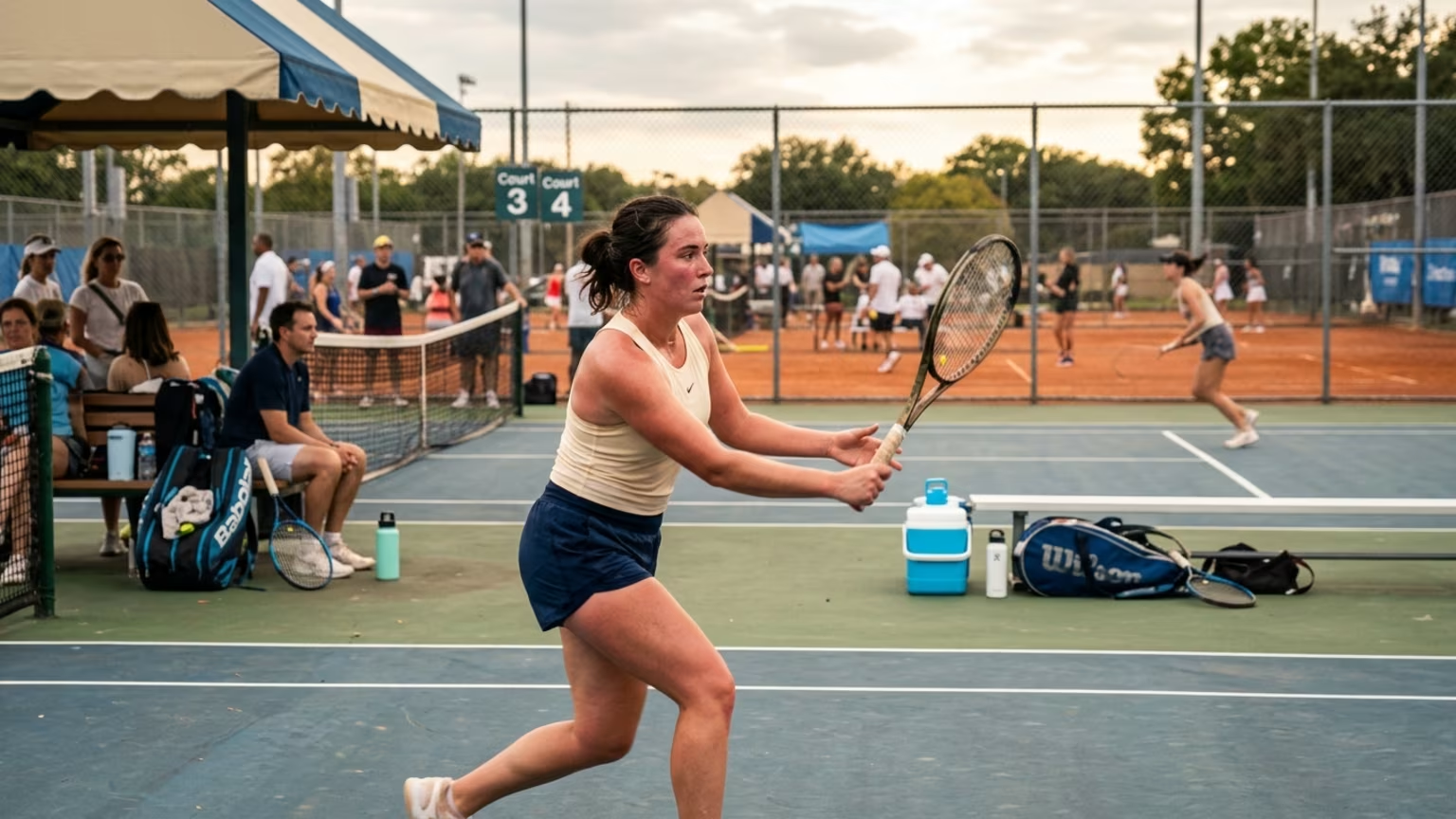

Learn how to manage your tennis, pickleball, or padel tournament workload to avoid physical burnout and prevent overuse injuries as an adult competitive player.




Entering a tournament is often the fastest way to derail your athletic progress. Most players treat competition as the reward for hard practice and dedicated training. In reality, poorly managed event schedules build up silent fatigue that eventually breaks down your body. Competitive adult players typically love the thrill of a match, but they often struggle to balance intensity with recovery. The desire to test new skills can easily lead to a crammed weekend schedule that ignores physical limits. By understanding how tournament formats impact your body, you can compete fiercely while protecting your joints.
"How do I play a full competitive calendar without breaking down from overuse injuries?" You must budget your weekly court hours and match formats like a financial expense, recognizing that not all tournaments demand the same physical toll.
This requires looking at total weekly exposure rather than just the weekend itself. Players often view their tournament days as completely separate from their normal practice routine. A 2026 peer-reviewed study of 383 recreational pickleball players in South Korea shows why this separation is flawed. The participants had a mean age of 47.0 years and played an average of 9.04 hours per week.
The researchers found that 38.1% of these participants reported at least one pickleball-related injury during the previous 12 months. When looking at injuries with available onset data, 52.1% were classified as overuse and 47.9% were traumatic. More importantly, the study found that greater weekly playing time was associated with higher odds of injury. The data showed an odds ratio of 1.06 for each additional weekly playing hour.
These findings suggest that a weekend tournament simply adds to your cumulative weekly stress. If you already practice for six hours during the week, a two-day event could easily push your total volume into a risky zone. Players should plan their competitive schedule with recovery buffers before and after heavy match weekends. Reducing your normal training hours in the days leading up to an event is a very practical safeguard.
You must also monitor your body using a practical traffic-light system. Green indicates normal movement and sleep. Amber signals unusual stiffness or soreness lasting into the next day. Red warrants immediate medical advice for acute pain or swelling.
Many competitive players habitually ignore these amber signals during a busy tournament season. They push through minor stiffness, assuming it is just a normal part of getting older. This mindset transforms a manageable fatigue issue into a severe overuse injury. Respecting your recovery buffers is the only reliable way to maintain your tournament availability year after year.
Your choice of format dictates your baseline physical commitment before you even step onto the court. An elimination draw means your weekend could end after one quick match. A round robin structure guarantees multiple matches regardless of whether you win or lose. Understanding these different tournament formats helps you accurately forecast your energy expenditure.
A 32-player single elimination bracket is highly unpredictable for load management. You might play five full matches to win the title, or you might pack up your gear after an hour. A round robin requires repeated efforts across consecutive days for every single participant. The total workload depends heavily on the scoring format and the rest periods provided between rounds.
Adult players should create a workload card before registering for any event. This card should list the draw size, the minimum match guarantee, the scoring format, and the potential maximum matches required. Evaluating these details allows you to choose appropriate competition events without accidentally overcommitting your physical resources. You can select one-day events for routine play and save multi-day brackets for specific goals.
Travel burdens further complicate the physical demands of any tournament structure. Distance matters greatly, but poor sleep and unfamiliar surfaces also drain your energy. A nearby round robin with poor scheduling might be more exhausting than a distant elimination event with direct travel and adequate rest days. Time zone changes and late arrivals disrupt your natural recovery rhythms.
Renting cars, eating unfamiliar food, and waiting around crowded venues all contribute to systemic fatigue. When planning your calendar, reserve long-distance travel for events that offer something genuinely distinctive. Local one-day events are much better suited for maintaining your weekly competitive rhythm without adding travel stress.
The specific physical demands vary substantially between tennis, pickleball, and padel. The Korean pickleball study highlighted that lower-extremity injuries accounted for 44.0% of valid body-part responses. Upper-extremity injuries accounted for 39.8%, with the knee representing 21.4% and the ankle or foot representing 15.8%. These statistics emphasize the unique stop-and-start forces present on a small court.
Tennis often involves longer rallies on larger courts, creating different endurance requirements and shoulder stresses. Padel requires frequent changes of direction while interacting with walls, adding unique rotational loads to the lower back and knees. While all three sports require careful load management, your tournament calendar should reflect the specific movement patterns of your game. The participants in the pickleball study had an average of 18.3 months of playing experience, highlighting that injuries affect both newcomers and veterans.
Racquet sports generally offer excellent benefits for athletic longevity when played sensibly. A Danish observational study followed 8,577 residents aged 20 to 93 from 1991 to 2017. The researchers found that regular tennis players lived almost 10 years longer than their sedentary counterparts. A separate 2018 study reported that participation in racquet sports was associated with a 47% decrease in all-cause mortality and a 59% reduction in cardiovascular-disease mortality.
However, these impressive longevity findings are observational associations rather than absolute guarantees. The Danish study did not examine newer racquet sports such as pickleball or padel. It is essential to pace your tournament entries to maintain your physical health over the long term. Consistent, moderate participation yields the best results for a lifetime on the courts.
Registering for both singles and doubles in the same event drastically increases your court time. Many players mistakenly view doubles as a light activity that does not require significant recovery. Doubles matches still require explosive acceleration, sudden deceleration, repeated serving, and intense mental concentration. Combining both formats can easily double your daily match count and exhaust your legs.
You should decide in advance whether the doubles draw is your primary focus or a supplementary activity. If singles is your priority for the weekend, limit your doubles participation during demanding tournaments. Splitting your focus often leads to fatigue, mechanical breakdown, and poor performance in both brackets. A sustainable schedule requires honest prioritization of your physical resources to prevent long-term overuse issues.
If you decide to play both formats, you must communicate openly with your doubles partner about your workload. A deep run in the singles draw might force you to dial back your intensity during the doubles matches. Adult players cannot expect to perform at maximum capacity across six matches in a single weekend. Treating doubles as a real physical load is essential for protecting your shoulders and knees.
The most successful competitive calendar is one that allows you to play consistently without breaking down. By treating every match as a calculated investment in your overall health, you can enjoy racquet sports for decades to come.
Follow Evercourts for practical insights on tennis, pickleball and padel performance, movement, recovery and healthy ageing. Stay connected for new articles, research-led guidance and ideas to help you play well and keep playing for years.


Holger Rune withdrew from the European Open with a back problem. The facts behind his decision and a grounded perspective for recreational players.

The Dink’s October 17 guide emphasizes deep returns, ball-height decisions and positioning against faster pickleball opponents.

A new report outlines padel and tennis gear trends. Learn how to assess adjustable rackets, sensor feedback and smart-court claims.
Read practical guidance for better movement, smarter preparation and a game that keeps working for you.
explore the Blog
