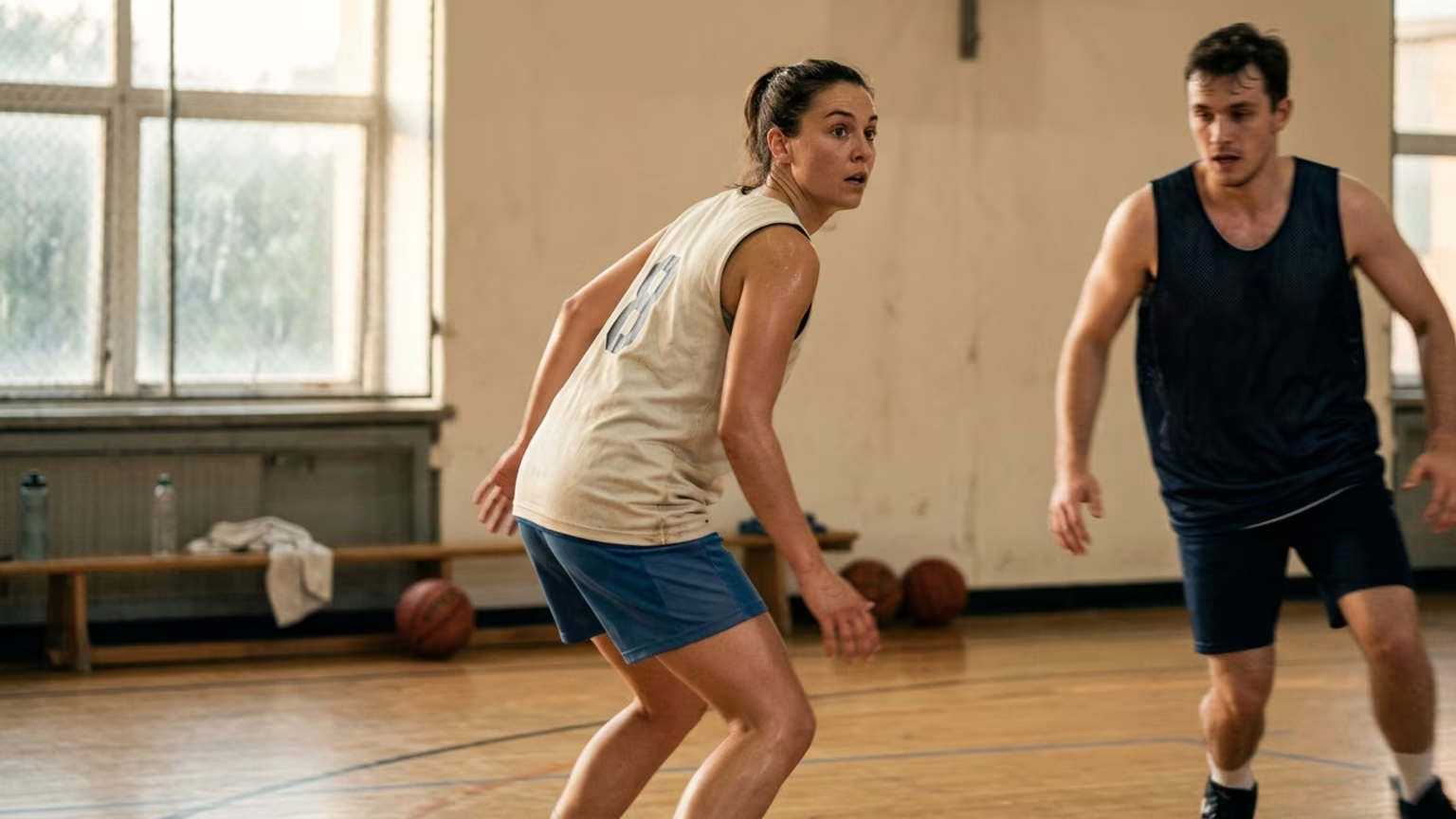

Learn why reaction time in tennis, pickleball, and padel relies on early preparation. Discover practical drills to improve anticipation and athletic longevity.




Fast hands are not the secret to fast reactions. The players who seem to have lightning reflexes are simply starting their movement early.
Many players believe that reaction time is a fixed physical trait that degrades as we get older. We see endless advertisements for flashing light boards and apps designed to test raw reflexes. Social media algorithms reward videos of athletes catching falling tennis balls or tapping unpredictable targets on a wall. The marketing suggests that adult recreational players can train their nervous systems to fire faster through these isolated games.
Unfortunately, this approach misinterprets how the human body works in a competitive sporting environment. The reality on the court is entirely different. Hitting a tennis ball or defending a padel smash requires more than a simple twitch response to a random light. Players must perceive a complex physical environment, interpret the information, and organize their feet.
Chasing an abstract laboratory reaction score will not help you return a heavy serve. Real speed comes from recognizing patterns and arriving in the right position before the ball gets there. Adults looking to improve their game should focus on practical anticipation. We can learn to read the court, understand our opponent, and choose our response before contact is even made.
This pragmatic approach respects the intelligence of the player and directly translates to better match performance. By shifting our focus away from fitness fads, we can build habits that genuinely support healthy aging. Understanding the underlying science of vision and movement provides a clear roadmap for lasting improvement. Let us look at what the research actually says about speed.
The physics of racquet sports demand early recognition. A recent tennis report notes that a receiver facing a serve above 230 km/h may have less than 0.2 seconds from racket contact to the start of the return movement. You cannot rely on raw hand speed to manage that timeline. If you wait until the ball crosses the net to decide on your stroke, you are already completely out of position.
Human vision requires time to capture and process movement. One report estimates that visual processing takes approximately one-tenth of a second, during which a rapidly traveling ball can cover several metres. This processing delay explains why waiting to see the complete flight path of the ball is a failing strategy. By the time your brain registers the speed and spin, the ball has already bounced.
Expert performers have learned to extract useful information long before contact. A recent eye-tracking report on table tennis found that professional players used a more centralized, predictive gaze strategy, focusing on likely information zones rather than continuously following the ball. They watch the shoulder rotation, racket angle and weight transfer of their opponent. While table tennis differs from court sports, the underlying principle of anticipation applies perfectly to tennis and padel. Elite athletes do not just react faster. They simply gather better data from the environment before the ball is even struck.
Some players try to shortcut this process by using new visual training technology. One included study reported a 147-millisecond improvement in on-court response time after VR gaze training, but that result came from a single study and should not be treated as a general guarantee. A separate review of stroboscopic visual training reported improvements across 14 studies involving 542 athletes, but the source presents this as a synthesis of heterogeneous protocols rather than proof that stroboscopic equipment is necessary for ordinary players.
At evercourts, we believe that players improve faster when they understand the mechanics of the game. Relying on sheer athleticism is a strategy that inevitably fails as we get older. By replacing frantic movement with calculated anticipation, we can protect our joints and maintain our competitive edge. The science clearly shows that perception and preparation are the true drivers of court speed.
Anticipation only matters if your body is prepared to move efficiently. I remember finishing a tough two hour padel match on a cold Tuesday night and waking up the next morning feeling like my lower back was locked in concrete. For a long time, I just accepted this as the price of playing hard in my forties. But once I started spending just ten minutes on targeted hip mobility before heading to the club, the stiffness almost completely vanished.
It taught me that we do not have to accept pain as a default state of aging. Maintaining basic mobility allows us to adopt the low, athletic ready positions required for quick reactions. You cannot execute a rapid directional change if your hips and knees are locked in a rigid, upright stance. A proper physical foundation is crucial for any player pursuing athletic longevity on the court.
The health benefits of maintaining this physical capacity are well documented. A separate report on racquet sports cited observational evidence linking tennis and other racquet-sport participation with lower mortality, including a 59% lower cardiovascular-disease mortality rate and 47% lower all-cause mortality rate in one 2018 study. Staying healthy enough to keep moving well is the ultimate goal.
Players should structure their training around a simple sequence. They need to perceive early, choose a response, and prepare their feet. The split step is the mechanical bridge between seeing the visual cue and moving to the ball. Pickleball coach Michael Loyd describes the split step as a ready hop that occurs just as the opponent makes contact.
Weight should remain on the balls of the feet to facilitate a rapid first step in any direction. Tennis players can practice this with a serve-return callout drill. A server hits from a controlled position while the returner watches the toss and shoulder alignment. Before contact, the returner must call out wide, body, or the center T to predict the location.
The returner executes a split step and moves in the predicted direction. This effectively trains reaction and anticipation using realistic court cues. Another valuable tennis exercise involves using freeze-frame video. Watch recorded match footage and pause the video immediately before racket contact.
Try to predict the depth, direction, and spin of the shot based purely on the body mechanics of the hitter. This method develops cue recognition without the physical fatigue of a live practice session. Another effective tennis drill focuses entirely on the split step and first movement. A partner feeds balls alternately to the forehand, backhand, and body without giving any verbal direction.
The player begins in a ready position and executes a split step exactly as the feeder contacts the ball. The goal is to focus entirely on the first movement, such as an outside-leg push or crossover step. This drill is not about achieving maximum speed on every single repetition. It is designed to synchronize the split step with contact and avoid wasted false steps.
Making the first movement in the correct direction is far more valuable than rushing blindly toward the net. Practicing these precise movements helps players get faster without hurrying their technique. Pickleball requires rapid decision-making at the non-volley zone line. During a dink drill, the feeder varies the height and pace of the incoming ball.
The defending player must call out reset, neutral, or attack before making contact with the paddle. This verbal constraint forces the player to evaluate the ball early and select the appropriate tactical response. Coach Loyd also recommends a micro-step-only rally for pickleball players. During a short rally, neither player is allowed to take a step longer than a shoe length.
This specific movement constraint forces players to stay balanced and make small adjustments instead of lunging late. It is a fantastic way to train the first step and build a stable defensive foundation. Padel players must anticipate both the opponent and the complex rebounds off the surrounding walls. Play a controlled point where the receiver watches the opponent prepare until contact, deliberately ignoring the incoming ball for a split second.
The player then shifts their attention to the flight of the ball and the expected glass rebound. This specific drill teaches the brain to prioritize early visual cues over late ball tracking. Padel anticipation can also be developed through a logical progression. Start by reading the height and speed of the backswing.
Next, analyze the stance and weight transfer of the opponent. Finally, practice reading the bounce off the glass to determine if the ball will rebound sharply or die in the corner. Players who master this sequence will consistently arrive at the ball with time to spare. From the appropriate defensive position, a padel player should use a small split step just before the opponent strikes.
After landing, the player takes their first movement toward the expected rebound trajectory. The player must avoid freezing after the split step, using the balanced platform to push, pivot, or retreat smoothly. This creates a rhythm of continuous, balanced movement rather than isolated sprints.
True speed on the court is simply the result of paying attention to the right details slightly earlier than everyone else.
Follow Evercourts for practical insights on tennis, pickleball and padel performance, movement, recovery and healthy ageing. Stay connected for new articles, research-led guidance and ideas to help you play well and keep playing for years.


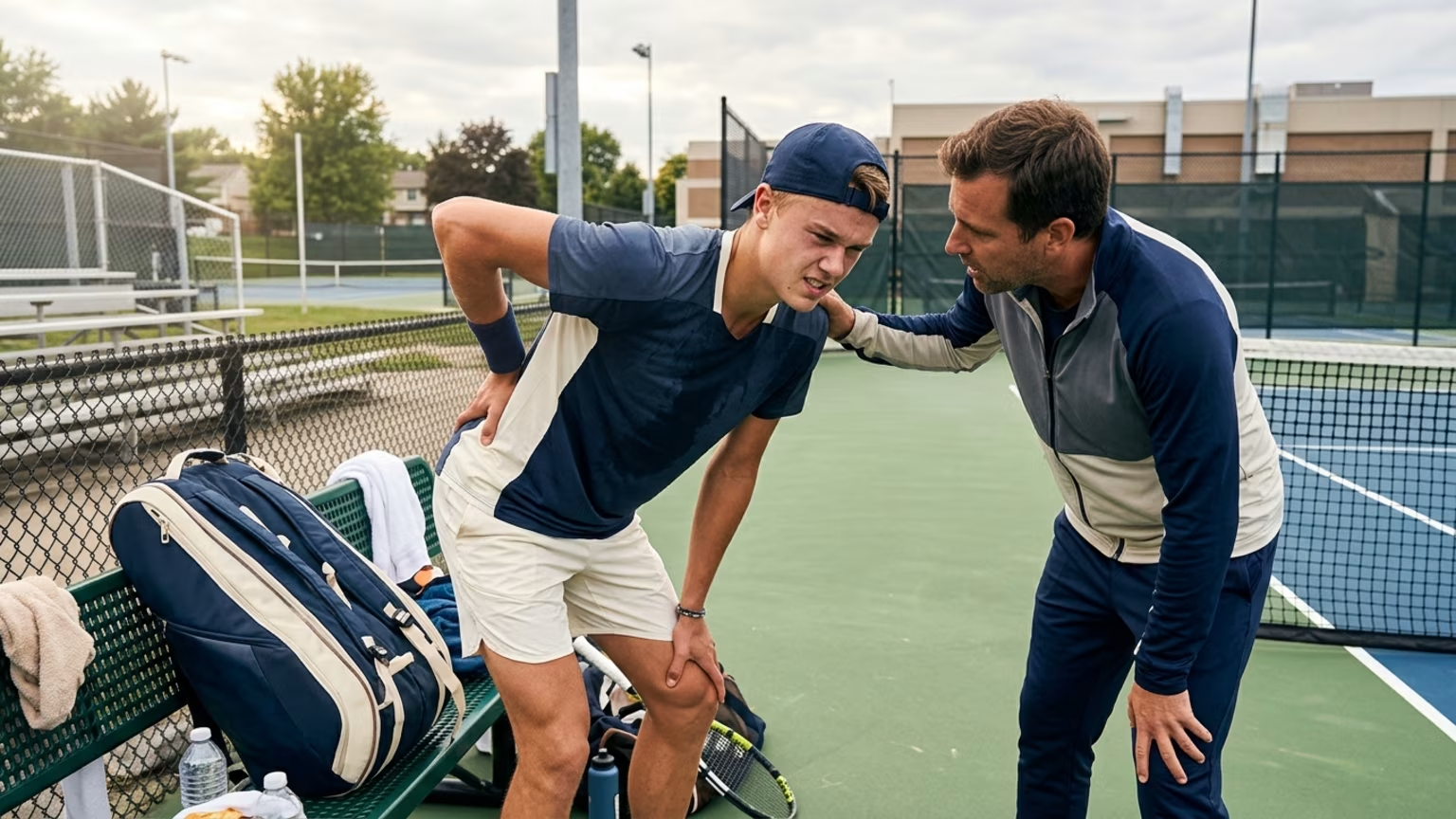
Holger Rune withdrew from the European Open with a back problem. The facts behind his decision and a grounded perspective for recreational players.

The Dink’s October 17 guide emphasizes deep returns, ball-height decisions and positioning against faster pickleball opponents.

A new report outlines padel and tennis gear trends. Learn how to assess adjustable rackets, sensor feedback and smart-court claims.
Read practical guidance for better movement, smarter preparation and a game that keeps working for you.
explore the Blog
