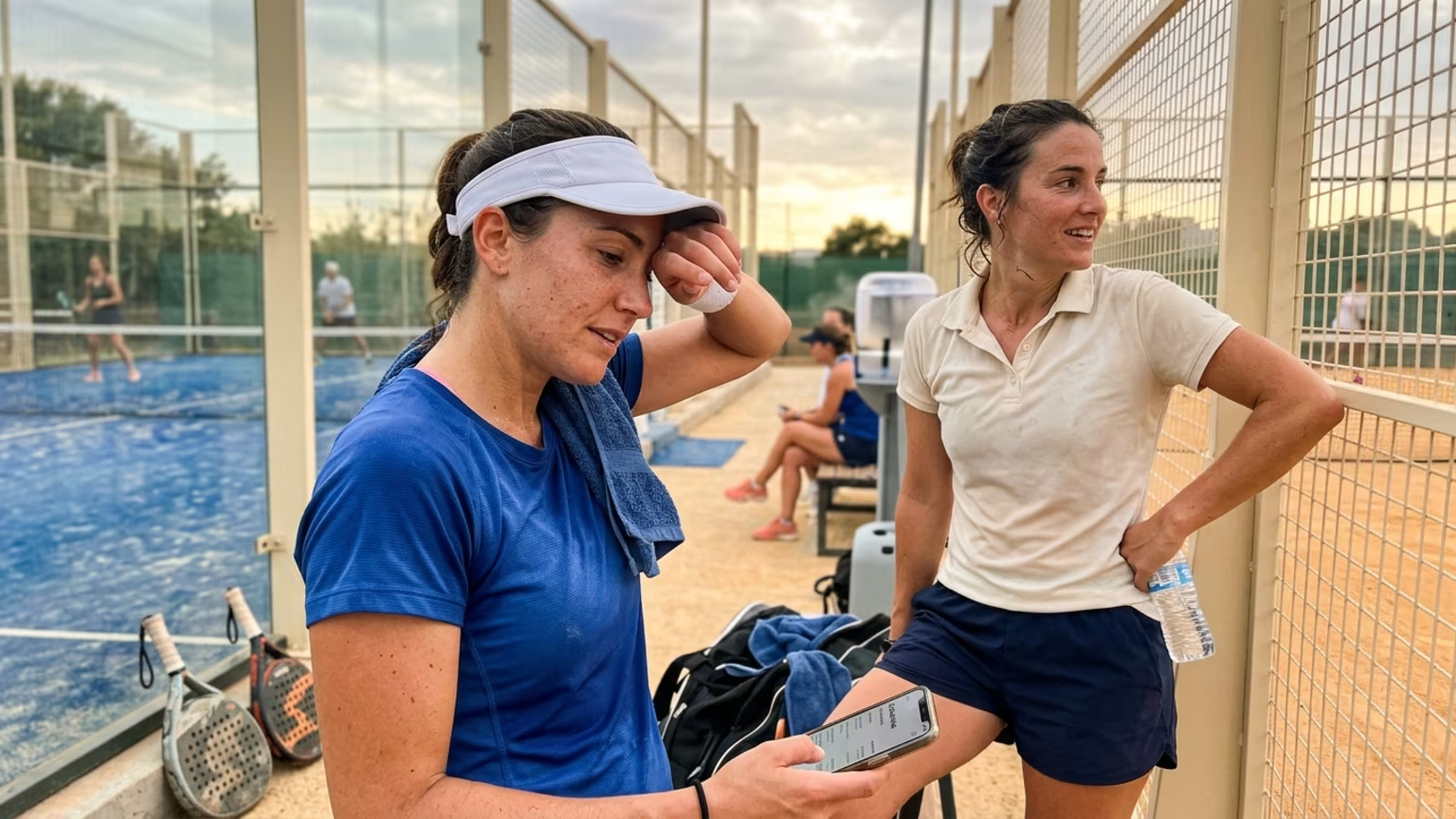

The International Padel Federation's 2026 Mediterranean Games schedule features structured recovery windows for padel athletes competing in multiple draws.




On August 19, the International Padel Federation published a schedule revealing that 88 athletes from 18 countries will compete at the 2026 Mediterranean Games. This marks a critical moment for the sport as it enters a major multisport competition. The event takes place in Taranto from August 22 to August 28. Padel will make its first appearance as a medal sport during this specific competition.
The federation schedule explicitly highlights the physical toll of modern tournament play. Familiarity with the official FIP dimensions and rules helps players appreciate the precise geometry that dictates these physical demands. The format includes men’s doubles, women’s doubles, and mixed doubles. A separate FIP preview breaks the field down into 49 men and 39 women. There are 17 countries represented in the men’s draw, 14 in the women’s draw, and 12 in the mixed draw.
The published schedule structures play across a full week at Parco Mediterraneo Salinella. Draws take place on Friday, August 21, based on the FIP Ranking. Men’s and women’s first-round matches are scheduled for Saturday, August 22. The mixed event begins on Sunday, August 23.
Action then progresses to quarter-finals on August 25 and 26. Semi-finals are set for August 27. The tournament concludes with bronze-medal matches and finals on Friday, August 28. The International Padel Federation has officially branded this final day as "Super Friday."
Athletes competing in a gendered draw and the mixed draw will receive adequate time between matches. This formal emphasis on built-in rest is a significant policy choice. The federation wants to permit meaningful physical recovery for athletes managing overlapping schedules. The published program does not provide a precise minimum number of hours for every match combination.
Instead, the schedule uses staggered competition rather than placing every draw on the same day. This structure creates clear opportunities for rest throughout the week. The amount of recovery available to an individual athlete will still depend on their specific draw position. Match duration and doubles participation will also influence the total physical load.
Elite players benefit from organizers building rest into the official competition program. Adult recreational players must take full responsibility for their own physical pacing. A simple rule is to avoid stacking your hardest sessions on consecutive days. If you play a demanding match, you should not schedule an intense practice block immediately afterward.
I used to think a tough conditioning block was the only way to improve my court endurance before I started tracking my sleep. I noticed that on days I slept less than six hours, my reaction time at the net was noticeably sluggish, and I felt gassed by the second set. Prioritizing consistent rest did more for my late match stamina than any extra sprints ever did. Recovery is the true foundation of performance.
Understanding how to approach seasonal recovery planning requires separating match intensity from technical practice. A lighter technical session or basic mobility work is often more appropriate after heavy competition. You must plan around your whole workload. That means counting matches, strength training, heat exposure, and travel alongside court time.
Age is a reason for better planning rather than complete physical withdrawal. The most practical approach is to progress gradually after time away from the court. You should increase match volume progressively rather than trying to reproduce a previous peak workload. Multi-draw players should specifically request schedule spacing that avoids unnecessary back-to-back matches.
Basic recovery supports like sleep and hydration are essential for everyday play. However, these basic habits cannot compensate for a schedule that repeatedly exceeds your current physical capacity. Persistent pain or unusual fatigue should always prompt a reduction in load. Following these principles helps players model the FIP approach to athletic sustainability.
Workload management is an increasing priority across all modern racquet sports. The Professional Tennis Players Association told Reuters that shrinking recovery time was contributing to injury concerns in professional tennis. The organization reported a 42% increase in upper-body injuries in the first quarter of 2026 compared with the same period in 2025. They also cited a 112% increase in arm injuries compared with the 2025 average.
These statistics highlight the physical consequences of inadequate rest between heavy efforts. Tracking physical strain through an acute-to-chronic workload ratio is one way to monitor risk. A 2026 review in Frontiers in Public Health found a small-to-moderate association between an elevated ratio and injury risk. The effect size was g = 0.35 with a 95% confidence interval of 0.16 to 0.54.
However, the same review cautioned that this metric should not be used as a stand-alone injury predictor. The researchers found substantial heterogeneity across the studies, noting a variance of 95.8%. A simple numerical ratio cannot fully capture sleep quality, previous injuries, or high heat exposure. Players must still use symptom monitoring and professional coaching advice to stay healthy.
Focusing on the broad recovery demands in tennis, pickleball, and padel provides a healthier perspective on aging. A 2018 observational study summarized by Women’s Health associated racquet-sport participation with lower all-cause and cardiovascular mortality. Research coverage from ScienceDaily reported that lifelong physical activity was associated with healthier muscle function and fatigue resistance in adults aged 68 and older. The long-term physical benefits are substantial when players manage their weekly volume effectively.
The Mediterranean Games schedule sets a valuable precedent for multi-event racquet tournaments. We expect to see more federations explicitly write adequate rest into their organizing documents over the next season. Relying on players to handle overlapping draws without built-in recovery windows is no longer a sustainable model. Tournament directors will likely face increasing pressure to adopt staggered start days for singles, doubles, and mixed brackets.
The emphasis on dedicated recovery time will reshape how competitive events are run globally. When the medal matches finally conclude in Taranto on August 28, the biggest success might just be the health of the 88 athletes. Returning to those opening draw statistics, maintaining a healthy field across a seven-day tournament is a massive logistical victory. Prioritizing rest proves that physical longevity is the ultimate metric for competitive success.
Follow Evercourts for practical insights on tennis, pickleball and padel performance, movement, recovery and healthy ageing. Stay connected for new articles, research-led guidance and ideas to help you play well and keep playing for years.


Holger Rune withdrew from the European Open with a back problem. The facts behind his decision and a grounded perspective for recreational players.

The Dink’s October 17 guide emphasizes deep returns, ball-height decisions and positioning against faster pickleball opponents.

A new report outlines padel and tennis gear trends. Learn how to assess adjustable rackets, sensor feedback and smart-court claims.
Read practical guidance for better movement, smarter preparation and a game that keeps working for you.
explore the Blog
