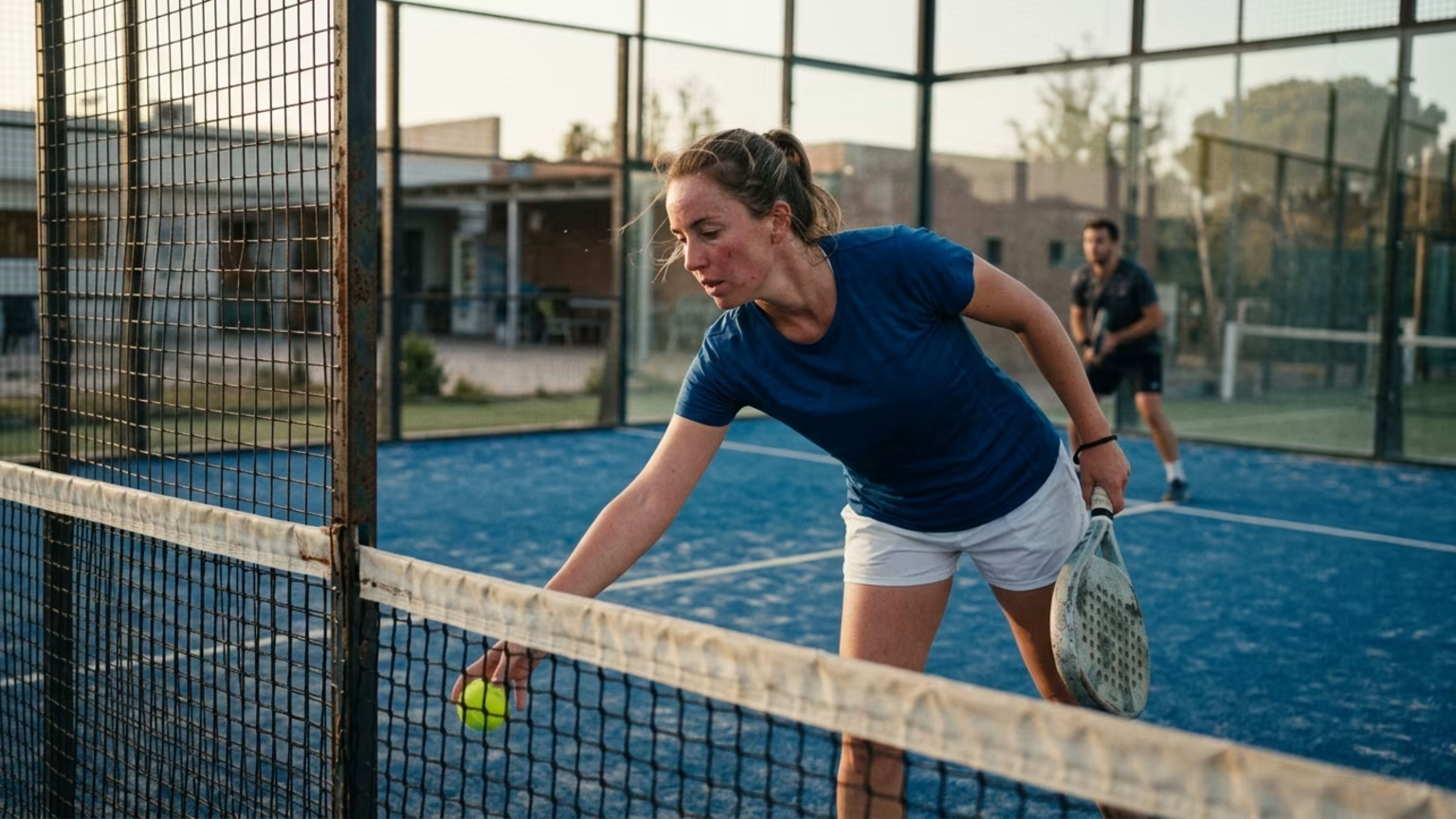

Explore official FIP padel court standards, including exact floor dimensions, net heights, and enclosure specifications for healthy aging and athletic longevity.




The foundation of any sanctioned competition rests on strict measurements for the floor space. According to the International Padel Federation (FIP), the standard court provides a fixed environment for players. A standard doubles padel court is an enclosed rectangle measuring 20 metres long by 10 metres wide using internal playing dimensions. This geometric layout gives each half of the court a reliable 10-by-10-metre playing area. The sport relies entirely on these exact boundaries to maintain consistent tactical strategies.
Within this space, the service lines define the parameters for starting a point. The service lines are positioned 6.95 metres from the net on each side of the court. Small inaccuracies in service-line placement can drastically alter the legal serving area even if the footprint looks correct. The court lines are 5 centimetres wide under the 2026 rules summary reported by WePadel. Venue operators must mark these lines consistently to ensure fair competitive play.
The net itself serves as the central dividing barrier across the entire playing surface. The net is 10 metres long and divides the court across its full width. Its height sits specifically at 0.88 metres at the centre. It then rises gradually to reach 0.92 metres at the ends or posts. The maximum height at the ends should not exceed 0.92 metres according to the current construction summary.
The variation in net height directly influences how players construct offensive strategies. Because the net dips to 0.88 metres at the centre, players naturally funnel aggressive attacks down the middle. Conversely, hitting toward the edges requires clearing the taller 0.92-metre barrier. This subtle architectural feature rewards precision over sheer power.
The International Padel Federation publishes these regulations to ensure absolute consistency worldwide. The current operational material is based on rules effective January 1, 2026. This follows amendments approved by the FIP General Assembly in Acapulco on November 28, 2025. Consistency across these horizontal measurements helps players build reliable muscle memory and reduces the risk of missteps.
While the floor defines the running area, the vertical enclosure completely changes how players construct points. Padel depends heavily on this vertical environment for its unique tactical identity. Because the enclosure is part of the playing area, a ball may remain in play after bouncing in the opponent's court and rebounding from a wall or fence. This requires players to constantly calculate angles and spatial depth.
The physical enclosure literally shapes the rulebook and daily match tactics. If a ball hits the opponent's wall or fence before bouncing in the opponent's court, the striking player loses the point. A point is also lost when the ball bounces twice in a player's half or when a player touches the net. Furthermore, a ball that escapes through a hole in the fence counts as an outright winning shot.
The back walls provide the most consistent rebound surfaces on the court. Current summaries specify the back walls as having 3 metres of solid rebound wall. This is topped by 1 additional metre of metallic mesh. This construction creates a structured 4 metres total height across the back of the facility. Players must understand this exact ratio to judge when a high ball might strike the unpredictable metallic mesh.
Side-wall construction can vary significantly depending on the specific court design and facility layout. A commonly described side-wall layout uses a taller solid section near the back of the court and lower wall sections as the enclosure approaches the net. The available summaries note that the solid lower sections frequently use glass. The upper sections rely on steel or metallic mesh to safely contain the ball during aggressive rallies.
Overhead clearance is another critical element of the vertical playing environment. The minimum clear height above the playing area is reported as 6 metres throughout the court. Some construction guidance recommends 8 metres for new facilities. This recommendation is particularly relevant where a venue is intended for high-level or international competition. However, this higher figure should be treated as a recommendation rather than the basic six-metre minimum.
It is important to note that publicly accessible summaries do not verify every single construction detail. The accessible rules summary specifically notes it does not provide specifications for posts, doors, flooring, lighting, or out-of-court play. Exact requirements for glass thickness and mesh aperture require consulting official technical regulations. Players should remain vigilant about loose panels or protruding bolts at local venues.
Different court structures force players to adapt their physical output and conditioning strategies. The multidirectional movement of padel demands constant rotational control as players track fast rebounds off the glass. This physical requirement contrasts sharply with the explosive linear demands of a traditional tennis court. It also differs significantly from the rapid stop-start nature found at the pickleball non-volley zone.
Tennis requires players to cover vast open spaces with sprinting power. Pickleball demands quick reflexes and short lunges near the kitchen line. Padel sits uniquely between them, requiring constant anticipation of the ball's trajectory after a rebound. Recognizing these differences allows players to transition between sports without injury. Proper cross-training between tennis, pickleball, and padel ensures that your joints can handle each unique environment.
I remember finishing a tough two hour padel match on a cold Tuesday night and waking up the next morning feeling like my lower back was locked in concrete. For a long time, I just accepted this as the price of playing hard in my forties. But once I started spending just ten minutes on targeted hip mobility before heading to the club, the stiffness almost completely vanished. It taught me that we do not have to accept pain as a default state of aging.
Because the padel enclosure forces players into deep defensive corners, joint health becomes absolutely vital. Taking a heavy ball off the back glass requires lowering your centre of gravity rapidly and smoothly. Players must navigate these tight spaces without striking the metallic mesh or tripping near the glass panels. Building multi-planar movement for tennis, pickleball, and padel helps prepare the body for these structural demands.
FIP's expanding competitive calendar highlights the global relevance of adapting to these standardized courts. The organization has announced that it became a signatory to the World Anti-Doping Agency framework in July 2026. This move reflects the sport's expanding formal governance structure. FIP's 2026 calendar includes events across multiple international markets like London and Indonesia. Moving safely across these identical courts is essential for proper court positioning in tennis, pickleball, and padel.
When comparing the physical impact of the horizontal playing surface against the vertical enclosure, understanding the enclosure is the definitive winner for healthy aging. The fixed dimensions of the floor provide a very reliable baseline for cardiovascular conditioning and footwork drills. However, it is the interaction with the walls that poses the greatest physical challenge to recreational players. Mastering the spatial limits of the court prevents rushed movements.
Navigating wall rebounds requires rapid changes in direction and sustained deep defensive postures. Players who respect the four-metre back walls and six-metre overhead clearance are far less likely to suffer traumatic joint impacts. They learn to let the ball travel to the glass rather than forcing awkward volleys in the middle of the court. This learned patience naturally reduces the heavy strain on knees, ankles, and lower backs over time.
As padel continues to grow, evercourts encourages players to observe their physical environment closely before starting a match. Checking the minimum clear height and the stability of the metallic mesh allows for much safer movement. Practicing good lower-body strength for tennis, pickleball, and padel will ensure your legs can handle the deep corner defensive work. A predictable and safe court environment supports the long-term mission of staying active and capable.
The true value of official court specifications is not found in strict regulatory perfection. The quiet comfort of stepping onto a familiar court allows the mind to finally settle.
Follow Evercourts for practical insights on tennis, pickleball and padel performance, movement, recovery and healthy ageing. Stay connected for new articles, research-led guidance and ideas to help you play well and keep playing for years.


A recent live-play test of a silent pickleball highlights its value for practice, but standard balls still perform better for match play and power control.

An evidence check on sports supplements like tart cherry juice. Learn why racquet sports players should prioritize core nutrition over functional foods.

In late 2026, Oura analyzed wearable data to see how recreational tennis impacts heart health and recovery. Learn what this means for your athletic longevity.
Read practical guidance for better movement, smarter preparation and a game that keeps working for you.
explore the Blog
