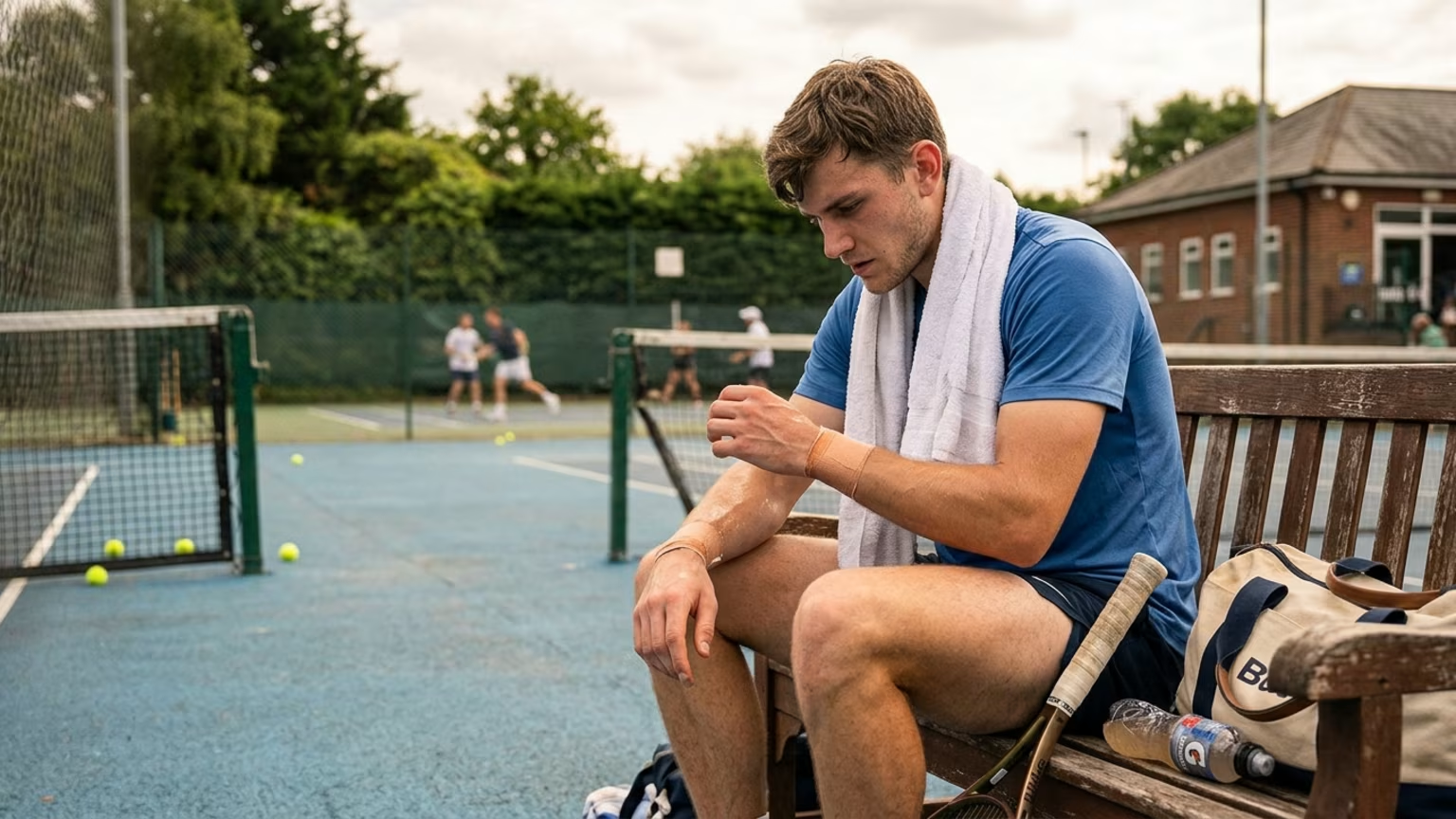

Jack Draper will miss the 2026 US Open due to a bone bruise in his arm. Learn how adult racquet sports players can safely manage lingering arm pain.




The US Open main draw moves forward in August 2026 without Jack Draper. The 24-year-old player is missing the tournament while he continues to recover from a bone bruise in his dominant left arm, having recently broken down in tears during a match in Canada. When a professional athlete steps away due to ongoing discomfort, club players frequently ask us one exact question: does recurring arm pain require complete rest or just a simple equipment change? Persistent arm pain that alters your stroke mechanics requires a structured reduction in workload and an individualized physical assessment.
The ability to finish a tennis match does not prove that your body is ready for a full competitive workload. The recent coverage of Jack Draper provides a clear example of this reality. ESPN reported that Draper returned to competition in Canada earlier in August 2026 but broke down in tears during the third set of a loss to France’s Terence Atmane. He then lost the final five games of his Cincinnati match against Spain’s Martin Landaluce the following week, proving he was not yet healthy enough to tolerate the strain.
Adult recreational players often fall into a similar trap of using match completion as a health diagnostic. If you can physically hold a racket and swing, you might incorrectly assume the pain is just normal soreness. However, a new or recurring ache that repeatedly flares up during high-load strokes requires a much more careful approach. General rehabilitation guidance cited in the recent coverage favors individualized progression and follow-up when pain persists.
You must honestly assess how your arm responds the day after a match. When symptoms interfere with normal movement, repeatedly testing the injury on the court delays proper recovery. You might adjust your swing to protect a sore elbow, which can then shift excess stress to your shoulder or wrist. This is why distinguishing normal recovery from real injuries is a fundamental skill for players who want to enjoy athletic longevity.
A structured reduction in intensity is often necessary to stop the cycle of recurring discomfort. The culture of racquet sports often glorifies players who battle through extreme physical adversity. However, professional athletes operate with dedicated medical teams, immense financial incentives, and completely different risk profiles. You must base your return to play on clinical milestones rather than sheer willpower.
Equipment adjustments are frequently the first solution players try when arm pain begins. Draper attempted several equipment and technique changes to address his persistent left arm issues. ESPN reported that he changed his racket and strings and modified his service motion, but those adjustments had not removed the pain. Changing your gear might alter the vibration and feedback of the racket, but it will not automatically heal underlying bone bruising.
Speaking to The Guardian after his Cincinnati match, Draper described the injury as an incredibly difficult problem to solve. He explained that simply taking time off or changing his service motion did not provide a complete cure. His experience highlights that equipment changes alone cannot replace a comprehensive, medically guided recovery plan. Racket weight, balance, string type, and string tension are certainly worth reviewing with a qualified technician.
Some players spend hundreds of dollars swapping out premium rackets in search of a magic fix for elbow or shoulder pain. While using a highly rigid frame can certainly contribute to arm fatigue, the equipment is rarely the sole culprit. A stiff racket might expose a biomechanical flaw, but it does not independently cause bone bruising in a healthy, well-conditioned athlete. Address your physical capacity first, and treat your racket as a supplementary tool.
Those gear modifications must always be paired with close attention to your overall workload and physical conditioning. Adult players should view equipment changes as one small part of a broader, holistic troubleshooting process. If your stroke mechanics are altered because you are in pain, changing your strings will not fix the mechanical flaw. Restoring proper movement quality is the priority before you attempt to transition from first soreness to safe adjustment on the court.
A lingering injury does not necessarily end your playing days, but it does require strict workload management. The tennis calendar is highly demanding, and cumulative strain can quickly derail a season. The withdrawal means Draper will not have played a Grand Slam tournament during the 2026 season. His year had already been disrupted by a knee problem that forced him out of the French Open, while renewed arm pain led him to miss Wimbledon.
These cascading physical issues are common when athletes rush back into extreme competition before fully healing. ESPN reported that Draper’s ranking had fallen to No. 143 by August 2026, meaning he would have needed to enter US Open qualifying rather than the main draw. Jannik Sinner also withdrew from the 2026 US Open due to a knee injury, according to recent coverage. Emma Raducanu was similarly reported among the British players sitting out the tournament because of injury.
The physical demands on your arm will vary significantly depending on your specific racquet sport. Tennis players generate massive force during the service motion, which places intense stress on the humerus and shoulder joint. Padel players execute frequent overheads, which demand excellent shoulder mobility but generally involve slightly less peak force than a flat tennis serve. Pickleball players face lower overhead impact, but they still experience repetitive strain on the elbow and wrist during fast baseline exchanges.
Managing these different sport-specific demands requires a mature, patient approach to your weekly schedule. If you play tennis on Monday, shifting to pickleball on Tuesday does not mean your arm is resting. The accumulated stress from gripping, swinging, and decelerating the racket continues to build across all your matches. You must account for your total workload across every court sport you play.
Regardless of the sport you play, treating workload and match day routines with respect is essential. If pain prevents you from generating power with your affected arm, you must pause and reassess. Missing a few weeks of your local league is much better than risking a chronic issue that ruins your entire year. Pushing through severe discomfort rarely leads to long-term success.
Long-term athletic participation requires a mindset shift away from short-term competitive deadlines. Draper’s situation illustrates the absolute danger of using a tournament start date as your primary rehabilitation timeline. ESPN reported that his arm issues forced him away from competition for seven months after Wimbledon in 2025. He only participated in that year’s US Open, where he withdrew before his second-round match.
Our team has experienced this stubborn reality directly on the court. I remember finishing a tough two hour padel match on a cold Tuesday night and waking up the next morning feeling like my lower back was locked in concrete. For a long time, I just accepted this as the price of playing hard in my forties. But once I started spending just ten minutes on targeted hip mobility before heading to the club, the stiffness almost completely vanished.
It taught me that we do not have to accept pain as a default state of aging. Effective recovery means building a plan that prioritizes function over immediate, maximum-intensity court time. You should slowly progress from daily activities to controlled hitting, and finally to more demanding serves and full match play. This step-by-step approach aligns perfectly with learning safe progressions from drill to point.
If your physical progress stalls, returning to a qualified physical therapist is the smartest investment you can make. Patience during the rehabilitation phase is the ultimate performance enhancer for adult players. Rushing back to the court to test your arm might provide a temporary thrill, but it often resets your healing timeline back to zero. You must give your tissues the time they need to adapt, strengthen, and handle force again.
This disciplined approach ensures that when you finally return to the baseline, you can play with total confidence.
Your ability to enjoy tennis, padel, or pickleball for decades depends on listening to your body and respecting the recovery process. By prioritizing completely pain-free mechanics over immediate match results, you can maintain your health and keep thriving on the court.
Stay capable, stay patient, and we will see you on the courts.
Follow Evercourts for practical insights on tennis, pickleball and padel performance, movement, recovery and healthy ageing. Stay connected for new articles, research-led guidance and ideas to help you play well and keep playing for years.


Holger Rune withdrew from the European Open with a back problem. The facts behind his decision and a grounded perspective for recreational players.

The Dink’s October 17 guide emphasizes deep returns, ball-height decisions and positioning against faster pickleball opponents.

A new report outlines padel and tennis gear trends. Learn how to assess adjustable rackets, sensor feedback and smart-court claims.
Read practical guidance for better movement, smarter preparation and a game that keeps working for you.
explore the Blog
