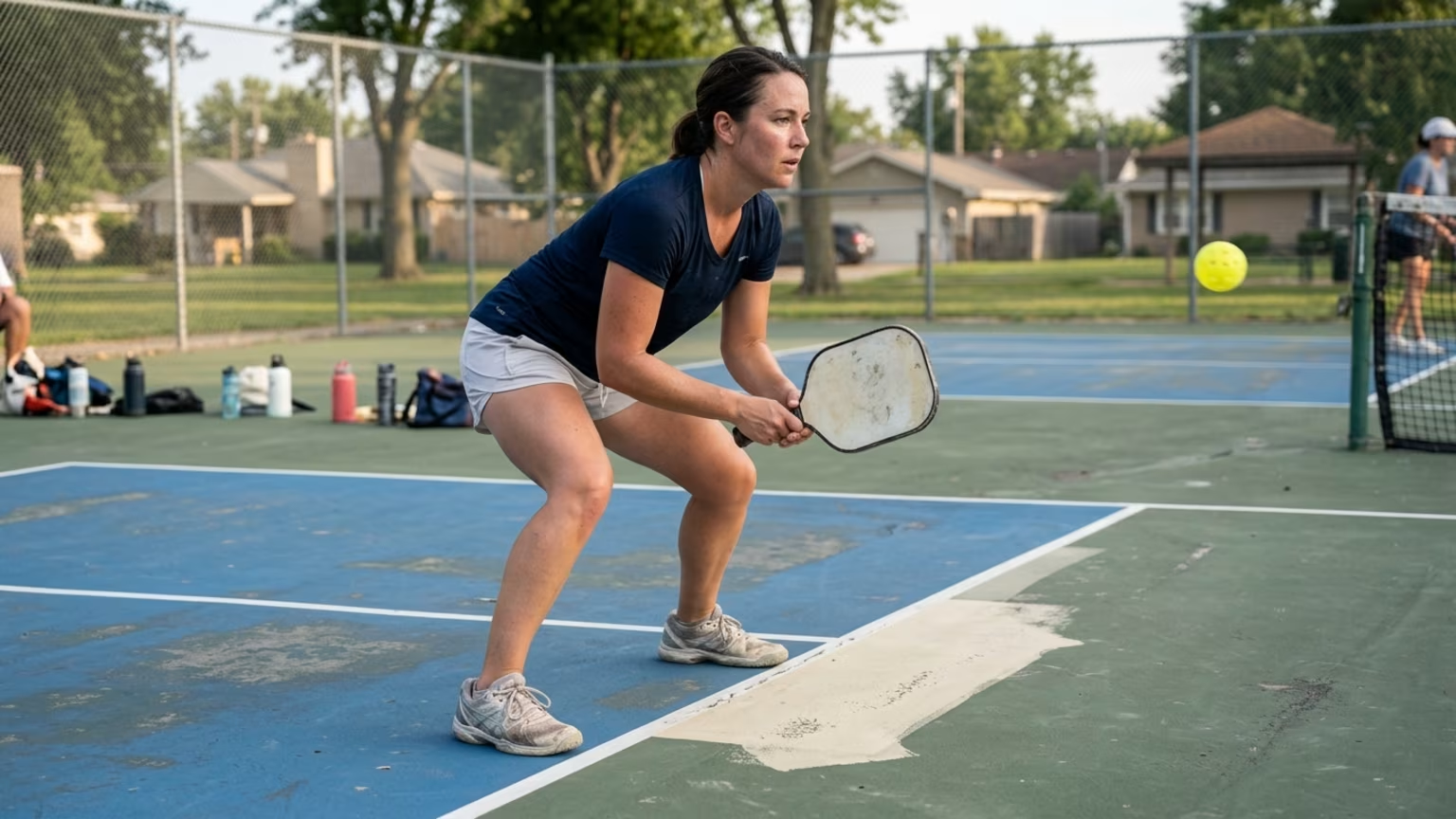

Understand split steps, small adjustments and controlled lunges at the pickleball kitchen line, with partner practice ideas and clear evidence limits.




Kitchen-line footwork is how you position and move your feet to reach a pickleball shot while staying ready for the next one. The central coaching idea is to move toward the ball before stretching for it. In The Dink's footwork guidance, that means repositioning your base of support, the area around and between your feet, rather than leaning away from it.
The movement problem is not simply reaching a ball. It is repeating a quick effort, stopping and becoming ready to respond again. The Dink's coaching coverage addresses that sequence through split steps, short lateral movements and recovery after contact.
For someone who also plays tennis or padel, the useful question is whether repeated explosive efforts and direction changes finish in a position ready for the next shot. That is a way to think about movement demands rather than a reason to copy identical footwork across sports. The specific coaching examples here concern pickleball.
At the kitchen line, The Dink favors shuffling for nearby lateral balls rather than turning and running. Its guidance also puts recovery alongside reaching the shot. Our discussion of balance during movement offers a broader way to think about that distinction.
These sources provide practitioner coaching and a drill description rather than clinical or biomechanical research. They do not establish injury reductions, comparative benefits across sports or long-term health outcomes. They also provide no validated practice dosage or progression, so the practice ideas below should be understood as coaching exercises rather than injury-prevention protocols.
The Dink's movement breakdown recommends a small split step timed with the opponent's contact. The player lands ready to move either way. The emphasis is on resetting for the incoming shot rather than continuing to travel through it.
Its separate footwork article describes a step-based alternative: bring the trailing foot up and regain balance before settling into the ready position. The shared coaching aim is readiness. A visible hop is one version of the reset rather than the only version described by the sources.
The Dink recommends small steps during kitchen-line dinking instead of relying on one large stride. It also describes an open lateral step followed by a closing step. For routine lateral movement, the article cautions against relying on cross-steps.
The practical distinction is between moving your position and merely extending your reach. In the article's coaching explanation, the feet move so the ball comes within the player's base of support. Reaching while leaning away from that base is the pattern it advises against.
That does not make every wide ball comfortably reachable. It gives practice a clear focus: adjusting the feet before asking the rest of the body to stretch farther.
The Dink describes a lunge as a fallback for a ball almost beyond reach. Its sequence begins by lowering the body and stepping with the outside foot. The player then stabilizes and makes contact before shifting weight back to resume the shuffle.
The important editorial distinction is that this is a backup option rather than the default way to cover nearby balls. In the same article, pivot-and-reach movement is also presented as a fallback. Neither replaces the basic coaching preference for moving the feet and recovering afterward.
For adult players, a useful athletic longevity goal is to retain movement options they can perform comfortably. That makes a balanced recovery a worthwhile practice target alongside reaching the ball. The Dink explicitly advises letting a ball go rather than attempting an unfamiliar movement it considers unsafe.
The following partner activities translate the cited coaching cues into practice. The reset-and-shuffle and small-step activities are editorial combinations of those cues. The return-and-approach sequence comes from a published drill description.
At the kitchen line, a partner feeds a ball while the receiving player resets their weight as the shot begins. The player then shuffles toward the ball and recovers to a ready position. This combines The Dink's split-step timing with its short lateral movement guidance.
The useful observation is what happens around contact. Did the player move toward the ball before reaching? After the shot, could they settle into position for another response? Those questions keep the activity focused on the complete movement rather than the contact alone.
A CoachDink drill description uses a partner's serve followed by a deep return and an approach toward the kitchen. The returning player split-steps as the partner hits the third shot.
This gives the reset a place within an actual point sequence. Instead of treating arrival at the kitchen as the only task, the practice includes becoming ready for the next ball. The relevant observation is whether forward movement gives way to a settled response as the partner hits.
For related context, see our discussion of slowing down before the next shot.
A cross-court dink rally can give the players a simple movement focus: use small adjustment steps rather than a single large stride. This applies The Dink's small-step cue without adding a new technical sequence.
The observation is whether the feet reposition before contact or remain planted while the player leans farther away. The practice target is a ball played from a position the player can recover from. A longer rally need not be the only measure of a useful attempt.
These activities fit within the larger question of how much court time feels manageable. Our guide to building playing load thoughtfully addresses that broader planning issue. Here, the priority remains comfortable movement rather than making every feed wider or every recovery more demanding.
Consider an individual assessment if discomfort changes how you step or makes a movement difficult to perform comfortably. Repeated difficulty regaining balance is another reasonable reason to seek qualified guidance rather than keep testing a larger reach.
If a lunge feels unfamiliar or beyond your control, the source-supported choice is to let that ball go. A qualified physio or healthcare provider is the appropriate person to consult when the uncertainty concerns your physical capability or discomfort. You do not need to identify a particular injury yourself before asking for help.
Give your movement the same attention as your shot.
Follow Evercourts for practical insights on tennis, pickleball and padel performance, movement, recovery and healthy ageing. Stay connected for new articles, research-led guidance and ideas to help you play well and keep playing for years.


Holger Rune withdrew from the European Open with a back problem. The facts behind his decision and a grounded perspective for recreational players.

The Dink’s October 17 guide emphasizes deep returns, ball-height decisions and positioning against faster pickleball opponents.

A new report outlines padel and tennis gear trends. Learn how to assess adjustable rackets, sensor feedback and smart-court claims.
Read practical guidance for better movement, smarter preparation and a game that keeps working for you.
explore the Blog
