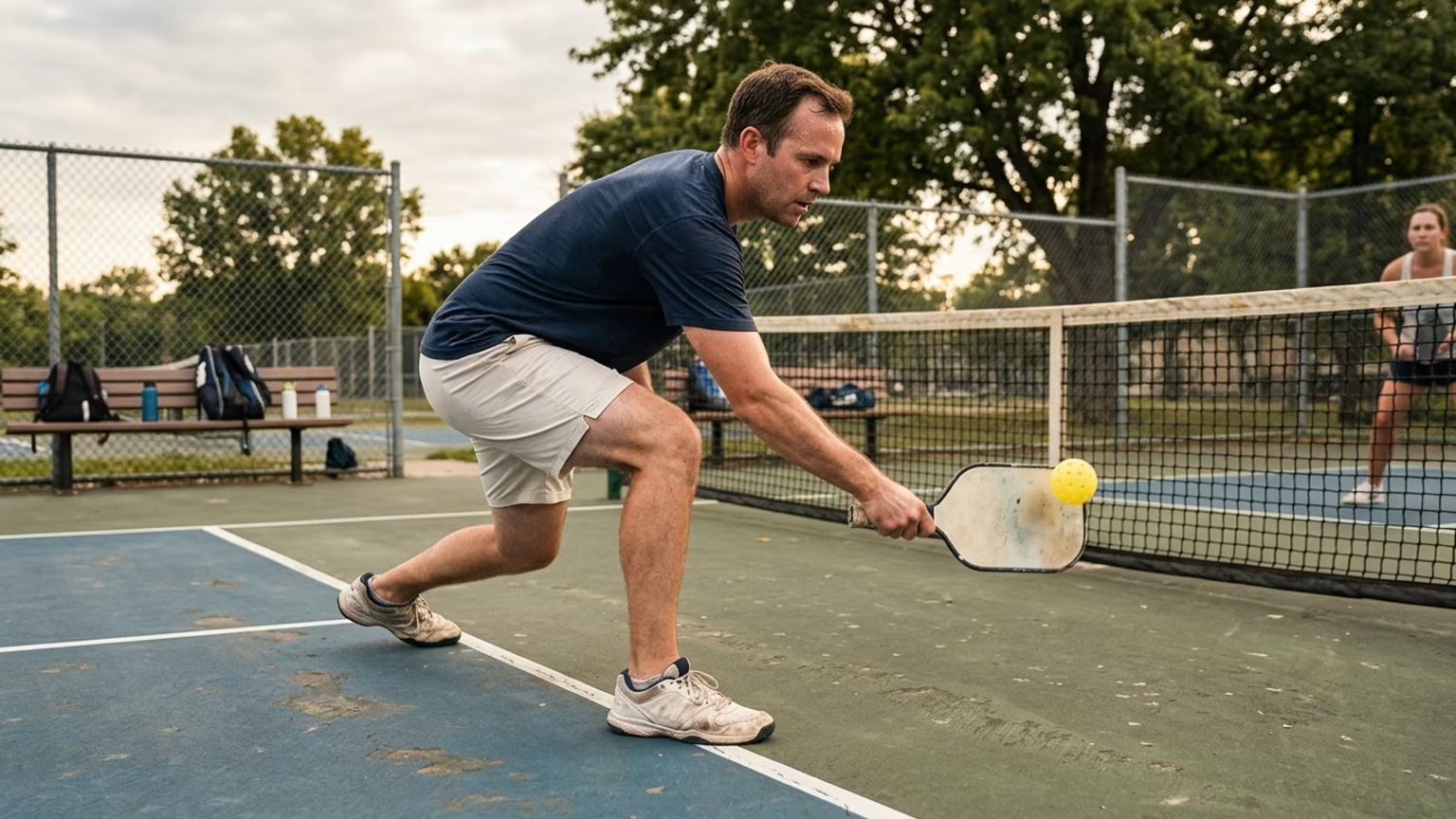

Understand kitchen-line mobility, use a modest comfort self-check, and consider simple movement options without treating flexibility as an injury forecast.




Mobility is the ability to move through a joint range that you can comfortably use and control. At the pickleball kitchen line, that means more than reaching a low ball. It includes lowering into position and returning to a balanced stance.
Repeated lunges and low reaches ask something of your hips, knees and ankles. They also involve leg strength and movement control. A deeper position is not automatically a more useful one if it feels painful or leaves the recovery unsteady.
The practical goal is comfortable movement that remains useful throughout the whole action. Getting down is only part of it.
Racquet sports challenge movement through repeated explosive efforts and changes of direction. A player must reach a position, manage the movement and prepare for the next action. Looking only at the lowest point of a reach misses much of that task.
In pickleball, the kitchen-line example is a low reach followed by a return to readiness. The useful question is not simply whether your paddle can reach the ball. It is whether lowering and recovering feel comfortable and controlled.
For tennis and padel players, the same movement lens applies to repeated starts and directional changes. That does not mean the sports impose identical demands or need identical preparation. A kitchen-line sequence is a pickleball-focused example rather than a complete conditioning plan for every racquet sport.
This is why connecting joint range with usable movement matters. Range describes an available position. Court movement also asks what happens before and after it.
The available pickleball injury research provides context for sensible preparation. It does not identify an ideal squat depth or a minimum ankle range for kitchen-line play.
A U.S. preprint hosted on medRxiv examined emergency-department data from 2014 to 2023. Its authors reported 1,738 adjudicated pickleball injury cases and weighted those cases to an estimated 101,450 injuries nationally. These are emergency-department estimates rather than a count of every pickleball injury or a measure of an individual player's risk.
A 2024 analysis recorded in the University of Arkansas repository reported differences in injury patterns across age groups. Its abstract described overuse as a concern among middle-aged players. That finding does not identify restricted mobility as the explanation.
The exercise guidance is more practical than experimental. One pickleball coaching guide suggests squats, lunges and calf raises among its lower-body exercises. A therapy-provider guide recommends ankle and hip movements alongside basic strength options such as calf raises and controlled step-downs.
The evidence boundary is straightforward: these sources do not establish that limited joint range alone predicts injury. They also do not validate the self-check or exact exercise sequence below. Those are editorial suggestions for noticing comfort and choosing general movement options, not an injury forecast or a proven prevention protocol. The coaching and therapy recommendations should be understood as guidance rather than clinical trial results.
For adult players, athletic longevity means keeping useful physical capabilities in view. In this context, that includes comfortable lowering and a controlled return to balance. Mobility belongs alongside strength and control rather than replacing them.
That perspective gives movement practice a clearer purpose. The target is not an impressive stretch or a deeper position than another player can reach. It is a range that remains relevant to the movements you want to keep using on court.
A modest self-check can focus on familiar positions rather than a score. The observations worth noting are:
The emphasis is on the complete movement. A comfortable reach followed by an uncontrolled recovery is a different observation from a reach that feels steady throughout.
These observations can help frame exercise choices or a conversation with a qualified professional. They do not require comparing your depth with someone else's. Support can be used as needed, and a movement that causes pain is a reason to stop rather than push farther.
The same emphasis appears in looking at balance through the reach and recovery. The return deserves as much attention as the position reached.
The following sequence groups gentle movement options drawn from the research packet's practical guidance. It keeps ankle movement, lowering and leg strength in the same conversation without prescribing a training dose.
These are general movement options, not treatment instructions for a painful joint. Across the sequence, the boundaries remain simple: use a comfortable range and support as needed. Stop any movement that causes pain.
The practical distinction is between collecting more range and making movement more usable. For a player thinking about years of participation, comfort and control are worthwhile reference points. Neither requires turning every practice session into a flexibility test.
Pain during a shallow squat, step or lunge is a reason to discuss the movement with a qualified physiotherapist or healthcare provider. The same applies when returning to balance feels uncontrolled or discomfort keeps recurring during play. Those observations are more useful to bring to a consultation than a self-assigned mobility score.
Personal exercise and healthcare decisions belong with a qualified professional when symptoms are involved. A general article cannot determine why a movement hurts or which exercise fits that situation.
The lasting aim is not to reach the lowest possible position. It is to keep the reach and the return part of a game that still feels comfortable to play.
Follow Evercourts for practical insights on tennis, pickleball and padel performance, movement, recovery and healthy ageing. Stay connected for new articles, research-led guidance and ideas to help you play well and keep playing for years.


A practical guide to padel fatigue, flexible pacing, hydration considerations and symptoms that mean stopping play and seeking care.
Understand tennis shoulder strength beyond cuff exercises, including shoulder-blade work, whole-body serving, workload and signs to seek assessment.

Compare court size, singles and doubles formats, and wall rebounds to choose tennis, pickleball or padel around your preferences and schedule.
Read practical guidance for better movement, smarter preparation and a game that keeps working for you.
explore the Blog
