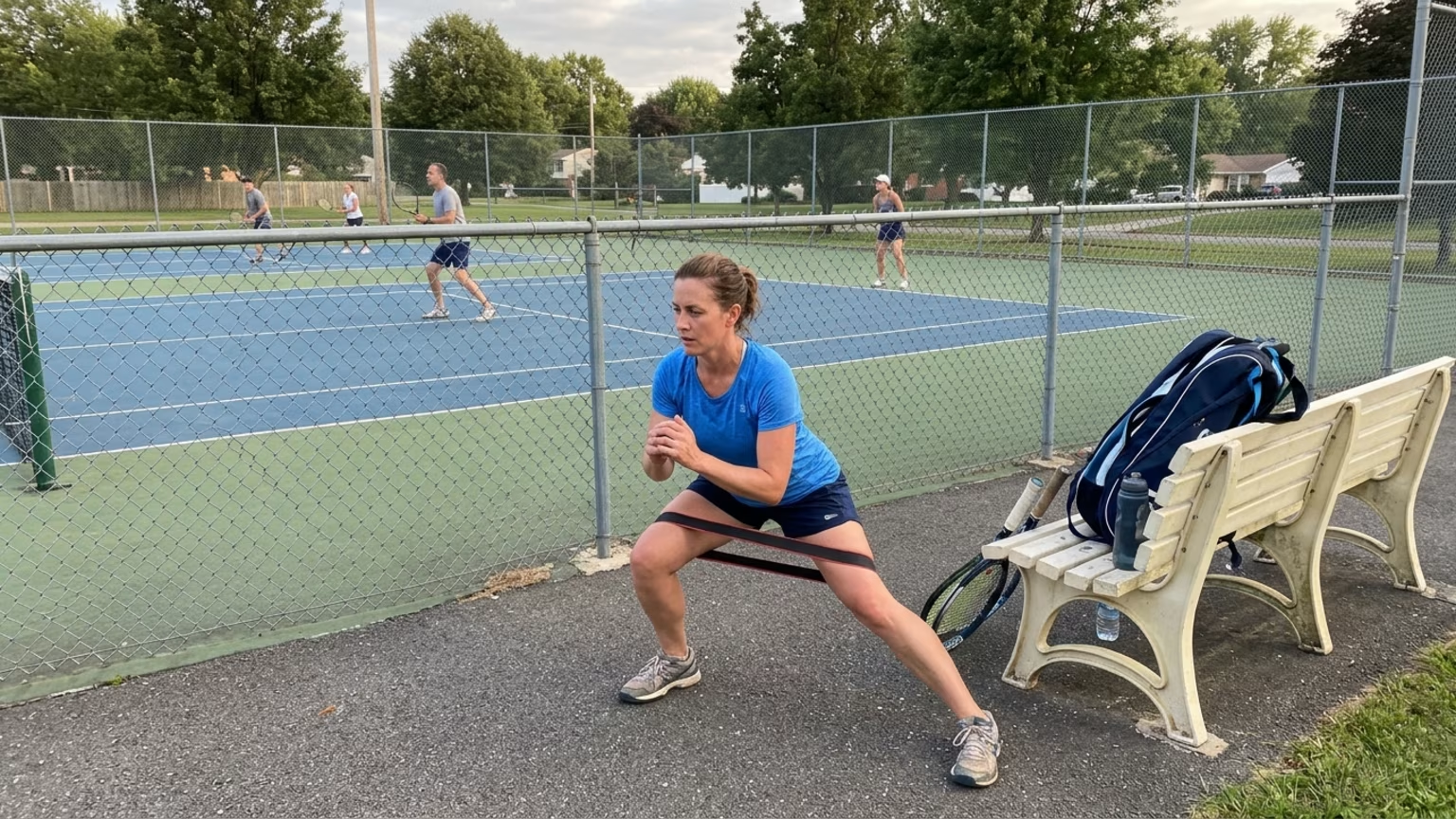

How off-court strength, balance and braking control can complement racquet sports, with clear evidence limits and signs to seek professional advice.




Off-court conditioning is strength, balance and movement-control work done away from matches to complement the demands of play. For adult racquet players, the central idea is straightforward: playing your sport and preparing for its movements are related tasks, but they are not the same task.
Strength is one part of that preparation. Balance concerns keeping the body steady as its position changes. Controlled deceleration means slowing down or stopping with control rather than focusing only on getting somewhere quickly.
Together, these concepts offer a useful way to think about athletic longevity. The question is not simply how much tennis, pickleball or padel you play. It is also how you approach the physical work behind those games. Evercourts' guide to making room for strength and balance alongside court time takes that broader view.
Tennis, pickleball and padel involve repeated bursts of movement and changes of direction. Getting into position is only part of the task. Players also need to slow down and organize themselves for the next movement.
That makes braking a useful focus for off-court preparation. In its training commentary, World Tennis Magazine describes tennis as involving repeated acceleration, braking and lateral movement. Its emphasis is on preparing for those demands rather than judging strength work only by how much weight someone lifts.
The practical emphasis should still reflect the sport:
For padel players, connecting preparation with the movements used in matches is a more useful editorial framework than treating every racquet sport as interchangeable.
The available material offers two different kinds of information: observations about pickleball participation and practitioner guidance about tennis preparation. Keeping those categories separate makes the practical message clearer.
A club publication's secondary summary of pickleball research describes a 2026 scoping review covering 27 research articles. It characterizes the evidence as promising while identifying a need for more research into injury prevalence and severity.
The same publication summarizes a small pilot study of 33 adults aged 65 and older who already played pickleball at least twice a week. Participants averaged 3,477 additional steps on pickleball days. They also accumulated more than 68 minutes of moderate-to-vigorous activity per session.
Those observations describe activity during participation. They do not directly test whether off-court strength or balance work improves braking. That distinction matters when deciding what a busy playing schedule tells you about your wider preparation.
For training ideas, World Tennis Magazine's commentary emphasizes controlled single-leg lower-body work and eccentric control. In plain language, its focus includes controlling the lowering or braking part of a movement. For the shoulder, it recommends low-load work performed with control and an emphasis on rotator-cuff stability rather than simply pursuing heavier loads.
The evidence boundary belongs in one place. These are secondary study summaries and practitioner recommendations rather than a comparable trial across tennis, pickleball and padel. They do not establish a universal training sequence or a short routine that guarantees injury prevention. The practical principles below are therefore an adaptable planning framework, not a tested program for every player.
For athletic longevity, the useful shift is from collecting exercises to identifying capabilities worth maintaining. Strength, balance and controlled stopping become categories to consider rather than promises attached to a particular routine. That keeps preparation connected to the goal of continuing to play.
The research brief supports a practical framework built around progressive strength work, balance practice appropriate to the player and controlled stopping before added speed or complexity. Personal exercise selection belongs within that framework rather than being dictated by a generic article.
The tennis commentary suggests looking beyond heavier loads alone. Its lower-body emphasis is control during braking. Its shoulder emphasis is stable movement under relatively low loads.
The editorial lesson is to ask what a training choice is intended to develop. A strength exercise and a balance task need not serve the same purpose. Naming that purpose makes it easier to discuss preparation with a qualified professional without turning every session into a test of maximum effort.
Progression also belongs in the plan. The supported principle is to build strength progressively rather than prescribe the same starting point for every adult player. The material does not supply a universal load or progression schedule.
Balance practice should be appropriate to current ability. Controlled stopping can be considered before adding speed or complexity. These are planning principles rather than an invitation to copy demanding drills without context.
For adult players, that distinction respects both experience and individual circumstances. A competitive background does not require choosing the hardest version of every task. Equally, a recreational label does not identify which physical qualities deserve attention.
World Tennis Magazine also recommends organizing targeted strength work around playing and recovery demands. Its author's preference for lower-body training the day after play is a personal approach rather than a schedule to apply to everyone.
The broader takeaway is to consider court time and off-court work together. Evercourts' resource on planning match play alongside strength work addresses that planning question. The aim is a workable relationship between preparation and participation rather than an increasingly crowded exercise calendar.
Understanding these distinctions gives adult players a clearer vocabulary for their preparation. Instead of asking whether one routine will keep them playing indefinitely, they can ask whether their plan addresses strength, balance and movement control in a way that fits their sport and circumstances.
Persistent pain, a recurring sense of instability or another health concern is a reason to seek individualized advice rather than simply add more training. These concerns deserve attention beyond a general exercise framework.
A qualified physiotherapist or healthcare provider is the appropriate person to discuss what those symptoms mean for your situation. An article can explain movement concepts and summarize research. It should not diagnose the cause of discomfort or decide which training choices are appropriate for a particular player.
The goal is informed participation rather than proving you can work around every concern on your own. If persistent pain or instability is affecting your play, contact a qualified physiotherapist or healthcare provider today.
Follow Evercourts for practical insights on tennis, pickleball and padel performance, movement, recovery and healthy ageing. Stay connected for new articles, research-led guidance and ideas to help you play well and keep playing for years.


Understand pickleball balance research, reaching and backward movement, with practical control cues and signs to seek qualified guidance.

Use tennis movement demands to guide flexible strength priorities, adjust gym work around court play, and recognize when to seek qualified advice.

Balance for tennis, pickleball and padel, with controlled off-court practice ideas, research context and signs to seek professional advice.
Read practical guidance for better movement, smarter preparation and a game that keeps working for you.
explore the Blog
