

Understand pickleball balance research, reaching and backward movement, with practical control cues and signs to seek qualified guidance.




Balance is the ability to stay steady while you stand, move or change direction. In pickleball, that includes what happens after a reach or lunge, not simply whether your paddle meets the ball.
A useful court-side question is: Can you regain a stable stance before the next movement? That shifts attention from making contact at any cost to completing the movement under control. It also gives balance practice a clear purpose without turning every awkward step into a warning sign.
Think of balance during repeated explosive efforts and changes of direction as a moving task rather than a pose. The movement has a beginning, a reach and a finish. Deceleration simply means slowing down; it deserves attention alongside getting to the ball.
For tennis, pickleball and padel players, the useful observation is how one movement sets up the next:
These are court-side observation prompts. The research discussed here focuses specifically on recreational pickleball and pickleball injuries.
A large reaching step is a useful example to consider. Rather than judging it by its size alone, ask what happens afterward. Does the movement finish with control, or does it leave you scrambling to recover? That question fits within a broader understanding of how court footwork connects successive movements.
A secondary summary of research involving 92 recreational pickleball players reports that 42% had fallen during play. It reports that 30% had fallen more than once. Lunging and moving backward were the leading reported circumstances.
The same summary describes measurements of hip-abductor strength and change-of-direction speed. Stronger hip abductors were associated with faster change-of-direction times. However, hip-abductor strength alone did not distinguish players who had fallen from those who had not.
A separate secondary account of a U.S. emergency-department analysis covering 2013 to 2022 reports an estimated 66,350 pickleball-related injury cases. Falls accounted for 65.5% of those cases. That provides a reason to take movement control seriously without presenting ordinary court movement as something to fear.
For practical context, a practitioner article proposes practicing a controlled “step back and stop” rather than rapidly backpedaling. It also suggests general balance practice near a counter or wall.
The research findings above come through secondary summaries, and the recreational-player percentages describe a small study sample rather than all pickleball players. The emergency-department figures describe treated injuries rather than every fall or an individual player’s risk. The strength association does not establish that strengthening prevents falls. The available evidence also does not compare one large step with smaller steps or establish a universal stopping technique.
The movement prompts and supported practice ideas in this article are coaching suggestions, not validated screening tests or proven fall-prevention methods.
A practical observation is whether a reach or lunge leaves room to regain a stable stance. The point is not to label lunging as a mistake. It is to pay attention to the recovery as well as the contact.
Useful questions include:
These questions keep the focus on the whole action. A ball reached successfully can still offer something useful to discuss about the movement that followed.
For balls behind the player, the court-side cue is to move deliberately and regain control rather than rush into backward steps. The proposed step-back-and-stop practice gives that idea a simple focus: pay attention to the stop.
Questions about balls behind you also connect with movement decisions around lobs. A coach can help discuss those choices in the context of the point being played. Where unsteadiness is part of the concern, individualized healthcare guidance belongs in that conversation too.
For adult players, athletic longevity is a useful reason to value control alongside speed. The aim is not to remove every demanding reach from the game. It is to make the ability to recover from movement part of what you pay attention to.
That offers a practical way to think about progress. Instead of judging a session only by balls reached or points won, consider which movements felt controlled and which deserve further discussion. This is reflection on your game, not a pass-or-fail assessment of your body.
General balance practice can sit alongside court play as complementary work. The supported option described above keeps a counter or wall nearby. Choosing suitable support and getting individualized guidance are sensible considerations when the movement feels uncertain.
There is also value in separating different goals. The reported relationship between strength and change-of-direction speed concerns one aspect of movement. The ability to finish a reach under control is another useful focus for observation. Neither needs to become a claim that one exercise will solve every movement concern.
For a longer playing life, the editorial priority is straightforward: give the recovery phase a place in the conversation. Paying attention to the stop as well as the step makes that priority concrete. It keeps the discussion centered on the movements you actually encounter rather than an abstract idea of being “good at balance.”
Seek individualized guidance if you feel unsteady during play, have a history of falls or are unsure how to practice challenging movements. Those concerns are enough reason to consult a qualified physiotherapist or healthcare provider.
Describe the movement that concerns you: reaching forward, lunging sideways or moving toward a ball behind you. Explain whether the uncertainty happens during the movement or while trying to settle afterward. That gives the conversation a specific court-related focus without trying to diagnose the problem yourself.
If supported balance practice still feels uncertain, ask for guidance on suitable support and an approach matched to your situation.
Keep control part of the game.
Follow Evercourts for practical insights on tennis, pickleball and padel performance, movement, recovery and healthy ageing. Stay connected for new articles, research-led guidance and ideas to help you play well and keep playing for years.


Use tennis movement demands to guide flexible strength priorities, adjust gym work around court play, and recognize when to seek qualified advice.

Balance for tennis, pickleball and padel, with controlled off-court practice ideas, research context and signs to seek professional advice.
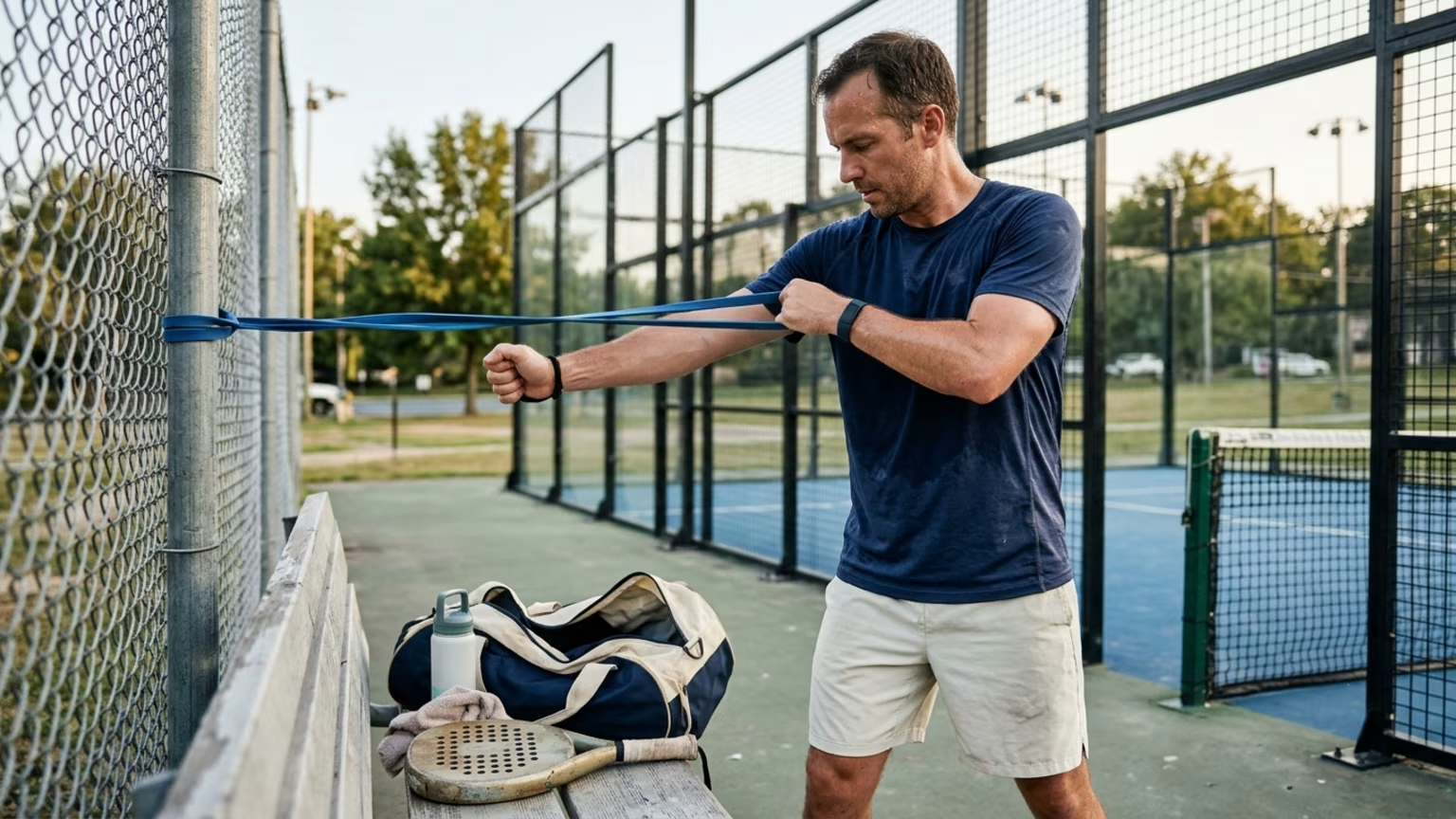
Understand padel shoulder demands, gradual preparation and workload management, plus the recurring symptoms that call for qualified advice.
Read practical guidance for better movement, smarter preparation and a game that keeps working for you.
explore the Blog
