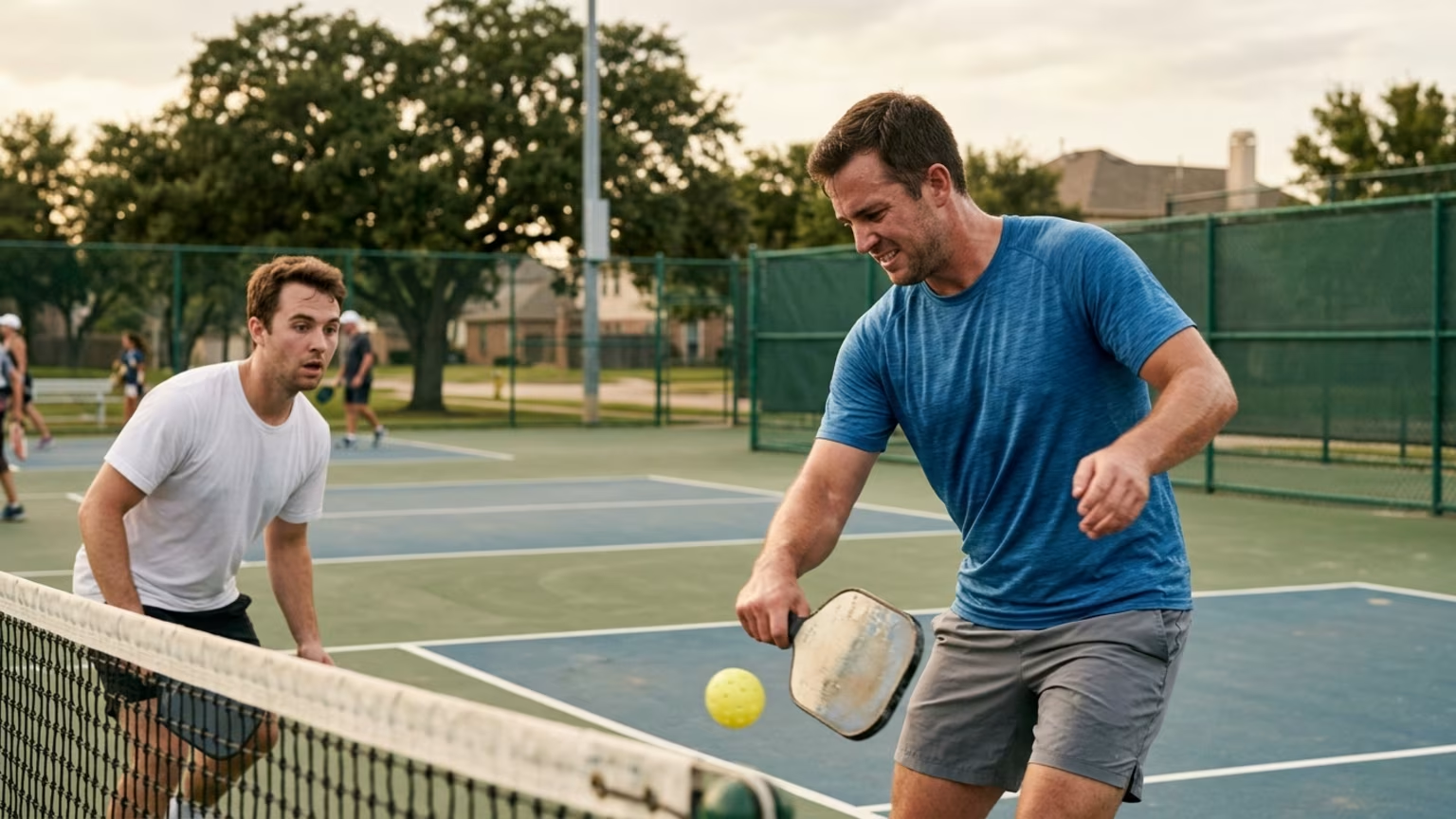

Learn how elite pickleball players use consistent mechanics and compact swings to disguise their shots, forcing errors without needing maximum power.




High-speed footage recorded at 4,000 frames per second recently captured professional pickleball player Rachel Rohrabacher generating 2,273 revolutions per minute of topspin on a stationary forehand. That massive number matters because she achieved it using a remarkably compact stroke that looks exactly like a soft dink. Pickleball.com analyzed this phenomenon in a piece titled "The Best Shot Disguise in Pickleball" on August 25, 2026. The article reveals that elite offense in racquet sports relies on mechanical repetition rather than wild acceleration.
Most players believe they need a harder swing or a violent wrist snap to hit a winning shot. The opposite is actually true for sustainable performance. You create a far heavier offensive burden for your opponent by making every shot look boringly identical. Disguise is simply a byproduct of efficient and repeatable body positioning.
Racquet sports media often highlights aggressive power and massive topspin as the secrets to winning matches. Recreational players watch highlight reels and immediately try to swing faster or snap their wrists harder. This approach usually leads to unforced errors and unnecessary physical fatigue. Chasing pure velocity without a solid technical foundation rarely works for an adult player.
SFIA data reports that 24.3 million Americans played pickleball in 2025. This massive figure represents a 22.8% annual increase in participation. SFIA's midyear data also reported a 1.3% increase during the first half of 2026. With millions of players crowding the courts, adopting efficient and sustainable mechanics is more crucial than ever.
Many newer players fall into the trap of trying to out-muscle their opponents. They see social media videos promoting massive overheads or aggressive wrist action. This creates a false impression that athletic longevity requires hitting the ball as hard as possible. In reality, trying to dominate through sheer force is a quick path to physical burnout.
The reality of smart court play looks much more controlled. In the Pickleball.com feature written by Joseph Sutton, analyst Zane Navratil notes that Rohrabacher's swing is powerful without being reckless. She commits to a highly consistent preparation phase regardless of whether she plans to hit a dink, speed-up, or lob. This sensible approach allows her to execute effective offensive shots without telegraphing her intentions.
The mechanics behind this deception rely on keeping the paddle path and body posture consistent. The Pickleball.com feature details how Rohrabacher maintains a 65-degree stroke angle on both her forehand and her two-handed backhand. Her forehand also utilizes a precise 23-degree launch angle. Navratil points out that she brushes directly upward on the back of the ball while keeping her wrist position nearly unchanged.
This lack of extra wrist movement is critical for true shot disguise. Many players reveal their topspin intentions early by dramatically cocking or snapping their wrists. By removing that visible change, Rohrabacher leaves her opponents guessing until the very last fraction of a second. Even when watching the 4,000 frames per second video, Navratil found it difficult to identify her intended shot before contact.
Generating pace without a massive arm swing requires intelligent use of the whole body. Navratil explains that Rohrabacher uses her non-dominant hand to initiate a small forward movement. This subtle action allows her to coil her torso and drive the shot with her legs rather than just her arm. Integrating the lower body is a foundational principle of athletic longevity and consistent court movement.
Incorporating the non-dominant hand is something many adult players forget to do. When the non-dominant arm simply hangs by your side, your hitting arm is forced to do all the work. This leads to poor rotation and a weak overall kinetic chain during the swing. By actively using that off-hand to set your body, you generate effortless momentum from the ground up.
We see these same efficient habits discussed in racquet sports shot selection guides. Rohrabacher reportedly produced 1,613 revolutions per minute of topspin on her backhand using this compact method. The feature mentions she uses a Friday Fever 102 paddle, but the underlying mechanics would function with almost any equipment. Technique always dictates the outcome more than the specific gear in your hand.
The consistency of the stroke angle is what makes the disguise effective from a physics standpoint. If the paddle face is always at 65 degrees, the opponent cannot use paddle angle to predict the shot. They are forced to wait and observe the actual speed of the swing right at contact. This delay in recognition severely cuts down their reaction time and positional readiness.
When your opponent has less time to react, they are more likely to hit a weak return. Evercourts emphasizes that you do not need overwhelming power to force an error. Taking away just a fraction of a second from their response time achieves the same result. This is why elite players invest so heavily in perfecting their basic movement patterns.
Adult recreational players should not interpret professional statistics as mandatory targets for their own games. Attempting to recreate a 2,273-RPM forehand will likely result in poor timing or frustration. Instead, players should focus on making their basic preparation look identical for every shot. You can start by establishing a standardized stance and paddle position before you ever initiate a swing.
A separate article published by The Dink in August 2026 highlights a highly relevant practice routine. That piece describes a drill where players repeatedly perform a specific hop-and-pivot movement before varying their shot. The player alternates between hitting a soft dink and a fast speed-up from the exact same setup. Practicing this sequence helps engrain a repeatable preparation phase that confuses opponents.
Incorporating specific targets is the next step for developing functional disguise. The Pickleball.com analysis notes that Rohrabacher can land a soft dink about two feet from the net. When she decides to attack, she directs her speed-up toward a specific corner rather than just hitting the ball hard. Smarter practice design requires choosing a distinct target for every ball you hit.
You should separate your disguise training from your maximum power training. Work on brushing upward with a stable wrist at a moderate pace first. Ask a drilling partner to wait until after contact to guess what shot you just hit. This instant feedback will tell you if your posture is giving away your tactical decision-making too early.
Another helpful method is recording your own practice sessions to check for physical tells. Set up your phone behind the baseline and film yourself hitting various shots. Watch the footage to see if you drop your shoulder or change your stance before a speed-up. You might be surprised by how much early information your body is unintentionally revealing.
Once you identify those physical tells, you can systematically remove them from your stroke. It often takes deliberate repetition to unlearn the habit of winding up for a big swing. You will need to train your brain to trust a shorter and more compact motion. Over time, this refined technique will feel natural and require much less physical exertion.
Keep in mind that consistent mechanics do not eliminate the need for proper recovery or conditioning. Compact swings provide tactical benefits, but they are not a proven cure for joint stress or poor physical conditioning. Players must still manage their fatigue and prioritize sensible warm-up routines. A calm and compact stroke simply gives you the best chance to play effectively while conserving energy.
Those ultra-high-speed cameras captured impressive spin rates, but the true lesson has nothing to do with maximum velocity. The most dangerous offensive weapons on the court are built on quiet, repeatable habits. When you stop trying to swing harder and start focusing on mechanical consistency, the game slows down in your favor. You conserve your physical resources while keeping the player across the net constantly off balance.
By maintaining identical preparation and a compact swing until the moment of contact, racquet sports players can significantly improve their offensive disguise while conserving valuable physical energy.
Follow Evercourts for practical insights on tennis, pickleball and padel performance, movement, recovery and healthy ageing. Stay connected for new articles, research-led guidance and ideas to help you play well and keep playing for years.


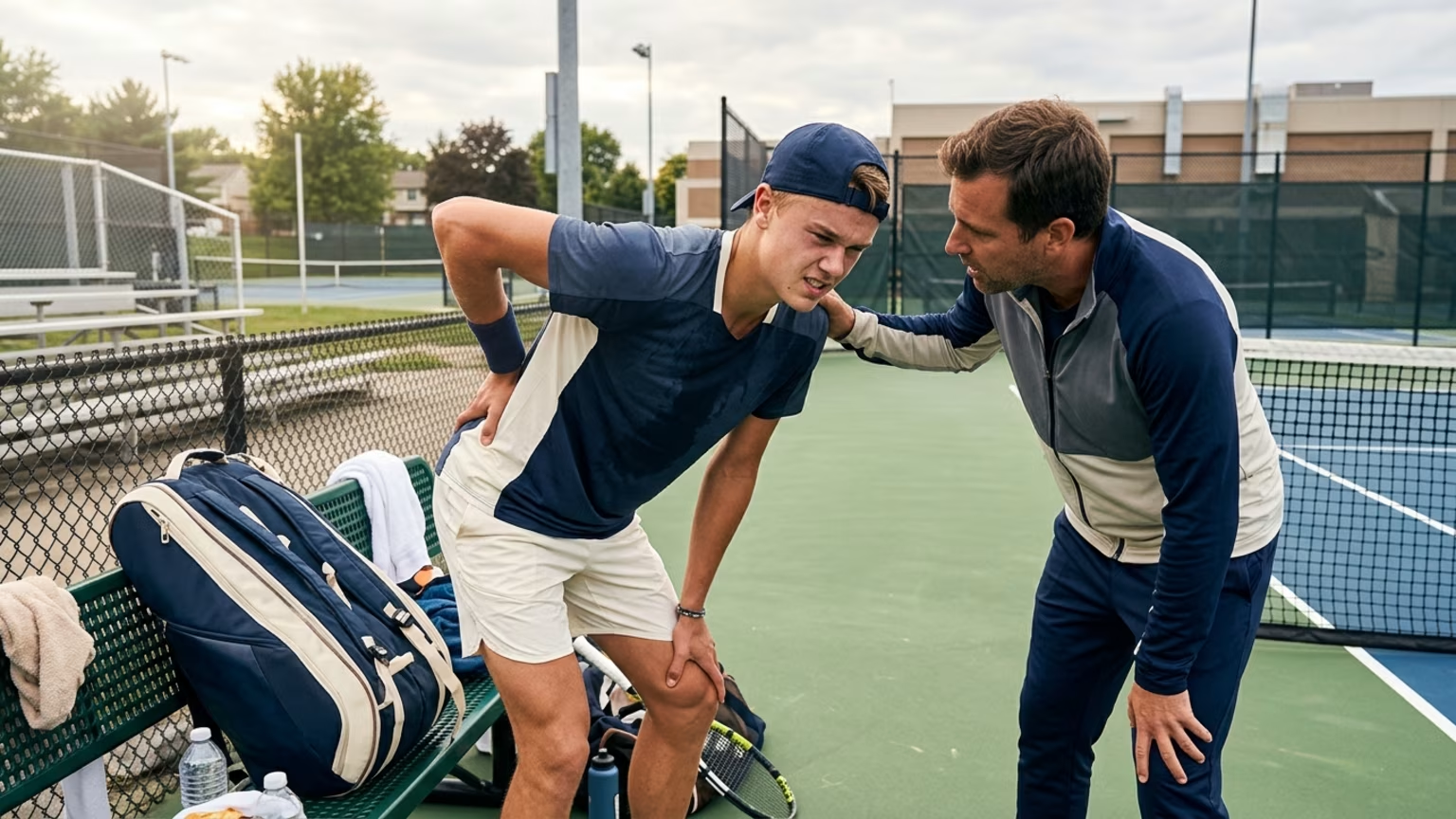
Holger Rune withdrew from the European Open with a back problem. The facts behind his decision and a grounded perspective for recreational players.

The Dink’s October 17 guide emphasizes deep returns, ball-height decisions and positioning against faster pickleball opponents.

A new report outlines padel and tennis gear trends. Learn how to assess adjustable rackets, sensor feedback and smart-court claims.
Read practical guidance for better movement, smarter preparation and a game that keeps working for you.
explore the Blog
