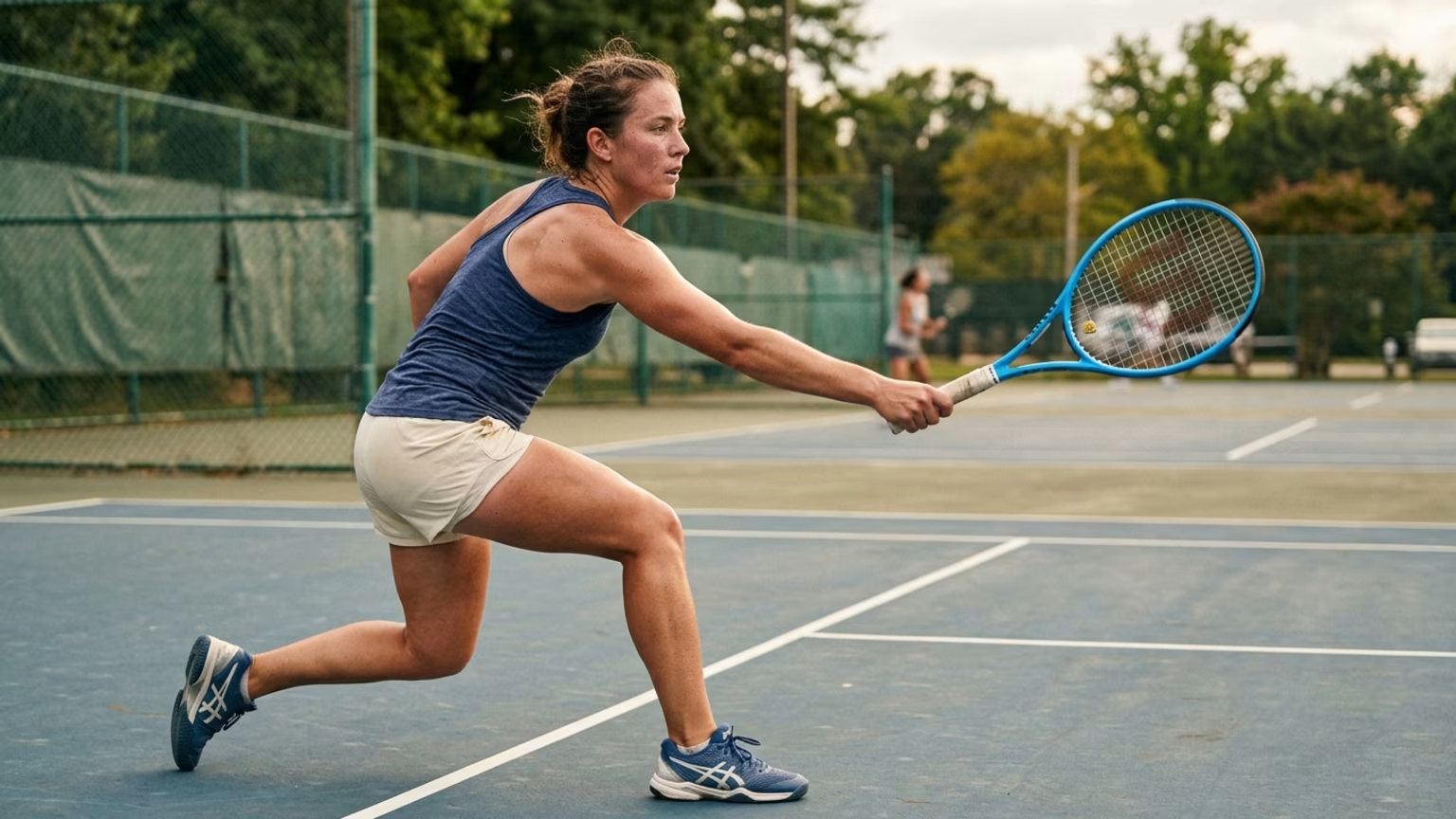

Learn the five central movement categories for tennis, pickleball and padel. Discover how to improve your split step, braking and court recovery.




A primary footwork framework identifies exactly five central movement categories that dictate court coverage across all racquet sports. These include the split step, lateral shuffle, crossover step, kitchen-transition advance and backward recovery. When I first started playing pickleball, I noticed how many people skipped warming up entirely. They would jump straight out of their cars and right up to the kitchen line.
I tried doing that and immediately pulled a calf muscle. Pickleball requires just as much explosive lateral movement as tennis, just in a tighter space. Since then, I always spend five minutes doing dynamic lunges and ankle rolls. It changes everything about how confident I feel pushing off the baseline.
Court movement requires the body to absorb force constantly during every single point. Players must establish a ready position, prepare to react, move toward the ball and brake under control. After organizing the hitting posture, they must then recover rapidly for the next shot. Repeating this sequence places substantial mechanical stress on the lower body throughout a match.
The physical toll centers heavily on how quickly you can absorb and redirect horizontal momentum. A split step serves as a vital weight-settling action that places the player in a balanced stance before the subsequent movement. Without this balanced foundation, the lower body fights against its own residual momentum. Poor preparation forces the joints to manage harsh stops rather than executing smooth muscular decelerations.
A poorly timed preparation phase forces players to overexert themselves during the sprint to the ball. When a player lands too late, they must rely on upper-body compensation to reach the shot. This reactive deficit accumulates over multiple sets and accelerates muscular fatigue. By prioritizing efficient movement foundations, players drastically reduce the overall wear on their lower extremities.
Research identifies five specific movement categories that dominate successful court play across all disciplines. A widely cited pickleball footwork guide categorizes these as the split step, lateral shuffle, crossover step, kitchen-transition advance and backward recovery. Understanding these distinct patterns helps players organize their off-court physical conditioning effectively. The goal is to build strength and coordination for the precise postures you occupy during match play.
The ideal split step is typically a compact, two-footed hop rather than a deep jump. Players should land with their feet roughly hip-width apart and keep their knees relatively soft. Weight must be distributed evenly so the athlete can push effectively in multiple directions. The objective is never to jump higher but rather to neutralize existing forward momentum efficiently.
Practical coaching guidance suggests timing the landing precisely as the opponent makes contact with the ball. This accurate timing allows players to push off immediately in the necessary lateral or forward direction. Landing substantially before or after contact nullifies this mechanical advantage entirely. This preparation technique is particularly useful when a player is actively approaching the net or kitchen line.
The lateral shuffle represents a side-to-side movement where the feet remain generally uncrossed. A practical shuffle sequence involves pushing from the inside leg and moving the outside foot toward the target. Next, the player brings the other foot back toward a balanced stance without letting the feet collide. This sequence works exceptionally well for short adjustments where maintaining a square stance remains advantageous.
Movement width dictates whether a player should shuffle or cross their feet during a fast exchange. When covering large distances, a tennis footwork coaching source recommends using crossover or cross-behind steps instead of lateral shuffles. Crossing the feet becomes highly preferable when a player has significantly more lateral court to cover. For players losing court speed, tennis coaching advises prioritizing controlled deceleration and single-leg stability instead.
Racquet sports require the player to turn the body and organize the feet carefully before hitting. This specific movement combines lateral displacement, deliberate braking and rotation of the pelvis and trunk. A practical distinction exists between making small lateral adjustments and responding to a deep ball. Small positional adjustments require a basic shuffle while remaining relatively square to the net.
Conversely, when the ball travels behind the player, proper turning mechanics become absolutely essential. A pickleball footwork source recommends pivoting and taking controlled steps backward when responding to a lob. Backpedaling is highly discouraged because it severely compromises balance and reduces backward movement speed. This structural principle is especially relevant to older players who want to maintain their healthy aging trajectory.
While racquet sports share fundamental underlying principles, the specific distances and geometric demands vary significantly across disciplines. Recognizing these precise structural differences helps players tailor their warm-ups and conditioning routines.
Tennis frequently demands expansive court coverage and higher-speed sprint recovery patterns from baseline to net. Singles players must handle an explosive first move to a wide ball followed immediately by an open-step recovery. Doubles players utilize short lateral shuffles near the net and must move toward the ball while maintaining formation. After the shot, the player should move toward the next tactically useful position and re-establish a ready stance before the opponent’s contact.
The sheer size of the tennis court places a premium on explosive sprint mechanics and rapid lateral acceleration. When forced wide, players must aggressively push off their outside leg to halt their momentum and begin recovering. This violent change of direction demands immense eccentric strength from the quadriceps and glutes. Without this foundational strength, players tend to slide past the ball or struggle to return to the center.
Pickleball involves highly compact movements and rapid directional shifts near the non-volley zone. A standard baseline progression might include a compact split step, a kitchen-transition advance and a lateral shuffle. When responding to a deep lob, a pickleball footwork source recommends pivoting and taking controlled backward steps. Backpedaling remains highly discouraged because it can severely compromise dynamic balance during a rapid baseline retreat.
The shorter distance between opponents in pickleball drastically reduces the available reaction time during net exchanges. Players must keep their paddles up, maintain a wide base and rely heavily on short lateral shuffles. These rapid side-to-side movements require exceptional calf and ankle stability to execute smoothly over three sets. Over-committing to any single direction leaves a player highly vulnerable to a well-placed return.
Padel introduces entirely different spatial variables due to its enclosed glass court design. Players must split-step before the opponent strikes and then constantly coordinate recovery movements with their partner. The presence of side and back walls requires continuous body rotation to handle unpredictable glass rebounds. Defensive sequences frequently involve retreating under control to manage lobs without losing court awareness.
Systematic-review work on padel examines temporal structure, court movement, game actions and how lobs can help teams recover the net. This research reinforces the fact that padel movement cannot simply be reduced to tennis footwork on a smaller court. Wall rebounds fundamentally alter the geometry of the point and force players to defend from entirely different angles. Coordinated partner positioning becomes essential to covering the gaps created by these unique bounce trajectories.
The most practical way to improve match performance is to practice full movement sequences instead of linear sprints. Training should seamlessly combine a split step, movement to the ball, controlled deceleration and a shadow stroke. Combine a sequence of split stepping, moving, braking, shadowing the stroke and recovering efficiently. Finish every repetition in a balanced position from which the exact next movement can begin.
Focusing on high-quality controlled braking mechanics allows you to arrive at the ball with superior posture. Improving eccentric leg strength provides the control needed to stop quickly without stumbling or slipping. To maximize your physical preparation, consider incorporating better reaction drills that rely on external visual cues. A training partner pointing or throwing a ball forces you to read, react and move realistically.
Older or returning players should always begin with low-impact versions of these specific movement patterns. Starting with smaller split steps, slower shuffle speeds and longer rest intervals prevents unnecessary early fatigue. Players with persistent stiffness should consult a qualified professional before adding high-speed change-of-direction work to their routines. Gradually building up your tolerance ensures that these drills enhance performance rather than causing unnecessary setbacks.
Replacing predictable ladder routines with drills that feature unpredictable directional cues can drastically improve reactive agility. Mastering these essential footwork skills ultimately extends your athletic longevity and enjoyment of the game.
Data to Action: Replace your standard pre-match baseline jogging with two minutes of multi-directional shadow repetitions that finish in a balanced ready posture.
Follow Evercourts for practical insights on tennis, pickleball and padel performance, movement, recovery and healthy ageing. Stay connected for new articles, research-led guidance and ideas to help you play well and keep playing for years.


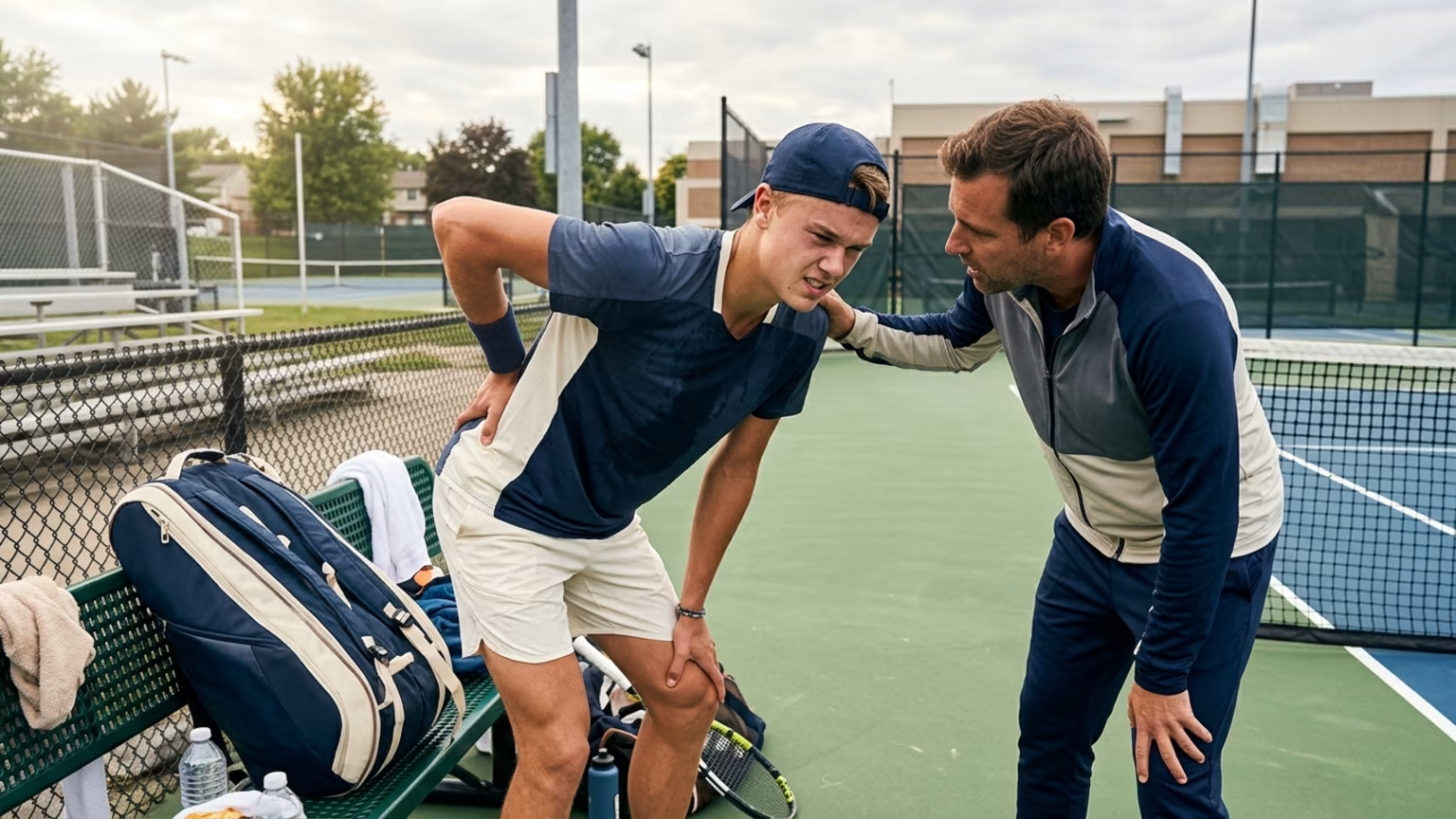
Holger Rune withdrew from the European Open with a back problem. The facts behind his decision and a grounded perspective for recreational players.

The Dink’s October 17 guide emphasizes deep returns, ball-height decisions and positioning against faster pickleball opponents.

A new report outlines padel and tennis gear trends. Learn how to assess adjustable rackets, sensor feedback and smart-court claims.
Read practical guidance for better movement, smarter preparation and a game that keeps working for you.
explore the Blog
