

Learn how to organize your racquet sport strength training around the specific movements your game demands for better performance and athletic longevity.




A player finishes a heavy set of seated leg extensions and moves directly to the bicep curl machine. They pack their gym bag, feeling confident they have built the strength needed for tomorrow's match. You have heard it a million times: to get stronger for racquet sports, you just need to build bigger leg and arm muscles in the gym. Here is why that is outdated.
True court conditioning is not about isolating individual muscle groups on stationary machines. It requires preparing your body for the complex, repeated actions your game actually demands.
Most fitness advice trickles down from traditional bodybuilding or generic powerlifting programs. When players want to protect their knees or hit harder, they naturally look for exercises targeting the quads, hamstrings, or shoulders. It makes perfect sense to trust the familiar machines that line the walls of commercial gyms. For decades, adult players were told that stronger muscles automatically equal a more resilient body.
This compartmentalized approach feels safe and measurable. It gives athletes a clear sense of progress as the weights go up week after week. Gyms standardize around these isolated machines because they are very easy to teach, not because they are optimal for court sports. Players are frequently taught to separate leg day from upper-body day, leaving the body entirely disconnected.
Unfortunately, a tennis court or padel court does not care about your seated leg extension maximum. Racquet sports require the body to function as an integrated unit. When you isolate muscles while sitting down, you completely bypass the nervous system coordination required to swing a racquet while moving. The result is a gym routine that looks impressive but fails to translate into actual athletic longevity.
The reality of racquet sports is far more dynamic than pushing a weight in a straight line. During a single point, a player must decelerate to a sudden stop, push off laterally, and rotate their trunk to execute a shot. A 2026 analysis reported by KCUR, citing ValuePenguin’s analysis of U.S. Consumer Product Safety Commission data, estimated that pickleball-related emergency-room injuries rose from about 8,300 in 2018 to more than 31,000 in 2025. The same report estimated that adults aged 50 and older accounted for 125,000 pickleball-related ER visits between 2018 and 2025.
A significant portion of these incidents involve the lower extremities during rapid directional changes, lunging, and sudden braking. Instead of working in isolation, the body operates as a highly linked mechanical system. Generating power for a tennis serve requires the coordinated contribution of the lower body, trunk rotation, and overhead reaching. If a player only trains their shoulders while sitting on a bench, they miss the vital connection between leg drive and upper-body execution.
The physical qualities that keep you on the court depend on the rehearsal of these full-body movement patterns. The International Padel Federation reported 38 million padel players across 178 countries and territories as of June 23, 2026. As participation surges globally, players need a framework that matches these intense movement requirements. Building sustainable strength you actually use on court is essential for maintaining your playing schedule.
Translating this biomechanical reality into a practical routine requires shifting your focus from muscles to specific movements. A durable training framework organizes your workouts around the actions you repeat during every single match. First, players should prioritize force absorption to handle sudden stops. Using controlled split squats, reverse lunges, and step-downs improves your ability to lower your center of mass safely.
Learning how controlled braking improves your court play is a massive step toward better movement. Next, incorporate lateral movement and single-leg control to handle the side-to-side demands of the court. Lateral lunges and supported single-leg deadlifts build the stability necessary for wide forehands and sudden volleys. You must also include exercises that train the body to hinge, pull, and press overhead.
The hip hinge is essential because it trains the posterior chain muscles used when repeatedly lowering and recovering your court stance. Romanian deadlifts and basic hip bridges provide the capacity needed for low volleys and challenging baseline retrieves. Rotational strength is another critical component that is often ignored in traditional gym settings. Exercises like cable presses, medicine-ball throws, and controlled trunk rotations teach the body to transfer force efficiently.
Rotation should be generated from the hips and trunk in coordination with the legs, rather than forced through the lower back. Finally, adding simple farmer carries to your routine provides an excellent way to build core stiffness and whole-body coordination. Simple tools like dumbbells, resistance bands, or kettlebells are perfectly effective for these functional patterns. Building shoulder capacity for serves and overheads can be done with very minimal equipment.
The American College of Sports Medicine emphasizes that consistency matters far more than complicated programming. Furthermore, World Health Organization guidance recommends muscle-strengthening activity involving major muscle groups on at least two days per week. For adult players, two brief full-body resistance sessions per week provide a realistic and highly effective schedule. You do not need to spend hours in a specialized gym to see meaningful benefits.
Adult players should always match their training stress to their weekly playing schedule to avoid joint overload. Adults balancing work and family commitments need a routine they can actually maintain across a long season. If you are entering a dense week of matches, it is wise to reduce your lower-body training volume. Progress your exercises slowly by changing only one variable at a time.
Practical strength training strategies focus on adding a slight increase in resistance or a single extra repetition. Always treat normal muscle fatigue differently from sharp joint pain, modifying your routine as needed.
The New Golden Rule: Do not train muscles in isolation to survive the court; train the specific movement patterns your game requires to thrive on it. By shifting your focus from stationary bodybuilding machines to dynamic actions like lunging, rotating, and decelerating, you build genuine court capacity. This organized approach respects your time, protects your joints, and supports long-term healthy aging. Train the movements, trust the process, and Evercourts will see you on the courts.
Follow Evercourts for practical insights on tennis, pickleball and padel performance, movement, recovery and healthy ageing. Stay connected for new articles, research-led guidance and ideas to help you play well and keep playing for years.


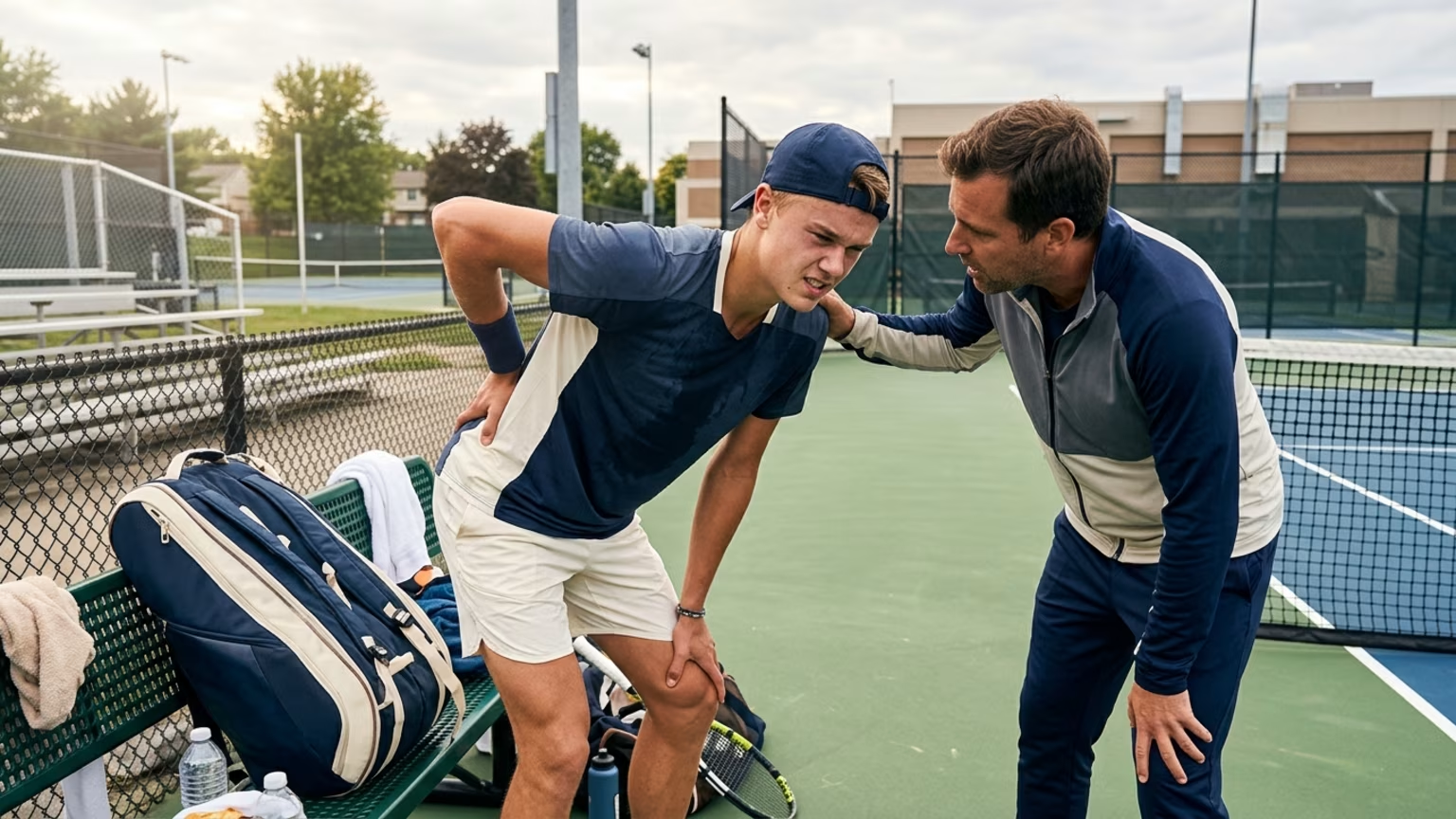
Holger Rune withdrew from the European Open with a back problem. The facts behind his decision and a grounded perspective for recreational players.

The Dink’s October 17 guide emphasizes deep returns, ball-height decisions and positioning against faster pickleball opponents.

A new report outlines padel and tennis gear trends. Learn how to assess adjustable rackets, sensor feedback and smart-court claims.
Read practical guidance for better movement, smarter preparation and a game that keeps working for you.
explore the Blog
