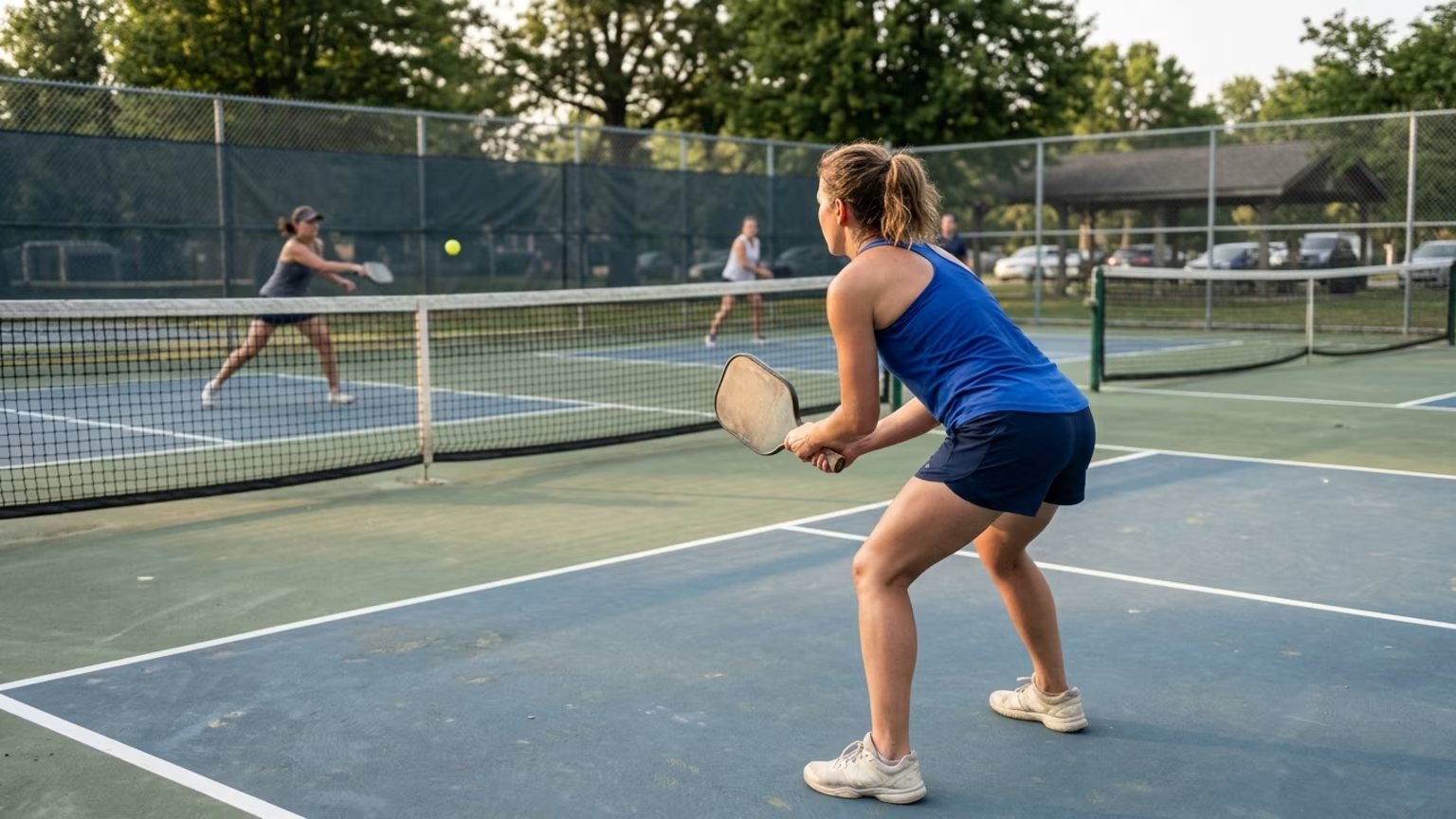

How anticipation informs movement in tennis, pickleball and padel, with research-backed distinctions and practical coaching cues for the next ball.




Anticipation is using an opponent’s movement and the ball’s flight to prepare your next move. On a tennis return, the ball has not yet left the server’s racket, but there is already something to watch. That does not mean the returner must choose a direction before contact.
The distinction matters: gathering information and committing to a movement are not the same thing. A useful way to understand reaction on court is to ask not only how quickly you moved but what information guided that movement.
For adult tennis, pickleball and padel players, this makes anticipation a skill worth understanding alongside physical preparation. The starting point is a better-informed decision rather than an earlier guess.
Repeated explosive efforts and changes of direction put a practical question behind every read: where should the next movement go? From a movement perspective, anticipation is about connecting the information available with the response the situation requires.
Tennis presents a timing problem. On a serve return, information develops through the service action and early ball flight. The challenge is deciding how to respond as that picture becomes clearer.
Pickleball brings positioning into focus. With a moving dink, the coaching question is whether the feet get the player into position or the response becomes mainly a lean and reach.
Padel adds the wall rebound. The incoming shot and its first court bounce become part of the information used to organize the response. Starting position also matters because the player needs room for the rebound.
These situations connect attention with footwork rather than treating them as separate subjects. They also fit a broader view of linking the shot with court recovery: the next movement belongs in the same conversation as the current ball.
A 2026 scoping review published in Sports Medicine reviewed 1,208 records and included 40 studies. It reports that skilled athletes can use opponents’ movement patterns to anticipate actions, including tennis serve direction. Those patterns include information from the opponent’s body and limbs.
The tennis-specific evidence adds an important distinction. A tennis-coaching article summarizing a systematic review reports that experts did not consistently begin moving laterally toward the eventual serve direction before racket contact under the most representative task conditions. Its account emphasizes information unfolding through the service action and early ball flight instead.
That supports a more useful interpretation of anticipation than simply committing sooner. A player can attend to developing information without treating an early impression as a certain prediction.
Healthy-aging research also needs careful interpretation. A 2026 systematic review and network meta-analysis in European Review of Aging and Physical Activity included 13 trials across 14 reports. Its primary analysis involved 10 randomized trials with 469 participants. Evidence was concentrated in table tennis, while tennis evidence came from one small trial.
The authors could not establish which racket sport was superior. Their findings do not establish equivalent benefits for tennis, pickleball and padel.
The evidence boundaries belong together. The biological-motion review found variation across sports and task formats, while the sport-specific coaching cues below are recommendations rather than controlled outcome findings. Taken together, these sources do not establish that anticipation or positioning reduces running distance, fatigue or injury risk. They also do not establish that these skills offset age-related changes.
For athletic longevity, the practical value is having another part of the game to understand and develop. Attention and positioning belong alongside physical preparation rather than replacing it. Understanding a shot and having the physical capacity to respond remain different questions.
A useful approach is to separate what you noticed from how you moved when discussing a rally with a coach. That gives practice a clearer subject than simply deciding that a difficult ball exposed a lack of speed.
The available guidance offers distinct starting points for each sport.
The tennis evidence summary points toward staying ready to use information from the service action and early ball flight. It does not support treating a pre-contact posture as a certain directional signal.
As a practical reflection after a return, consider what information was available when the direction became clearer. Was the response based on the developing serve or on a prediction made earlier? This keeps the discussion focused on the relationship between the read and the movement.
For related context, consider how preparing before the ball arrives differs from deciding its destination before there is enough information.
Pickleball.com’s coaching guidance recommends moving the feet so the outside leg gets behind a moving dink, then recovering toward the middle. Its emphasis is positioning rather than leaning and reaching to manage the ball.
That gives a player and coach something specific to discuss: foot position during the dink and the recovery that follows. The question becomes how the response was organized rather than whether the hands alone were quick enough.
Padelmesh recommends watching the first court bounce as well as the ball itself. Its guidance describes a starting position that leaves room to move back for a wall rebound, adjusted to the incoming shot.
The practical focus is the relationship between the incoming ball, its first bounce and the space available for the rebound. Treat the starting position as something to adjust to the shot rather than a fixed location to copy every time.
Across these examples, the useful long-term habit is to keep asking what the situation requires. That is also a helpful lens for adapting movement between singles and doubles, rather than assuming every court situation calls for the same response.
Recurring aches, stiffness that affects movement or a change in what you can comfortably do are reasons to consult a qualified physiotherapist or healthcare provider. Personal decisions about symptoms and physical capability need individual attention rather than another ball-reading cue.
A coach can help discuss attention and positioning. A health concern should not be treated as a technical fault simply because it appears during a rally.
Return to the image of a serve approaching contact. Reading that moment is a playing skill. If discomfort is shaping your first step, bring that concern to a qualified professional rather than asking anticipation to solve it.
Follow Evercourts for practical insights on tennis, pickleball and padel performance, movement, recovery and healthy ageing. Stay connected for new articles, research-led guidance and ideas to help you play well and keep playing for years.


Holger Rune withdrew from the European Open with a back problem. The facts behind his decision and a grounded perspective for recreational players.

The Dink’s October 17 guide emphasizes deep returns, ball-height decisions and positioning against faster pickleball opponents.

A new report outlines padel and tennis gear trends. Learn how to assess adjustable rackets, sensor feedback and smart-court claims.
Read practical guidance for better movement, smarter preparation and a game that keeps working for you.
explore the Blog
