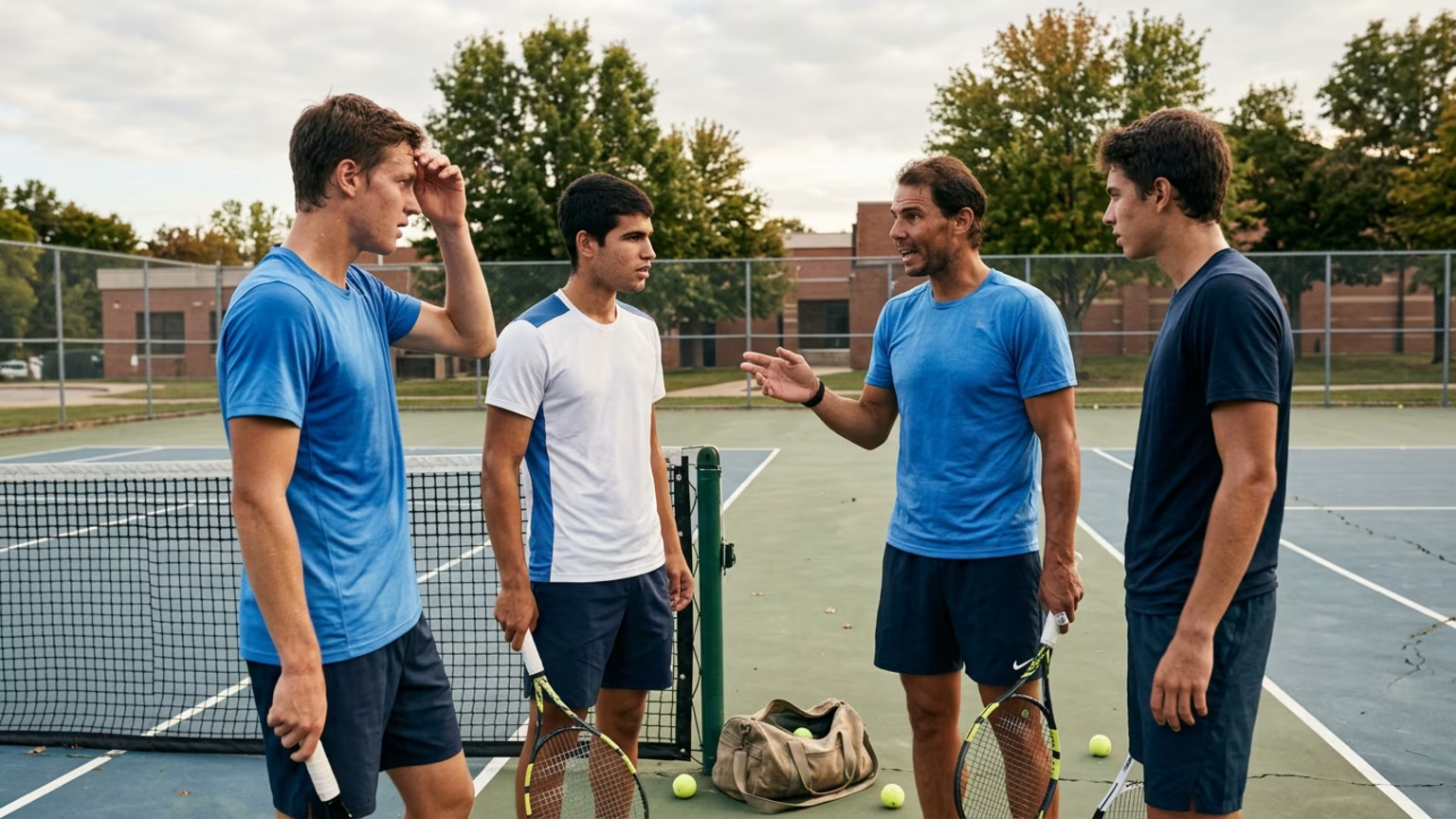

Rafael Nadal says top-tier injuries are normal. We explore the 2026 injury data and translate what pro tennis workloads teach recreational players about rest.




In September 2026, Rafael Nadal told Sky Sport that the physical setbacks currently affecting top players like Carlos Alcaraz and Jannik Sinner are a normal consequence of the intense physical demands placed on elite athletes. Speaking during a visit to Madrid for the Formula 1 Grand Prix, Nadal explained that after two or three years of such intense physical effort, injuries can naturally occur. His comments arrive on the heels of a 2026 season where significant injury interruptions affected both young stars, shifting the conversation around calendar demands and player health.
The practical reality of these physical demands has been highly visible throughout the recent tennis calendar. Sinner recently withdrew from the 2026 US Open because of a right-knee injury. Explaining the decision, Sinner noted that he and his medical team had determined he needed more recovery time to heal safely. His team announced he would remain in Europe to continue rehabilitation with his medical and performance staff, working with the specific aim of being ready for the Asian swing and tournaments in Beijing and Shanghai.
Alcaraz faced an even more prolonged absence from the tour. He missed more than four months of competition because of a right-wrist injury sustained at the Barcelona Open. His last match before the lengthy break took place on April 14, 2026, and the wrist problem eventually forced his withdrawal before his second-round match in Barcelona. Alcaraz finally returned to competition at the 2026 US Open, marking his first tournament appearance since April.
Despite these substantial setbacks, Nadal observed that both Alcaraz and Sinner were coping well and that their recovery processes appeared to be progressing positively. Alcaraz himself has pointed to structural issues in the sport, suggesting that the tight ATP calendar was actively contributing to players’ physical problems. He noted that many players were having issues with their bodies because the schedule was so tightly packed across the season.
Nadal’s perspective provides a crucial framework for adult recreational players, moving the focus away from total injury avoidance and toward continuous load management. His central point is that sustained exposure to high-level physical demands makes injury management a standard part of the performance environment. While recreational players do not face the same tournament density, they balance tennis, pickleball, and padel with daily work demands and less medical support.
The professional examples demonstrate that stepping away from the court is often a necessary performance decision. Sinner’s withdrawal from a major tournament shows that resting is sometimes the most strategic choice a player can make. Similarly, players analyzing Carlos Alcaraz's U.S. Open return can see that resuming play requires careful evaluation. At the US Open, Alcaraz remarked that playing a four-set match was a highly useful way to test his physical condition and assess exactly how his body felt the following day.
For adult athletes, tracking cumulative load is essential. This means looking at the total physical stress from court time, strength training, and daily life. It is easy to ignore early warning signs when trying to maintain a weekly league schedule.
I remember finishing a tough two hour padel match on a cold Tuesday night and waking up the next morning feeling like my lower back was locked in concrete. For a long time, I just accepted this as the price of playing hard in my forties. But once I started spending just ten minutes on targeted hip mobility before heading to the club, the stiffness almost completely vanished. It taught our team that we do not have to accept pain as a default state of aging.
Instead, players must plan for recovery before symptoms force a complete halt to play. By recognizing and preventing tennis injuries early, athletes can maintain their court routines for years. Taking a day off, or implementing a 12-minute court-ready warm-up, should be viewed as proactive management rather than a lack of dedication.
When athletes increase their playing volume progressively after time away, they reduce their vulnerability to sudden setbacks. Alcaraz’s first tournament back involved evaluating his body under real competition rather than assuming that being pain-free in practice guaranteed full match readiness. Adult players returning from their own extended breaks should follow this blueprint. Ramping up court time slowly allows the body to adapt to the specific explosive movements required by racquet sports.
The debate over match volume and player health is supported by several metrics, though the complete picture remains complex. A reported analysis of 167,211 ATP matches from 1973 through 2019 found an overall in-match retirement incidence of 0.87 per 1,000 games. This finding included a 95 percent confidence interval of 0.84 to 0.90.
The same analysis covered 46,268 WTA matches from 1975 through 2019 and found an overall retirement incidence of 0.81 per 1,000 games. This result also included a 95 percent confidence interval of 0.70 to 0.88. However, the reported peer-reviewed analysis did not include match duration in minutes. This omission limits what can be concluded about the precise relationship between time on court and retirement risk.
Recent data suggests that the nature of tour injuries may be shifting. The Professional Tennis Players Association reportedly claimed that upper-body injuries increased 42 percent in the first quarter of 2026 compared with the same period in 2025. Additionally, the association reported that arm injuries increased 112 percent against the 2025 average.
These PTPA figures certainly align with scheduling concerns, but they should be treated cautiously. The underlying dataset and a peer-reviewed methodology were reportedly not publicly released at the time of the report. Consequently, these statistics serve as a provisional claim regarding modern physical demands rather than independently verified evidence.
As the professional tennis calendar remains tightly packed, player scheduling will undoubtedly become more cautious over the next season. We expect top competitors to increasingly prioritize rest blocks and targeted rehabilitation over chasing ranking points at every available event. The traditional expectation of playing through early warning signs is steadily being replaced by a calculated approach to athletic longevity. Going forward, strategic tournament withdrawals and careful monitoring of next-day physical responses will dictate how elite players sustain their careers, setting a healthier standard for the rest of the racquet sports world.
Follow Evercourts for practical insights on tennis, pickleball and padel performance, movement, recovery and healthy ageing. Stay connected for new articles, research-led guidance and ideas to help you play well and keep playing for years.


A recent live-play test of a silent pickleball highlights its value for practice, but standard balls still perform better for match play and power control.

An evidence check on sports supplements like tart cherry juice. Learn why racquet sports players should prioritize core nutrition over functional foods.
In late 2026, Oura analyzed wearable data to see how recreational tennis impacts heart health and recovery. Learn what this means for your athletic longevity.
Read practical guidance for better movement, smarter preparation and a game that keeps working for you.
explore the Blog
