

A September 2026 evidence digest highlights updated ACL reconstruction findings on graft selection, pain control, and safe load management for racquet players.




On September 14, 2026, Orthogate published its Sports Medicine Clinical Evidence Digest. This publication covers three recent studies involving primary anterior cruciate ligament reconstruction. The digest reviews evidence on autograft selection, postoperative analgesia, and lateral extra-articular procedures. These findings clarify how surgical choices influence rotational stability for athletes returning to pivoting sports.
The first highlighted study is a June 2026 systematic review and Bayesian network meta-analysis. It evaluates several autograft configurations for primary ACL reconstruction. The research reviewed multiple options, including bone-patellar tendon-bone, hamstring, and quadriceps tendon constructs. The digest reports that quadriceps tendon autografts with a bone plug ranked highly for subjective outcomes and rotational stability.
The second study is a September 2026 double-blind randomized controlled trial. This trial evaluated early postoperative pain control methods for ACL patients. Researchers compared the use of local infiltration analgesia alone against a combination of local infiltration and an ultrasound-guided adductor canal block. The goal was to determine if the additional block provided superior early pain relief.
Finally, the digest examines a systematic review of lateral extra-articular procedures. These procedures aim to improve rotational stability when added to primary ACL reconstruction. The evidence suggests these additions can reduce persistent postoperative pivot-shift laxity. The review focused on identifying structural benefits for patients without significantly increasing surgical complication rates.
While elite competitors might have dedicated rehabilitation teams, adult recreational players must take an active role in their recovery. The latest findings emphasize that graft selection is highly individualized. A successful return to racquet sports relies on specific anatomical factors, prior injuries, and the physical demands of your game. You should always discuss these personal variables thoroughly with a medical professional.
Proper movement mechanics and targeted tissue preparation are non-negotiable for court athletes. "When I first started playing pickleball, I noticed how many people skipped warming up entirely. They would jump straight out of their cars and right up to the kitchen line. I tried doing that and immediately pulled a calf muscle," our team notes.
"Pickleball requires just as much explosive lateral movement as tennis, just in a tighter space," we learned from that early experience. "Since then, I always spend five minutes doing dynamic lunges and ankle rolls. It changes everything about how confident I feel pushing off the baseline."
The surgical evidence highlights the importance of rotational stability, but players must build that stability through targeted training. Good early pain scores do not indicate that a player is ready to resume full match play. The analgesia trial measured early postoperative markers rather than the ability to tolerate a full racquet-sport session. Recovering athletes must implement a careful load-management plan under clinical supervision.
Players should progress from controlled strength exercises to predictable court drills before attempting reactive cutting. Implementing an evidence-based pre-match routine helps players monitor their neuromuscular readiness. You must prioritize movement quality and single-leg balance before increasing your competitive match volume. A structured approach protects the graft while restoring athletic confidence.
Tennis, pickleball, and padel involve continuous lateral movement, lunging, and sudden deceleration. Returning to these pivoting sports requires careful consideration of rotational risk factors. The digest recommends that clinicians consider lateral extra-articular procedures in higher-risk patients. Players presenting with generalized ligamentous laxity or high-grade preoperative pivot shift may require these discussions.
It is important to remember that these procedures do not replace the need for physical conditioning. Building a sustainable weekly schedule allows players to balance court time with necessary neuromuscular training. Managing your total workload is crucial for long-term athletic longevity. By pacing your return carefully, you can rebuild joint tolerance safely.
The digest provides clear statistical context for evaluating different ACL reconstruction methods. The Bayesian network meta-analysis included 44 randomized clinical trials and involved 3,491 adults. Quadriceps tendon autograft with a bone plug, identified as QTB, achieved excellent objective rankings within this large cohort. The review compared QTB directly against several traditional graft choices.
QTB ranked highest for subjective IKDC outcomes with a SUCRA ranking of 90.1 percent. It also ranked highest for Tegner activity scores with a SUCRA ranking of 85.3 percent. When evaluated for stability, QTB ranked first for rotational control and second for anteroposterior stability. The digest characterizes QTB as a strong option for athletes involved in cutting sports.
Compared with four-strand semitendinosus autografts, QTB was associated with a lower risk of high-grade pivot shift. The digest reports a risk ratio of 0.26, with a 95 percent credible interval of 0.07 to 0.85. The graft also received the highest graft-survivorship ranking, presenting a SUCRA value of 83.3 percent. However, the clinically important difference between QTB and bone-patellar tendon-bone on the IKDC score was described as borderline.
Adding lateral extra-articular procedures showed measurable effects in the review of 1,327 skeletally mature patients across 12 randomized publications. These procedures were associated with a graft-failure effect estimate ranging from 0.235 to 0.580. They also reduced persistent postoperative pivot-shift laxity, demonstrating an effect-estimate range of 0.324 to 0.703. The review did note substantial ceiling effects in commonly used patient-reported outcome measures.
Specifically, 75 percent of studies reporting IKDC scores and all studies reporting Lysholm scores were affected by these ceiling effects. This phenomenon can make it harder for questionnaires to detect differences in rotational control. However, no significant increases in reoperation, surgical-site infection, or joint stiffness were reported with the additional lateral procedures. Contemporary evidence supports appropriate tensioning to protect the graft without over-constraining the knee.
The evidence also suggests that more clinical intervention is not always beneficial for early recovery. In the 100-person analgesia trial, adding an adductor canal block did not significantly improve early outcomes. Mean 24-hour opioid consumption was 28.5 oral morphine milligram equivalents for the local-infiltration-only group.
The group receiving both treatments recorded 31.2 MME, a difference that was not statistically significant. Quadriceps recovery, measured by the ability to perform an active straight-leg raise three hours postoperatively, was equivalent between the groups at p = 0.58. This indicates that meticulous local infiltration may be sufficient for early pain control.
The medical approach to ACL reconstruction continues to shift toward a multidimensional view of knee stability. Rather than relying on a single standard operation, clinicians are increasingly focused on tailored rotational control. Future treatment pathways will likely place heavier emphasis on selective extra-articular protection for high-risk athletes. Evaluating graft survivorship, donor-site symptoms, and early postoperative function together offers a more comprehensive recovery picture.
Large-scale clinical research is actively working to clarify these customized surgical strategies. The Pittsburgh Post-Gazette recently reported on an international trial evaluating ACL reconstruction with and without an additional lateral procedure. This trial involves more than 1,200 patients and will provide valuable long-term data upon follow-up. Until those definitive conclusions arrive, surgeons will rely on individualized risk assessments.
For now, adult racquet sports players must treat surgical recovery as an active, progressive process. Shared decision-making between the athlete, surgeon, and physical therapist remains the most reliable strategy. Emphasizing gradual load management and measurable neuromuscular readiness will continue to guide safe returns to the court. Players should focus on sustained rehabilitation rather than rushing back for the next league match.
Follow Evercourts for practical insights on tennis, pickleball and padel performance, movement, recovery and healthy ageing. Stay connected for new articles, research-led guidance and ideas to help you play well and keep playing for years.


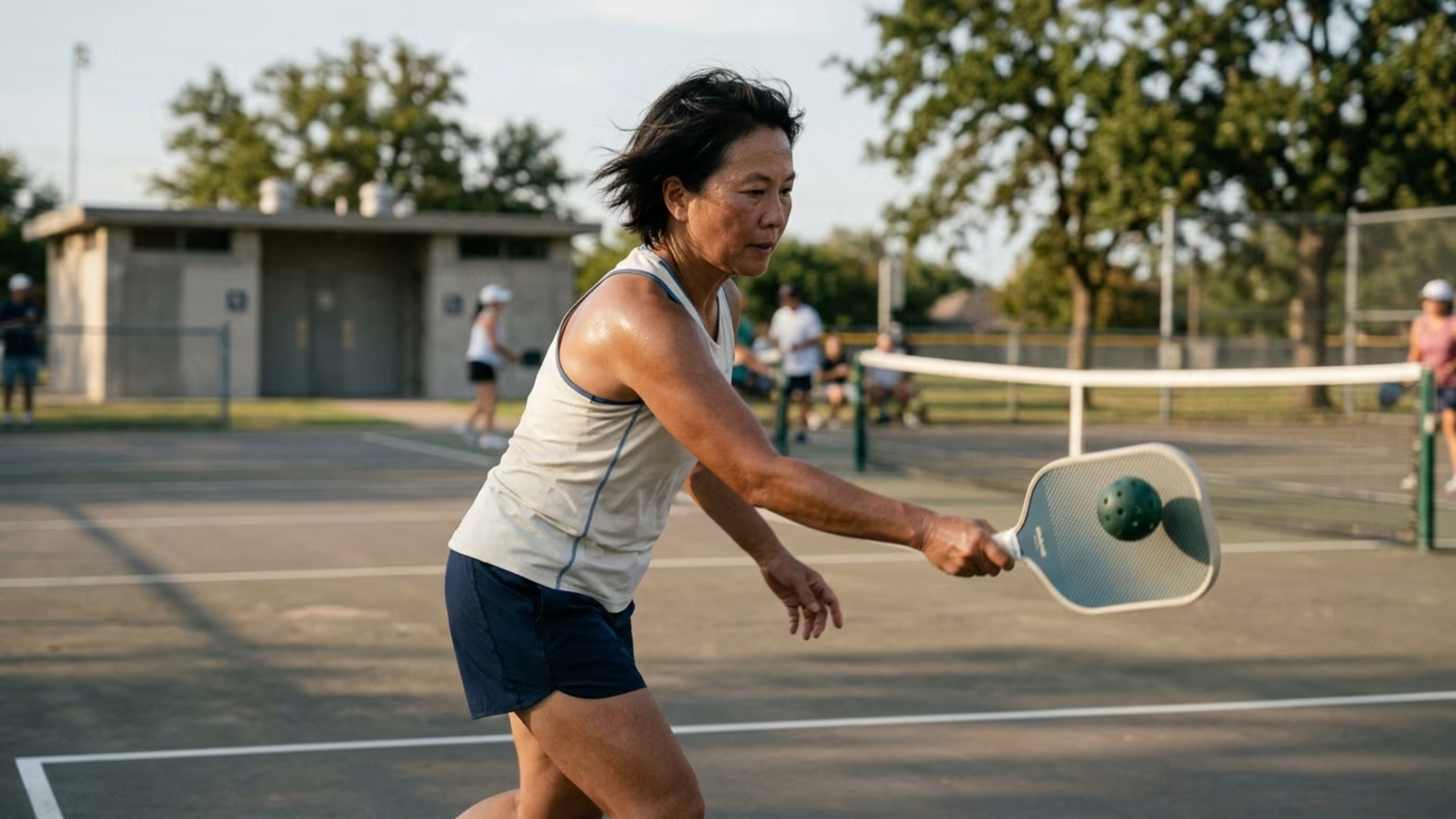
A recent live-play test of a silent pickleball highlights its value for practice, but standard balls still perform better for match play and power control.

An evidence check on sports supplements like tart cherry juice. Learn why racquet sports players should prioritize core nutrition over functional foods.
In late 2026, Oura analyzed wearable data to see how recreational tennis impacts heart health and recovery. Learn what this means for your athletic longevity.
Read practical guidance for better movement, smarter preparation and a game that keeps working for you.
explore the Blog
