

Learn how racquet sports players can adapt neuromuscular warm-ups to manage knee stress, build resilience, and support athletic longevity on the court.




A sharp squeak of rubber signals a sudden, desperate change of direction to retrieve a wide pickleball dink. The knee must instantly absorb the shifting momentum and stabilize the entire lower body. When that stabilizing mechanism falters, the resulting joint instability can alter the trajectory of a season.
An anterior cruciate ligament tear is a serious disruption of the primary stabilizing band in the knee that controls forward motion and rotation. This ligament acts as a crucial tether connecting the thigh bone to the shin bone. Neuromuscular warm-ups are structured movement routines designed to improve how the nervous system and muscles control these complex joint forces. By enhancing proprioception and movement coordination, these programs teach the body to maintain proper alignment during active play.
Tennis, pickleball, and padel demand constant changes of direction that place intense mechanical stress on the lower body. Players routinely sprint forward to reach drop shots, brake suddenly, and shift laterally to cover the width of the court. These repeated actions force the legs to absorb high impact loads over very short distances. If the muscular system does not adequately support the joint, the connective tissues must bear the kinetic force.
Tennis and pickleball are primarily played on hard, unforgiving surfaces that return maximum force through the body. Unlike softer grass courts, asphalt does not allow players to slide gracefully. When a player lunges for a wide ball, their shoe grips the surface instantly. This abrupt deceleration transfers the kinetic energy directly upward into the joints.
The mechanics of hitting also contribute significantly to lower body strain. Every powerful serve, aggressive volley, or deep groundstroke requires a firm foundation and coordinated weight transfer. Players must repeatedly plant their dominant foot, brace against the court, and forcefully rotate their hips. This repetitive torsional strain requires immense neuromuscular control to keep the knee properly aligned.
Fatigue plays a substantial role in how well the body manages these repetitive stresses during competition. As a match progresses, muscle activation can become delayed or less efficient. A tired player might land awkwardly or fail to keep their knee aligned over their foot. This subtle breakdown in movement mechanics increases the vulnerability of the joint structures.
The Jamaica Gleaner reported on August 19, 2026, that female athletes may be roughly eight times more likely to experience ACL injuries than male athletes. The report cited sports-medicine physician Dr. Brinks, who identified several possible contributors to this disparity. These factors include pelvic anatomy, ACL thickness, landing mechanics, and potential hormonal effects. The article emphasized that these elements remain under active study, offering a multifactorial view rather than a single definitive cause.
Understanding the full scope of knee injuries requires examining reinjury statistics and current prevention strategies. The Gleaner noted that approximately one in four athletes experience a second ACL injury. The article highlighted FIFA 11+, which is a free, structured warm-up developed for soccer and organized into three progressive segments. Dr. Brinks recommended at least 10 minutes of strength, balance, and knee-position work three or more times per week.
The Gleaner specifically stated that these exercises can be translated to sports including basketball and pickleball. Scientific evaluation of these prevention programs reveals nuanced results regarding direct injury reduction. A 2026 systematic review found that neuromuscular interventions significantly improved landing-error scores and biomechanical risk markers. However, the review cautioned that current evidence more clearly supports biomechanical improvements than direct reductions in ACL injury incidence.
A separate summary reported that FIFA 11+ trials produced varied results, noting that the included studies were not homogeneous. According to a Missouri Public Radio report, pickleball players frequently sustain ankle and knee sprains. The report described ACL tears as possible but less common serious injuries in the sport. It identified awkward landings and falls as the primary mechanisms for these acute events.
Pickleball injury data provides specific context, with a 2026 report estimating that United States emergency department injuries rose from 8,304 in 2018 to 32,960 in 2024. The same report noted a slight decline to 31,463 in 2025. Additionally, a 2026 peer-reviewed Korean study found a 38 percent one-year injury prevalence. This study reported that male sex and greater weekly playing volume were independently associated with injury occurrence.
Integrating structured movement preparation into your routine is highly effective for supporting long-term physical capabilities. The goal is to build resilience, improve load distribution, and maintain joint health without overwhelming your weekly schedule. Recreational and competitive players can reserve 10 to 20 minutes before selected sessions for progressive strength and balance exercises. These habits are essential for preserving court participation and ensuring athletic longevity.
A practical adaptation of neuromuscular principles involves a gradual pulse-raising phase followed by specific technical drills. Players can include controlled squats, walking lunges, single-leg balance work, and lateral movements. Low-level plyometrics and deceleration drills emphasizing a stable knee position are also highly valuable. The focus must remain on slow, technically controlled movements.
Players should only progress when they can consistently keep the knee aligned over the foot. Recent research emphasizes that joint health requires a comprehensive approach to lower body mechanics. A 2026 systematic review linked foot-and-ankle mechanics with proximal knee mechanics, including knee valgus and rotational moments. The review recommended mobility and neuromuscular training to improve load distribution and motor control.
Managing overall workload is just as critical as the exercises you perform. Avera sports-medicine guidance recommends movement-based activities such as walking lunges, jumping jacks, and high knees. Brisk walking or light jogging can effectively raise the heart rate before demanding directional changes. The emphasis is always on movement quality rather than simply breaking a sweat.
A clinical-framework article described neuromuscular training as improving proprioception, balance, strength, and movement coordination. Incorporating warm-ups and cool-downs is a proven way to prepare the body for racquet sports. Similarly, designing sustainable strength programs provides the necessary muscular support to handle abrupt deceleration. Building a comprehensive preparation routine ensures that the benefits of your warm-up translate directly to match performance.
Proactive movement training reduces risk, but it does not eliminate the possibility of joint injuries entirely. A warm-up cannot resolve structural damage, and players should never use exercise to self-manage acute medical symptoms. Anyone experiencing knee swelling, joint locking, instability, or persistent pain must seek proper clinical evaluation. The inability to bear weight or hearing an audible pop requires immediate cessation of play and a prompt medical visit.
Professional guidance is particularly critical for athletes managing prior injuries or returning to the court after surgery. Dr. Brinks recommended that youth and student-athletes consider biomechanical assessment by an athletic trainer, sports-medicine specialist, or physical therapist. A clinician-guided rehabilitation and return-to-play plan is vital for anyone recovering from ACL reconstruction. Attempting to accelerate this process independently often leads to setbacks and increased reinjury risk.
Expert evaluation can also optimize a healthy player's approach to injury risks and prevention strategies across different racquet sports. Physical therapists can identify subtle deficits in motor control or ankle mobility that standard warm-ups might miss. This specialized feedback allows athletes to tailor their movement preparation for maximum benefit. Book a dedicated movement assessment with a qualified physical therapist this season to establish a safe, personalized baseline.
Follow Evercourts for practical insights on tennis, pickleball and padel performance, movement, recovery and healthy ageing. Stay connected for new articles, research-led guidance and ideas to help you play well and keep playing for years.


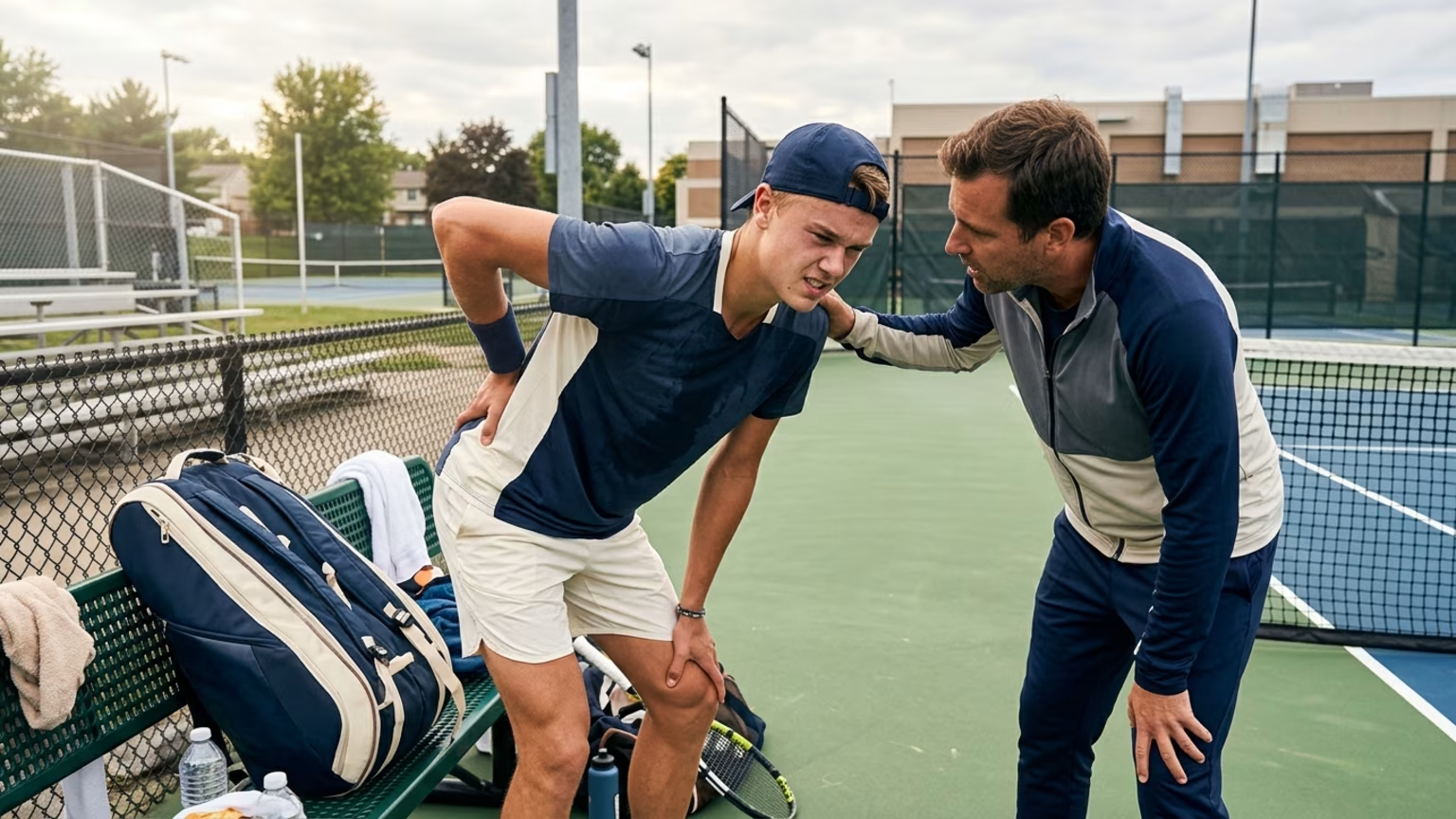
Holger Rune withdrew from the European Open with a back problem. The facts behind his decision and a grounded perspective for recreational players.

The Dink’s October 17 guide emphasizes deep returns, ball-height decisions and positioning against faster pickleball opponents.

A new report outlines padel and tennis gear trends. Learn how to assess adjustable rackets, sensor feedback and smart-court claims.
Read practical guidance for better movement, smarter preparation and a game that keeps working for you.
explore the Blog
