

Spanish medical experts warn that poor physical preparation drives lumbar injuries in amateur tennis. See how 15-minute activation routines protect your back.




On September 10, 2026, El Confidencial reported warnings from Spanish sports-medicine specialist Dr. Mindaugas Gudelis of Centro Médico Teknon about lumbar problems in tennis players. The report placed particular emphasis on recreational players who arrive at the court without adequate physical preparation. This medical caution arrives as amateur participation surges globally, bringing more unprepared adults onto the court. The article connects this warning to increased enthusiasm around major international tennis events like the Davis Cup. Quirónsalud is the official medical-services provider of the Royal Spanish Tennis Federation, giving these insights significant weight within the local tennis community.
Dr. Gudelis attributed lumbar stress in tennis to the asymmetrical movement demands of the sport and repeated microtrauma. Tennis inherently forces the body to operate unevenly, favoring the dominant arm and specific rotational patterns. These physical demands include frequent rotation, severe lateral flexion, and unpredictable impacts during aggressive match play. The lower back acts as the central transmission point for all these forces, transferring energy from the legs to the upper body.
The tennis serve is a complex kinetic chain event that routinely tests the structural limits of spinal stability. The report identifies the acceleration phase of the serve as a particularly demanding movement because it combines hyperextension and rotation. During this critical phase, the spine is extended backward and twisted simultaneously to generate maximum racquet head speed. This exact combination of forces places immense mechanical pressure on the delicate structures of the lower back.
Certain serving techniques amplify this physical stress significantly. Gudelis said that kick serves can require greater lateral flexion and shearing stress at the pars interarticularis, the bony bridge at the rear of each vertebra. When a player repeatedly executes this aggressive motion, the constant shearing forces can lead to accumulated microtrauma. The expert diagnosis is less about a single bad movement and more about an underlying physical preparation gap.
The medical report carefully distinguishes injury patterns strictly by a player's exact playing level. For professionals, the report links lumbar problems mainly to competition-load spikes and long travel. The report says stress injuries of the pars interarticularis are more common in developing players. Conversely, professionals more often show stress fractures or disc and facet-joint pathology.
For adult recreational players, the injury reality is entirely different and highly preventable. The report highlights low muscle conditioning, overall stiffness, and the habit of entering play too quickly as the primary culprits for amateurs. The specific preparation deficits identified by Gudelis include inadequate core and gluteus-medius strength, limited hip and spinal mobility, and shortened hamstrings and iliopsoas muscles. The gluteus medius is particularly crucial for stabilizing the pelvis during the rapid lateral movements required in tennis.
When the legs and hips fail to generate enough power during a shot, the upper body naturally tries to compensate. This mechanical compensation forces the lumbar spine to act as a primary power generator. The lower back is anatomically unsuited to perform this exact role repeatedly over a long match. The resulting mechanical overload is a leading driver of chronic back discomfort among dedicated racquet athletes.
Amateurs often spend hours sitting at desks, which directly contributes to tight hip flexors and weakened stabilizing muscles. Shortened hamstrings alter the pelvic tilt, which further restricts spinal mobility and forces the lower back to absorb dangerous impacts. Instead of worrying about travel fatigue, amateurs must focus on building functional capacity between their scheduled court sessions. This physical baseline makes consistent pre-match preparation an absolute necessity for adult players.
Without adequate core strength, the spine lacks the necessary bracing to handle sudden changes in direction. When players lunge for a wide forehand, a weak core allows excessive spinal rotation. Similarly, limited hip mobility forces the lower back to twist further than its natural anatomical limits allow. Addressing these fundamental weaknesses is a critical component of comprehensive overuse injury prevention for all court sports.
The report offers specific figures regarding how frequently these lumbar issues appear at the highest levels of the sport. The article states that up to 38% of professional players have missed at least one tournament because of pain in the lumbar region. This precise figure is attributed to scientific literature through Gudelis. It highlights the sheer physical toll that elite tennis takes on the body over a grueling season.
Furthermore, the article reports that up to 95% of asymptomatic players show radiological abnormalities at L4/L5 and L5/S1. The L4/L5 and L5/S1 segments are located at the very bottom of the lumbar spine. These particular segments bear the most weight and facilitate the vast majority of our lower trunk rotation. However, this specific imaging statistic requires careful interpretation by the amateur playing community.
The presence of an imaging abnormality does not automatically establish a symptomatic injury. Adult recreational players must interpret this medical information practically rather than adopting a fearful mindset. Experiencing a localized low-back pain episode that prevents playing or training is identified as a clear initial warning sign. Routine medical imaging provides a helpful reference point, but actual movement capacity remains the ultimate test of readiness.
To reduce injury risks, Gudelis recommends approximately 15 minutes of sport-specific muscular activation before entering the court. This critical preparation time must cover the exact muscle groups used in tennis. The report also recommends maintaining the stabilizing musculature and adjusting serve and rally technique so that the kinetic chain does not rely on unnatural loading patterns. Proper technique ensures that the powerful forces of the sport are distributed evenly across the entire body.
This dedicated 15-minute window allows players to transition safely from their daily routines to the intense demands of the sport. The focus should be on gradual progression rather than aggressive stretching from a cold start. Moving from easy locomotion to controlled lateral movements effectively prepares the nervous system for sudden changes of direction. This disciplined routine ensures that the muscles are fully activated before a player attempts their first high-speed serve.
Symptom management is equally critical for maintaining athletic longevity on the court. The report advises players to monitor their symptoms closely rather than simply pushing through back discomfort. If symptoms do not improve within two to three days with hamstring stretching and gentle core and gluteus-medius exercises, the article advises seeking medical assessment. Players must seek professional medical help sooner if the pain is severe enough to require prescribed analgesics.
Identifying serious warning signs ensures that players do not attempt to self-treat structural issues with simple stretching. The report explicitly states that certain symptoms require immediate evaluation by a qualified medical professional. Experiencing radiating pain down the legs, significant loss of distal strength, or reduced sensation should prompt an urgent clinic visit. Respecting these red flags is a mandatory part of responsible athletic participation for adults.
Finding the right balance between court time and recovery is key, which is why building a sustainable weekly routine protects your physical health. This proactive approach ensures that minor stiffness does not evolve into a season-ending injury. Proper management of acute symptoms allows players to maintain their court fitness while addressing the root causes of their pain. The evolution of adult racquet sports is moving away from the old mindset of playing yourself into shape.
As recreational tennis continues to grow, we expect adult players to adopt more disciplined approaches to their physical preparation. Relying on a quick static stretch will no longer be considered acceptable for anyone serious about competing safely. Over the next season, the standard for weekend leagues will likely shift toward mandatory activation routines. Those who integrate targeted mobility work will sustain their serving mechanics and continue enjoying tennis for years to come.
Follow Evercourts for practical insights on tennis, pickleball and padel performance, movement, recovery and healthy ageing. Stay connected for new articles, research-led guidance and ideas to help you play well and keep playing for years.


A practical reading of Body+Mind’s pickleball injury overview, covering falls, footwear, playing load and its reported injury statistics.
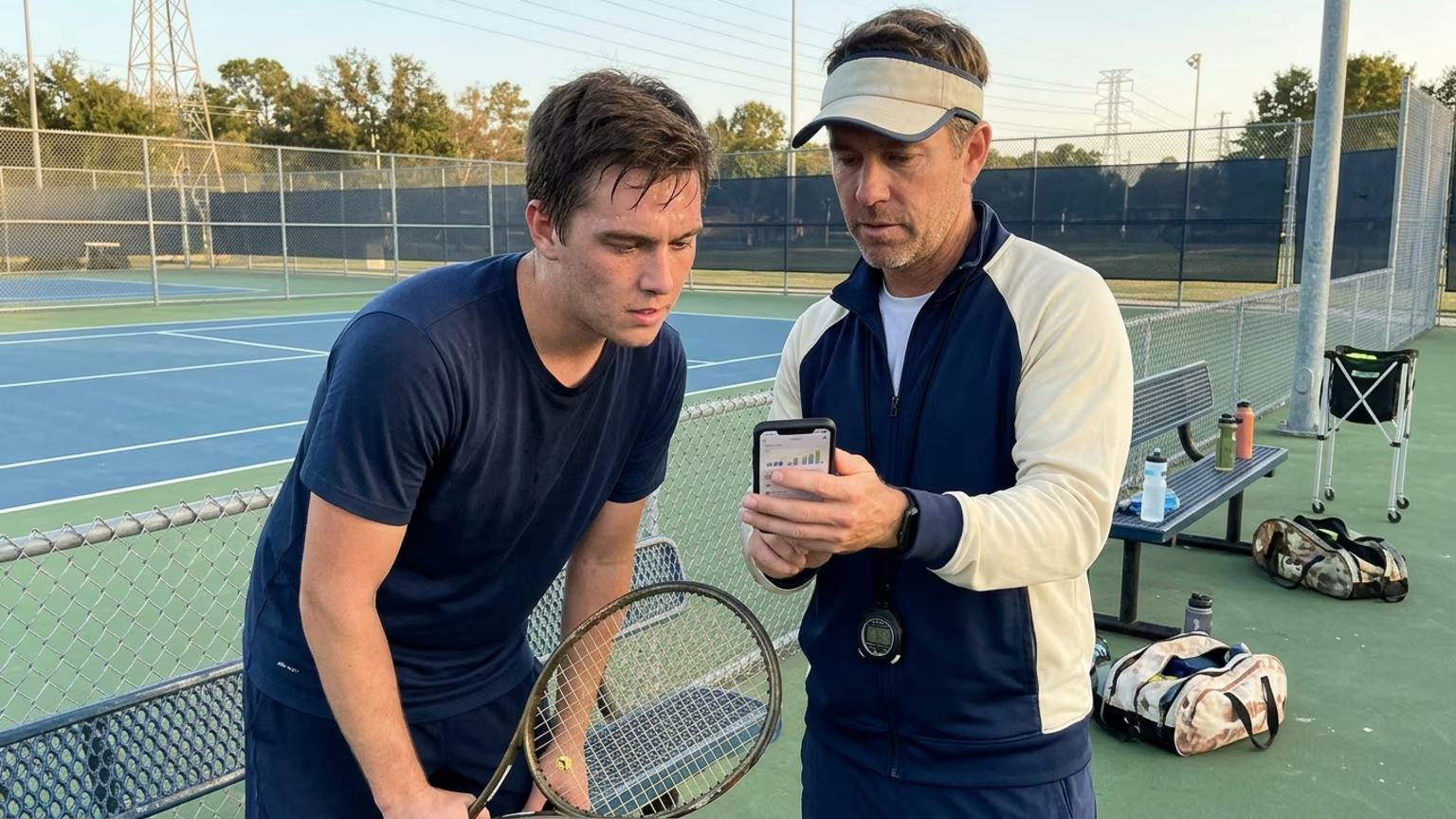
Track soreness, fatigue and movement between racquet-sport matches, with practical guidance on reviewing plans and seeking qualified advice.

A research-led look at tennis training load, with a simple log for court time, effort and symptoms to support a considered return after a break.
Read practical guidance for better movement, smarter preparation and a game that keeps working for you.
explore the Blog
