
Understand lower-body readiness through balance, footwork, footwear and court awareness, with evidence limits and signs to seek professional assessment.




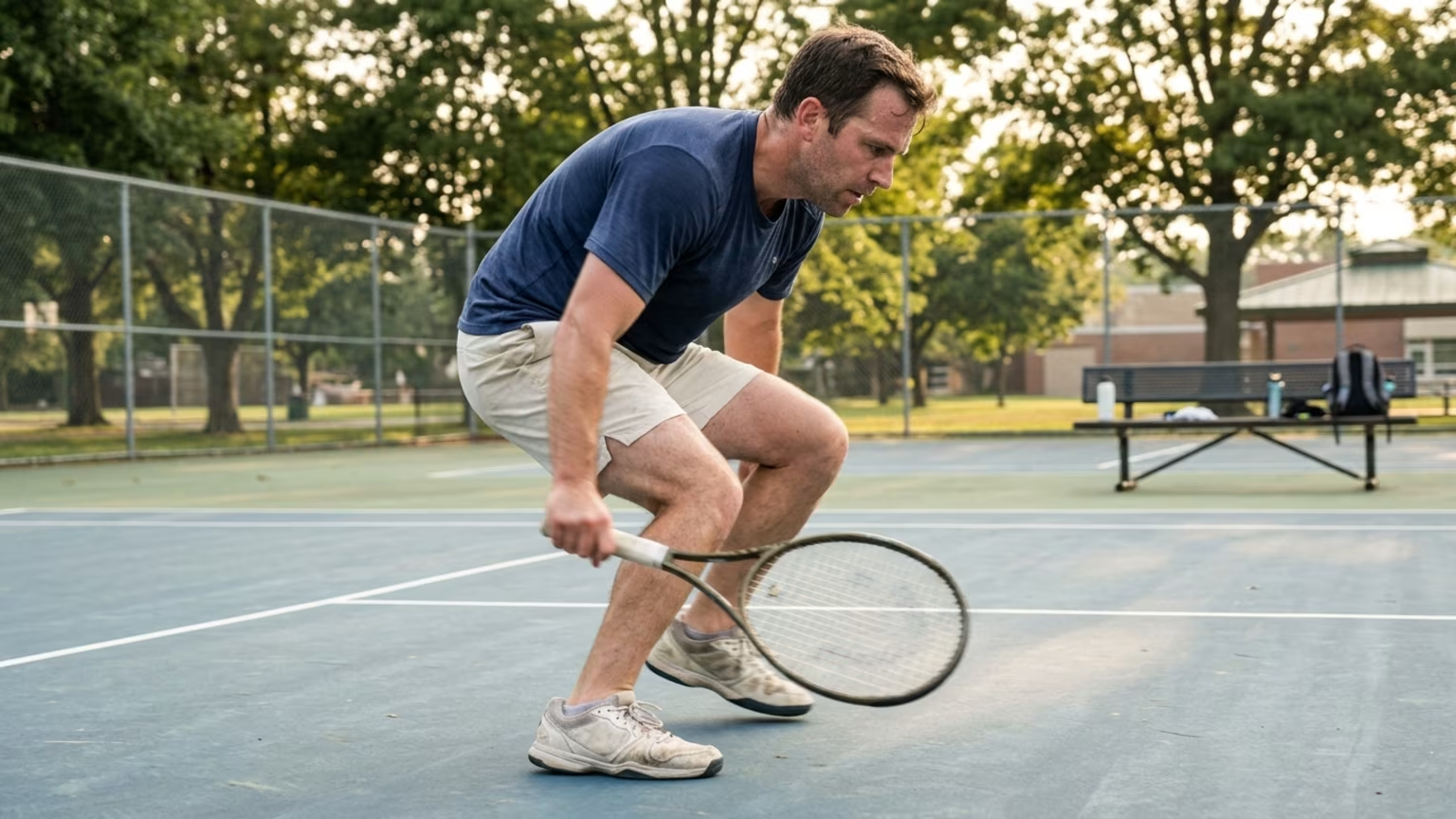
Lower-body readiness means having the balance and movement control to reach, stop and change direction on court. Picture the foot that plants before a reaching shot. The useful question is not just whether you can get there, but whether you can manage the movement and feel steady doing it.
For adult racquet-sport players, that question reaches beyond balance practice alone. The clinical guidance discussed below brings conditioning and preparation together with footwear and court awareness. The aim is a clearer way to think about playing capacity, not a promise of injury-free sport.
A burst toward the ball is only part of the movement. Stopping or changing direction adds another task. Repeating those efforts makes lower-body control relevant throughout a rally rather than only at the moment a player sets off.
A pickleball-focused clinical article describes lateral movement alongside reaching and lunging as features of play. These demands explain why preparation discussions include balance and lower-body conditioning. They do not mean that a reaching shot or a lunge is inherently harmful.
The useful movement lens differs from simply asking whether a player is fast:
These are reasons to connect balance with footwork rather than treat them as separate subjects. Thinking about movement tasks across different court formats also keeps the discussion tied to the game being played.
The clinical sources discuss several preparation factors together. These include balance-related activities and conditioning as well as footwear and movement choices. That supports a broad preparation conversation rather than searching for one exercise that solves every concern.
A paper hosted by University of Arkansas ScholarWorks reports that pickleball injury types and mechanisms differ across age groups. It argues for age-specific prevention approaches. The useful takeaway is that preparation should account for the individual rather than assume every adult player has the same needs.
The evidence has clear boundaries. The material is mainly pickleball-focused clinical guidance plus an age-related injury paper, not a direct trial of a prevention program across all three sports. It does not establish a universal exercise sequence or quantify the protective effect of balance practice and footwear. Nor does it establish that any single drill, shoe or warm-up guarantees injury prevention.
Those distinctions matter when reading advice. A clinical recommendation can identify something worth considering without proving how much it changes injury risk. For players, the practical response is to consider the relevant factors together and keep personal decisions connected to their own capabilities.
For athletic longevity, the useful goal is keeping preparation connected to the movements a player wants to continue making. That shifts attention from chasing a difficult balance exercise to understanding everyday movement control. It also leaves room for footwear and playing conditions rather than making physical conditioning carry the entire responsibility.
The following ideas come from the clinical guidance. They are options for observation and discussion, not an individual training prescription.
One clinical guide suggests several balance-related options:
These are possible practice activities or conservative self-observations, not validated pass/fail tests for court safety. The guidance also emphasizes that balance work should not create a fall risk.
A useful practical interpretation is to notice and describe the movement rather than award it a score. Feeling unsteady during a supported standing activity is information to discuss with a qualified professional. Completing an activity is not a reason to ignore concerns that appear during play.
This keeps attention on current movement capacity rather than on comparison with another player. It also gives a physio a clearer description of the concern than simply saying that footwork feels slower.
A pickleball-focused guide includes lunges and lateral bends among its warm-up examples. These provide concrete movements to discuss when considering preparation. They do not need to become a fixed routine for everyone.
The padel clinical material also includes strength and conditioning in its prevention discussion. For adult players, the practical question is how preparation relates to the movements they want to manage on court. Our guide to thinking about strength through court tasks offers a related editorial perspective.
The clinical footwear guidance favors court-sport shoes with lateral support and a sole suited to the playing surface. Footwear fit belongs in that suitability conversation. The emphasis is on considering the shoe in the context of play rather than assuming any athletic shoe serves the same purpose.
A practitioner guide also recommends avoiding wet or cracked courts and surfaces with clutter. It suggests turning rather than backpedaling when possible. These recommendations bring court awareness and movement choices into the same preparation picture as balance and conditioning.
For long-term participation, that is a useful change of emphasis. Preparation is not only something performed before a match. It also includes the conditions in which a player moves and the choices made while covering the court.
The clinical guidance recommends professional assessment for players with a history of falls or a feeling of unsteadiness. Either is a reason to consult a qualified physio or healthcare provider rather than use a balance activity to decide whether play is appropriate.
Unsteadiness noticed during ordinary movement or during one of the suggested activities belongs in that conversation too. Describe where it happens and which movements feel difficult. The purpose is an individual assessment, not an attempt to diagnose the problem yourself.
Return to the foot that plants before a reaching shot. Getting the ball back is only one part of the picture. If that step feels unsteady or there is a history of falls, the next useful step is qualified assessment rather than simply trying to move faster.
Follow Evercourts for practical insights on tennis, pickleball and padel performance, movement, recovery and healthy ageing. Stay connected for new articles, research-led guidance and ideas to help you play well and keep playing for years.



Holger Rune withdrew from the European Open with a back problem. The facts behind his decision and a grounded perspective for recreational players.

The Dink’s October 17 guide emphasizes deep returns, ball-height decisions and positioning against faster pickleball opponents.

A new report outlines padel and tennis gear trends. Learn how to assess adjustable rackets, sensor feedback and smart-court claims.
Read practical guidance for better movement, smarter preparation and a game that keeps working for you.
explore the Blog
