

Learn how adult racquet sports players can build a practical off-court strength foundation to support athletic longevity and improve court movement safely.




Off-court strength training for racquet sports is the systematic practice of using targeted resistance exercises to support the specific physical demands of playing. It provides the muscular foundation needed to push off a baseline, stop abruptly, and swing a racquet with control. For adult players, building this baseline capacity often dictates how frequently they can step onto the court without excessive soreness. A reliable strength routine serves as a highly practical bridge between daily life and the intense physical demands of court sports.
Most adult players do not need an elite collegiate conditioning program to see noticeable benefits on the court. The goal is simply to build enough physical resilience to handle repeated sprints and swings safely week after week. When you walk onto the court with your gear bag, your body needs physical preparation for the sudden forces it will soon experience. Preparing your muscles in a controlled environment makes those unpredictable match moments much more manageable for your joints and connective tissues.
Racquet sports require the body to handle intense, unpredictable forces that a typical daily routine cannot replicate. A tennis training guide from Phil Halfmann identifies repeated acceleration, braking, direction changes, and ground-up stroke production as useful considerations when planning strength work. Players must constantly start and stop in short bursts to reach the ball during a competitive baseline rally. This cycle of explosive movement and sudden deceleration places a heavy load on the legs, hips, and trunk over a two-hour match.
The physical tax varies slightly depending on the specific sport you play, but the underlying mechanisms remain similar. An Athleex padel training article recommends considering short accelerations and lateral movement. It also highlights overhead actions, shoulder control, forearm endurance, and trunk control as key training factors. The confined space of a padel or pickleball court forces players to react quickly and change direction constantly during rapid net exchanges.
These abrupt transitions ask your muscles and tendons to absorb high levels of force repeatedly throughout a match. Without supplementary strength, physical fatigue sets in faster, and overall movement quality naturally declines as the session progresses. This off-court foundation acts as a reliable buffer against that late-stage fatigue, preventing your footwork from becoming sluggish. A stronger lower body simply absorbs the shock of those continuous stops and starts much more efficiently.
The current research supports a pragmatic approach to training rather than a single perfect routine. Phil Halfmann suggests that a supportive gym program can be designed around squat, hip-hinge, and single-leg movements. Push-and-pull, calf, and trunk exercise categories also map closely to the movements you actually use during a match. The goal is to build general physical capacity rather than trying to perfectly replicate a forehand stroke with a heavy cable machine.
You can easily adapt these basic exercise categories to a home environment or a commercial gym setting. The tennis plan suggests rows and push-ups or presses for the upper body. A sensible approach is to select one or two exercises from these major categories and practice them consistently each week. If you prefer to train at home, a bodyweight sit-to-stand and a simple banded row can effectively target your major muscle groups.
The tennis training guidance lists trunk work and low-volume rotational power exercises, such as medicine-ball throws, for core stability. It also describes lateral movement drills and controlled changes of direction to further support agility on the court. You do not need complex equipment to challenge the muscles responsible for stabilizing your spine and hips during a swing. Basic core exercises build the necessary foundation for safely transferring power from your legs to your racquet.
While many fitness programs promise to make athletes completely injury-proof, no specific routine can guarantee absolute prevention. These foundational exercises simply provide a practical way to build muscular strength that complements your court time safely. The primary benefit is improved movement capacity rather than an unrealistic, guaranteed shield against all physical setbacks. Focusing on consistency over intensity will yield better results for your athletic longevity than following extreme workout trends.
Understanding how to balance strength work with court play is vital for your long-term athletic longevity. Phil Halfmann explicitly advises building movement quality first and raising only one training demand at a time. The same tennis source recommends adjusting gym volume to your court workload, scaling back when practice or match demands rise. This careful modulation helps prevent cumulative fatigue from overlapping too heavily with your actual playing time during busy tournament weeks.
A sustainable program for racquet-sport players should leave you feeling capable and energized on the court. Taking a measured approach helps adult players maintain their physical capabilities and continue enjoying racquet sports for years. When you align your strength routine with your weekly match schedule, you give your body a real chance to recover and adapt. Adjusting your exercises to fit your current physical tolerance is a fundamental hallmark of intelligent, sustainable training.
For example, the tennis program source says to adapt exercise angles and implements to your specific shoulder tolerance. A smart strategy prioritizes the off-court strength and balance work that keeps you moving well over time. Working within your physical limits ensures that your training supports your sport instead of directly competing with it. Modulating your workload around actual court demands is just as important as the specific exercises you select.
A general strength plan is meant to support healthy movement, but it is never a substitute for individualized medical advice. You should consult a qualified physiotherapist or healthcare provider if you experience sharp pain during any basic exercise. Persistent joint swelling or deep discomfort that outlasts normal post-match soreness also warrants an immediate professional evaluation. A professional can help identify specific mobility restrictions and tailor a targeted approach that suits your personal health history.
Players with existing cardiovascular concerns or a long history of joint issues should seek medical clearance before adding new physical demands. If you feel unusually breathless, experience chest discomfort, or notice sudden dizziness on or off the court, seek medical attention immediately. A structured medical evaluation provides necessary clarity and helps you return to your preferred physical activity safely. Ignoring clear warning signs in an attempt to push through discomfort will only sideline you longer.
Taking care of minor issues early is the most reliable way to stay active in the sports you love. Once you have a clean bill of health and a clear plan, you can confidently sling your gear bag over your shoulder again. Preparing your body properly ensures that the simple feeling of pushing off the baseline remains just as rewarding year after year. The goal is to keep playing the long game with confidence, strength, and joy.
Follow Evercourts for practical insights on tennis, pickleball and padel performance, movement, recovery and healthy ageing. Stay connected for new articles, research-led guidance and ideas to help you play well and keep playing for years.


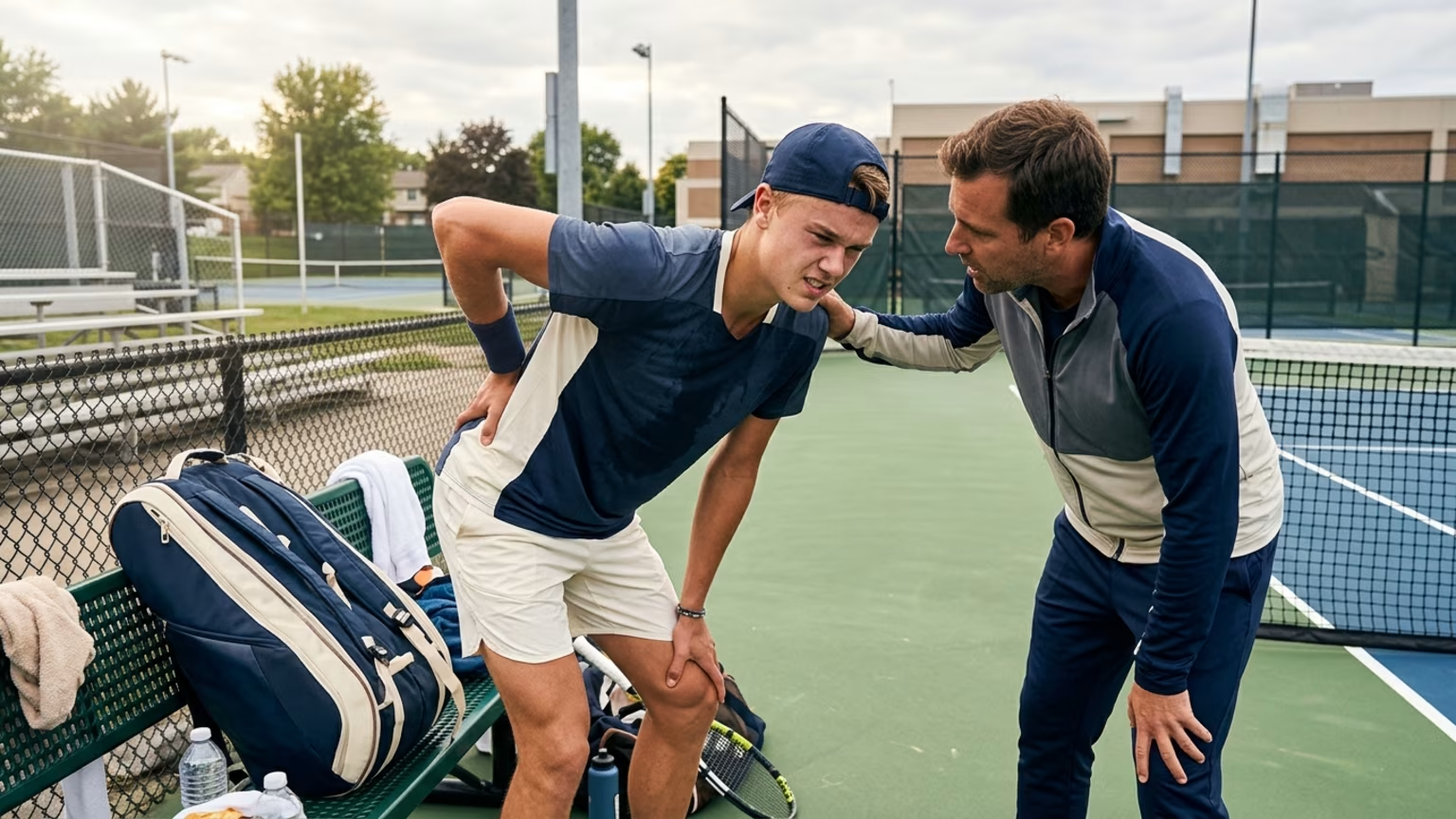
Holger Rune withdrew from the European Open with a back problem. The facts behind his decision and a grounded perspective for recreational players.

The Dink’s October 17 guide emphasizes deep returns, ball-height decisions and positioning against faster pickleball opponents.

A new report outlines padel and tennis gear trends. Learn how to assess adjustable rackets, sensor feedback and smart-court claims.
Read practical guidance for better movement, smarter preparation and a game that keeps working for you.
explore the Blog
