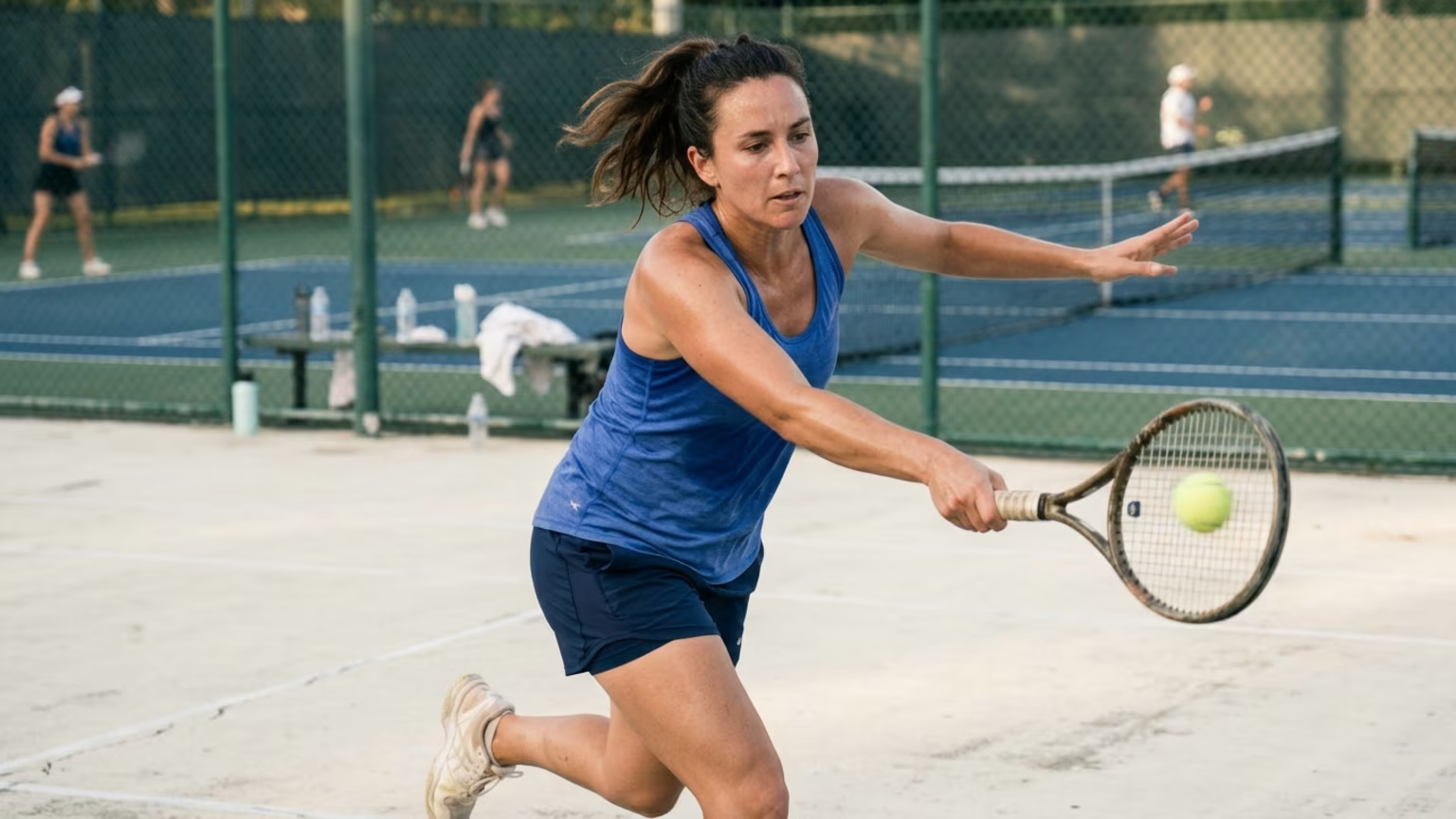

A practical strength guide for tennis, pickleball, and padel players. Learn how to train force absorption, braking, and lateral movement for athletic longevity.




Most gym workouts will completely fail a racquet athlete. Heavy back squats and rigid lifting programs are useless when you are frantically lunging for a drop shot. You have just finished a brutal three-setter, and your knees are barking with every step you take toward the car. The central problem across court sports is not maximum strength but the ability to repeatedly absorb and redirect force.
The repetitive stress of moving on a hard surface requires specific physical preparation. Every time you plant your foot to reach a wide backhand, your joints absorb massive force. If your muscles cannot handle that sudden braking action, the strain transfers directly to your tendons and ligaments. Recognizing this reality is the first step toward building a body that can handle decades of play.
The fitness industry loves to sell complex programs, but racquet athletes need straightforward capability and healthy longevity. A recent pickleball study describes lunging and rapid direction changes as key biomechanical demands. These frequent lateral movements and sudden jumps may help explain lower-extremity injury involvement. We need to train force absorption, unilateral control, rotational power, and work capacity.
The core objective is simple but frequently misunderstood by the general fitness industry. We are not trying to build massive powerlifters or aesthetic bodybuilders. Evercourts focuses on developing athletes who can move efficiently, recover quickly, and step onto the court without fear. A well-designed routine prioritizes specific capabilities over mere cosmetic muscle growth.
A few years ago, my tennis serve speed dropped, and my shoulder throbbed constantly after matches. Instead of pushing through the pain, I took a month to rebuild my mechanics and focus on rotator cuff endurance. I developed a much heavier kick serve, my win rate actually went up, and my shoulder stopped hurting. Sometimes athletic longevity means outsmarting your own ego on the court.
The need for accessible training options is massive. Tennis participation in the United States exceeded 27.3 million players in 2025, according to the United States Tennis Association. Nearly 40 percent of those players used public parks. Industry reports estimate that 24.3 million Americans played pickleball in 2025. This total divides into 16.8 million casual players and 7.48 million core players who played at least eight times during the year.
Meanwhile, available industry estimates for padel differ substantially. One report refers to more than 35 million active players, while another estimate is approximately 19.4 million worldwide.
General adult activity guidance supports at least two strengthening sessions per week. An overview indexed by PEDro found that physical-activity programs containing resistance training benefited frailty reversal and progression outcomes across 28 primary studies and 3,246 participants. For the active player, two nonconsecutive sessions of 25 to 40 minutes can maintain athletic longevity. You only need body weight, resistance bands, a backpack, or a pair of dumbbells.
Before starting your first session, remember that form dictates your long-term outcome. Pushing past your physical limits with poor technique is a recipe for disaster. The objective is to stimulate the muscles, not to leave yourself exhausted and sore for three days. You should finish every workout feeling capable of playing a light match.
Perform two to three sets of each movement, leaving two to three controlled repetitions in reserve. Start with eight to twelve repetitions of a sit-to-stand or goblet squat. Follow this with six to ten reverse lunges or supported split squats per side. Next, perform eight to twelve repetitions of a hip hinge using a backpack or dumbbells.
Move to upper body work with ten to fifteen band rows, and complete eight to twelve Pallof presses per side for rotational control. Finish with twelve to twenty calf raises and 20 to 40 seconds of single-leg balance work per side. Learning how to build a sustainable program for racquet-sport players ensures you progress safely over time. Consistency is far more important than intensity when building foundational tissue resilience.
This second session targets lateral control, braking, and overhead support. Perform two to three sets of eight to twelve step-ups per side. Follow this with six to ten supported lateral lunges per side. The third movement is a slow step-down, performing five to eight repetitions per side with a three to four-second lowering phase.
The slow step-down is arguably the most important exercise for preserving knee health. It trains the quadriceps to lengthen under tension, directly mimicking the stress of stopping on a hard court. Mastering this single movement will dramatically improve your lower-body durability. Incorporating this drill regularly provides a massive return on a very small time investment.
Include eight to fifteen incline push-ups and ten to fifteen band external rotations per side to build shoulder endurance. Add a suitcase carry for 20 to 40 seconds per side. Finish with eight to twelve wall slides and four to six controlled low-impact lateral step-and-stick repetitions per side. Understanding why traditional gym machines fail racquet sport players highlights why these free-weight movements work so well.
To progress safely, you must manipulate one variable at a time. You might add two repetitions, increase your band tension, or use a slightly heavier backpack. The player should always preserve perfect bodily alignment and control during every single repetition. This deliberate pacing prevents the connective tissue flare-ups that typically ruin a recreational season.
A sustainable weekly schedule balances your time on the court with adequate physical recovery. You might complete your first strength session on Monday, play a light match on Tuesday, and rest entirely on Wednesday. Follow this with your second strength session on Thursday, leaving your weekend open for serious competition. This cadence ensures your muscles are fully prepared before engaging in high-intensity rallies.
While the base protocol builds general resilience, the movement demands are not identical across sports. Tennis involves a larger court and substantial coverage, requiring highly conditioned lateral shuffles and split steps. Tennis players should prioritize their single-leg balance and lateral step-downs. This ensures strong force absorption when stopping to hit groundstrokes.
Moving across a full tennis court requires immense eccentric strength. You are often sprinting at full speed before suddenly planting an outside foot to hit a forehand. This violent deceleration creates a massive load on the lateral hip and ankle. Dedicated lateral lunges and banded step-downs prepare your body for this exact scenario.
Pickleball emphasizes short, reactive movements and low-position play. Players must handle repeated short accelerations, decelerations, lateral movements, and lunges. If you spend hours on a compact court, emphasize the slow step-downs and split-squat lowering drills. Building strong braking mechanics is crucial for protecting the knees during endless dinking rallies.
The geometry of a pickleball court changes the mechanical equation entirely. The non-volley zone line forces players into deep, prolonged crouching positions to defend against dinks. You are constantly lunging forward, recovering backward, and shifting laterally in a compact space. This repetitive low-level crouching requires exceptional muscular endurance in the quadriceps and glutes.
Padel introduces walls and frequent transitions near the net. Padel players perform constant rotational movements and overhead strokes. To maintain capability here, focus heavily on the Pallof presses, band-resisted rotations, and external shoulder rotations. Avoiding common strength training mistakes will keep you off the injured list.
Padel requires an entirely different approach to rotational mechanics and spatial awareness. The inclusion of glass walls means you are frequently twisting to dig out awkward rebounds. Your spine and core must act as a rigid cylinder to transfer power from the floor to your racquet. Dedicated anti-rotation work ensures you can handle these awkward defensive postures safely.
True resilience is built quietly in the hours away from the court, long before the first serve is even tossed.
Follow Evercourts for practical insights on tennis, pickleball and padel performance, movement, recovery and healthy ageing. Stay connected for new articles, research-led guidance and ideas to help you play well and keep playing for years.


Holger Rune withdrew from the European Open with a back problem. The facts behind his decision and a grounded perspective for recreational players.

The Dink’s October 17 guide emphasizes deep returns, ball-height decisions and positioning against faster pickleball opponents.

A new report outlines padel and tennis gear trends. Learn how to assess adjustable rackets, sensor feedback and smart-court claims.
Read practical guidance for better movement, smarter preparation and a game that keeps working for you.
explore the Blog
