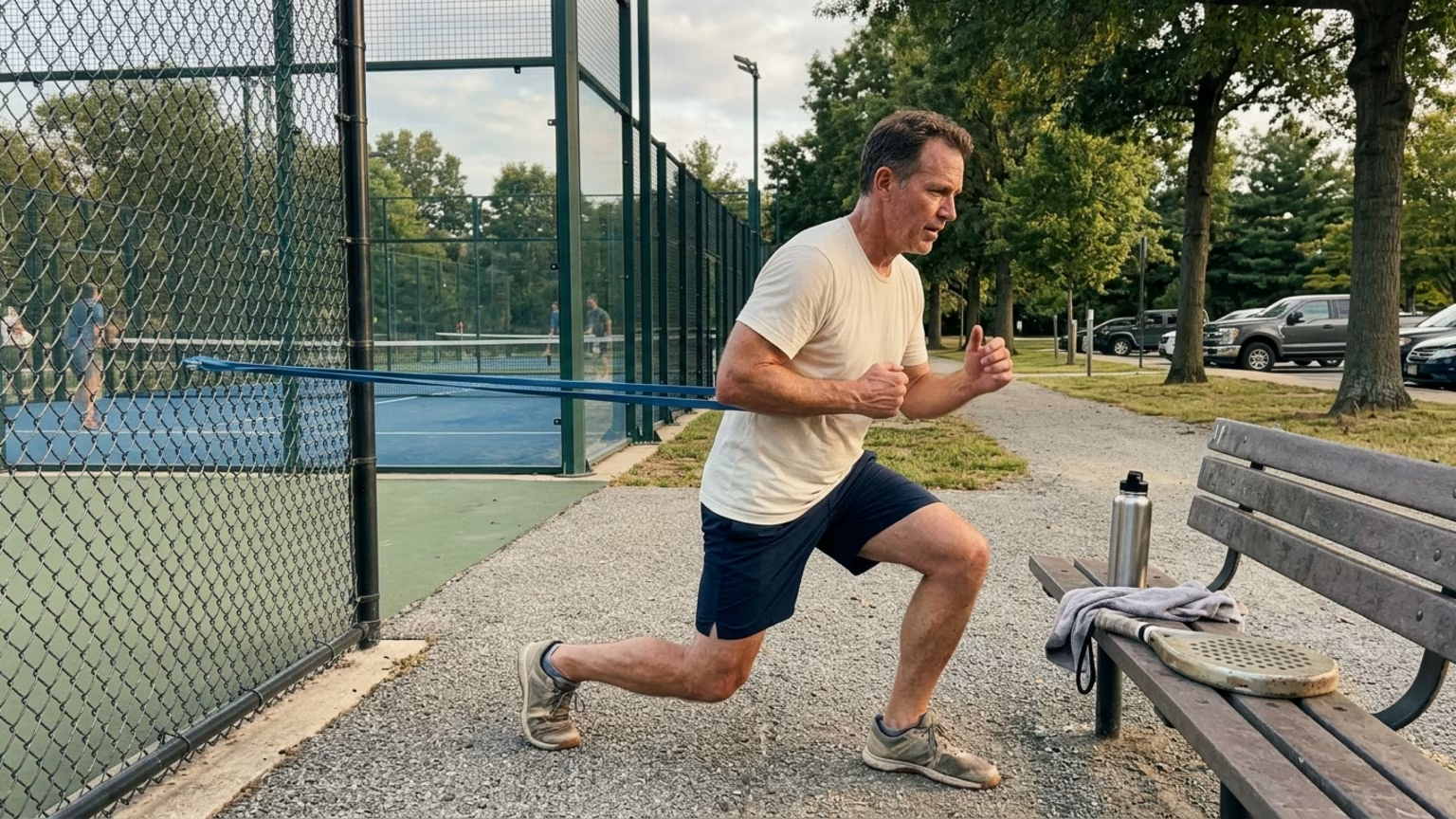

Strength training helps padel, tennis, and pickleball players maintain physical capacity and athletic longevity. Learn why conditioning matters for adult players.




Strength training for racquet sports is a targeted conditioning method that prepares your muscles and joints for repeated bursts of movement. Adult recreational and competitive players often view time in the gym solely as a way to hit the ball harder. However, a sensible routine actually serves to support your joints and maintain your everyday physical capacity. Building tissue resilience allows you to handle the unpredictable start-and-stop nature of court sports.
When you step onto the court, your body acts as a dynamic shock absorber. Every time you plant your foot to change direction, your muscles must manage forces that can exceed your body weight. A structured physical foundation ensures your legs, hips, and trunk can tolerate these repeated impacts safely over time. Without this baseline preparation, the repetitive stress of weekly matches can slowly wear down your movement efficiency.
Developing functional strength does not require lifting massive weights or adopting a grueling daily fitness regimen. Instead, it involves consistent, moderate resistance work that mirrors the physical demands of your chosen sport. Simple bodyweight exercises and banded movements can provide more than enough stimulus for the average adult player. The ultimate goal is simply to build a physical buffer that keeps you playing comfortably week after week.
Racquet sports tax the lower body and trunk heavily because they require constant changes of direction at varying speeds. You are rarely running in a straight line for long distances during a typical competitive point. Instead, you are lunging for a drop shot, pivoting backward to track a lob, and braking hard near the net. These erratic movement patterns place significant structural stress on your entire musculoskeletal system during every single match.
The continuous cycle of sprinting and stopping requires your muscles to absorb and generate force very quickly. Your hips and lower body serve as the primary engine for almost every explosive movement on the court. When you push off to retrieve a wide volley, your hips must generate immense lateral power safely. Proper physical conditioning builds a muscular buffer that protects these vulnerable hinge joints from excessive wear and tear.
This cross-chain demand is exactly why a targeted strength strategy is so incredibly valuable for regular players. Power in racquet sports is rarely generated by an isolated muscle group working entirely on its own. Energy transfers smoothly from your feet through your legs, across your trunk, and into your shoulder and forearm. If any link in this kinetic chain is weak, other joints will inevitably compensate and take on extra stress.
Your upper body also handles a tremendous amount of repetitive force during a standard hitting session. Your shoulders and forearms absorb the final physical impact of the ball against the rigid racquet face. Strengthening these connected upper body areas helps you manage the vibration of repetitive striking without developing chronic discomfort. A balanced training approach ensures that neither your upper nor your lower body becomes a physical liability.
The scientific literature provides practical context for racquet sports without making exaggerated promises about absolute injury prevention. Exercise science increasingly looks at how the specific, intermittent physical demands of court sports affect the adult body. The general consensus confirms that maintaining lower-limb strength is highly relevant to sustaining energy during prolonged match play. Building baseline leg strength gives you a larger physical buffer before fatigue-induced movement breakdown occurs on the court.
When your quadriceps become severely fatigued, your body often alters its movement mechanics to compensate for the lost stability. This subconscious compensation can place unintended stress on your knees and lower back as the match progresses. A well-rounded physical conditioning program helps delay the onset of this fatigue so you can maintain proper footwork. Maintaining your mechanical efficiency is crucial for playing competitive matches safely in your second or third hour.
It is important to view strength conditioning strictly as part of a broader physical maintenance plan rather than a cure-all. Conditioning is a sensible, well-documented piece of your overall athletic puzzle, not a guaranteed shield against all possible injuries. You can easily pair these gym efforts with seasonal recovery planning to manage your total physical load safely. The core scientific takeaway is simply that strong, well-conditioned muscles handle intermittent sporting demands much more efficiently.
It is also critical to remember that physical adaptations take time and consistency to manifest properly. The available research does not support the idea that a single magical exercise can resolve all joint stress. Instead, sensible guidelines point toward a moderate approach to progressive tissue loading over a period of months. Building functional strength is a gradual physiological process that requires patience and realistic expectations from the adult athlete.
Understanding the specific physical toll of racquet sports helps adult players stay on the court for years to come. Healthy aging requires proactively adapting your physical preparation to match your current capabilities and weekly match volume. One recent qualitative study investigated the health experiences of seniors playing padel in a forest setting. While environmental factors certainly play a role in enjoyment, maintaining general movement capacity remains the true foundation of athletic longevity.
Consistent, moderate conditioning directly helps preserve your agility, balance, and overall joint health as you grow older. When you rely too heavily on your forearm and shoulder, you drastically increase the risk of localized joint strain. Engaging your trunk allows you to distribute the physical stress of the swing safely across much larger muscle groups. Practicing these rotational patterns in a controlled gym environment properly prepares your nervous system for the chaos of live competition.
Building this essential baseline physical capacity allows you to maintain the strength training and court time balance needed for continued enjoyment. Prioritizing consistent strength work ensures that you can keep booking competitive court times well into your later decades. It transforms your physical preparation from a tedious chore into an empowering tool for long-term athletic independence. The goal is to build a resilient body that supports the active lifestyle you want to lead.
The benefits of a practical strength routine also extend far beyond your performance during a weekend padel match. Stronger legs and a more stable trunk directly improve your ability to perform everyday physical tasks with ease. Maintaining this functional independence is a major cornerstone of true athletic longevity for adult recreational players. The valuable time you invest in the gym pays massive dividends in both your sporting life and your everyday mobility.
Even with a highly proactive strength routine, racquet sports can sometimes lead to localized joint stress or unexpected discomfort. Minor muscle soreness a day or two after a tough match is often a perfectly normal part of the adaptation process. However, sharp pain that fundamentally changes how you swing or step always requires immediate expert medical evaluation. You should immediately consult a qualified physiotherapist if you experience swelling, numbness, or stiffness that lasts for multiple days.
A professional physical assessment can accurately identify whether a persistent ache is a minor technique issue or a deeper structural limitation. Qualified healthcare providers offer a highly personalized clinical diagnosis that general fitness articles simply cannot provide. Ignoring localized joint pain often forces your body to develop poor compensation habits that can be incredibly difficult to unlearn. Addressing these physical warning signs early is a critical component of taking your athletic health seriously.
Medical professionals can help you modify your weekly training load appropriately while you recover from a specific physical setback. They are your absolute best resource for creating a safe, progressive return-to-play timeline after an extended break from the court. Getting ahead of minor muscle tweaks prevents them from developing into chronic issues that force you off the court entirely. Your single actionable takeaway for today is to add a simple five-minute dynamic trunk rotation routine before your next match.
Follow Evercourts for practical insights on tennis, pickleball and padel performance, movement, recovery and healthy ageing. Stay connected for new articles, research-led guidance and ideas to help you play well and keep playing for years.



Holger Rune withdrew from the European Open with a back problem. The facts behind his decision and a grounded perspective for recreational players.

The Dink’s October 17 guide emphasizes deep returns, ball-height decisions and positioning against faster pickleball opponents.

A new report outlines padel and tennis gear trends. Learn how to assess adjustable rackets, sensor feedback and smart-court claims.
Read practical guidance for better movement, smarter preparation and a game that keeps working for you.
explore the Blog
