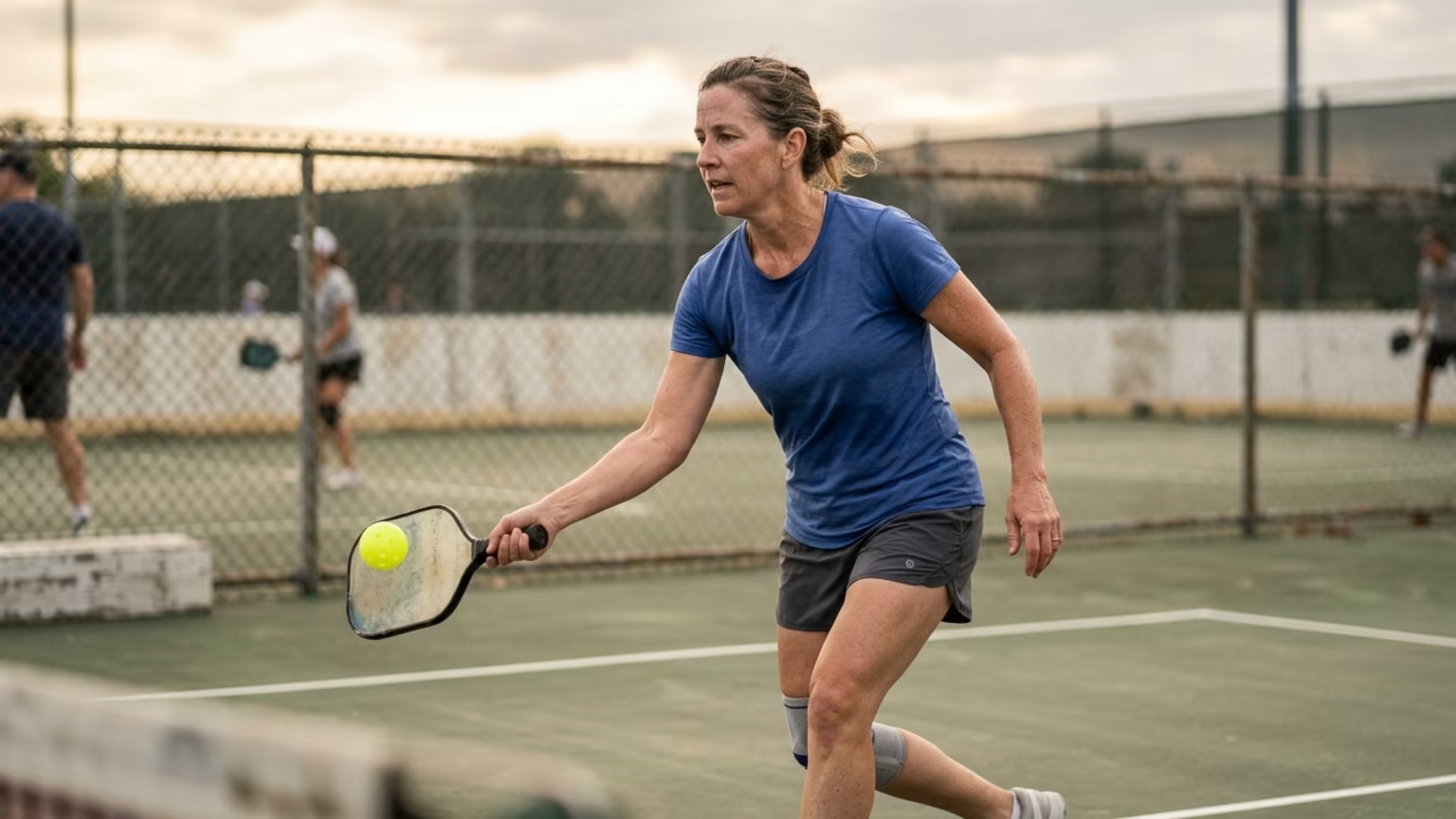

Discover a weekly strength plan for tennis, pickleball, and padel players. Learn how force, power, and balance support athletic longevity on the court.




Traditional strength training involves controlled movements that produce significant muscular force. Exercises like squats, hip hinges and calf raises build the physical reserve required for adult racquet sports. A systematic review found that resistance-training interventions improved strength and functional outcomes in older adults with dynapenia. Dynapenia simply refers to the age-related loss of muscle strength.
This modality fundamentally alters a player's physical capabilities by increasing total force capacity. Players need this raw strength to push away from an outside leg and maintain a defensive posture. It also protects the lower body during repeated court strokes. Health guidelines recommend that older adults perform muscle-strengthening activities involving the major muscle groups on at least two days per week.
A wide reach often ends with the player supported by one leg. The hips are typically lowered, and the trunk is angled toward the incoming ball. Traditional lifting excels at building the specific single-leg and trunk capacity required for this posture. The objective is to build enough capacity that a player can reach without collapsing through the knee or hip.
Useful strength qualities include single-leg stability developed through split squats and step-ups. Hip strength is reliably built using bridges and Romanian deadlifts. Trunk strength relies heavily on carries, dead bugs and side planks. This baseline strength acts as an essential insurance policy against the intense physical demands of competitive play.
Stopping is fundamentally a braking task that requires substantial force absorption. The player must lower their center of mass, place their foot effectively and absorb force through the lower joints. Controlled lowering exercises teach the body to tolerate heavy loads safely. Exercises like step-downs and single-leg hinges are particularly useful for this specific purpose.
When an athlete practices landing with control, they minimize the shock traveling through their joints. This precise mechanical control translates directly to smoother on-court footwork. By focusing on the lowering phase of a lift, players learn to manage eccentric forces. For a complete look at scheduling these sessions, review our guide on planning multi-year athletic habits.
Dynamic court training contrasts with traditional lifting by prioritizing speed and body control over raw load. This modality encompasses power exercises like fast sit-to-stands and balance drills like single-leg reaches. Power is simply force expressed quickly, which dictates how fast a player can react. It determines your ability to chase a short ball or recover from a wide defensive stance.
A specialist evidence summary reports that a 2022 meta-analysis found moderate functional benefits from power training compared with traditional strength training in older adults. While heavy lifting builds the engine, power training ensures the engine can accelerate rapidly. Sensorimotor exercise can also improve balance in older adult populations. Balance is crucial for controlling the body while braking after a sprint or moving laterally.
For older adults with poorer mobility, guidance recommends balance-focused activity on three or more days per week. Balance on court means controlling the body while reaching far outside the base of support. Beginners can start with supported single-leg stances and simple tandem walking. More experienced players can progress to single-leg reaches without hand support and lateral step-and-stick drills.
These exercises should include active movement and decision-making rather than just stationary holds. A 2025 systematic review identified braking forces, centripetal force production and ground-contact time as important change-of-direction variables. Dynamic training specifically targets these elements through controlled deceleration drills. Integrating these habits successfully requires structuring a sustainable schedule around regular match play.
Power tends to be especially relevant to aging athletes because the ability to perform fast movements declines rapidly. The goal is always controlled intent, meaning athletes should move quickly only when the landing position is safe. Fast training should never mean reckless training for any recreational athlete. A small number of high-quality repetitions is much more appropriate than conditioning-style fatigue circuits.
Beginners can focus on fast but controlled sit-to-stands and marching with rapid foot contacts. Intermediates might use low-amplitude lateral push-offs and light band-resisted acceleration steps. Experienced recreational competitors can incorporate lateral bounds to a stable landing and short shuffle-and-brake patterns. Players should stop any set immediately when movement becomes slow, noisy or poorly controlled.
Different racquet sports place highly unique biomechanical demands on the human body. The physical requirements shift dramatically depending on court size, equipment choices and match pacing. Players must align their physical conditioning with the specific realities of their chosen game. Applying a generic fitness plan often leaves critical sport-specific movement gaps entirely unaddressed.
Tennis requires explosive power to cover a massive court area effectively. A tennis player relies heavily on dynamic power training to fuel aggressive sprints and rapid directional changes. Without the ability to produce force quickly, reaching wide forehands becomes increasingly difficult during long matches. The sheer distance covered demands a very high degree of neuromuscular responsiveness.
Traditional strength training is equally vital to protect the shoulders and core during heavy serves. The combination of maximal force and rapid acceleration truly defines the sport. Players must carefully manage their lower-body training volume during tournament weeks to avoid accumulating excessive fatigue.
Pickleball is characterized by its stop-start nature and rapid physical transitions. Players frequently rush to the kitchen line and must hit the brakes almost instantly. This specific demand makes the braking focus of dynamic balance work incredibly advantageous. Learning to absorb force safely prevents forward momentum from overwhelming the knees and ankles.
Because the court is smaller, maximum sprint speed matters significantly less than rapid deceleration. Players must master low-amplitude lateral push-offs to defend the non-volley zone effectively. A heavy emphasis on eccentric strength and dynamic balance serves pickleball players exceptionally well.
Padel demands relentless multidirectional movement and constant rotational body adjustments. The sport forces players to track balls off the glass while moving backward and sideways simultaneously. Traditional strength training provides the single-leg stability required for these awkward, twisting positions. Heavy hip and trunk strength keeps padel players upright and balanced during prolonged, grueling rallies.
The turf surface also changes how players grip the court and absorb physical impact. A robust program of multidirectional hops prepares the lower body for these unique traction requirements. Padel competitors lean heavily on the single-leg resilience developed through traditional resistance training.
When choosing the best approach for healthy aging on the court, traditional strength training remains the definitive winner. Resistance exercise is one of the most consistently supported ways to improve neuromuscular function and overall physical performance. While power and balance drills enhance court-specific skills, they require a baseline of muscular strength to be performed safely. You cannot absorb braking forces effectively if your muscles lack the basic capacity to tolerate the load.
Public health targets advise at least 150 minutes of moderate-intensity aerobic activity per week, or an equivalent amount of vigorous activity, alongside muscle strengthening. Players should establish two weekly strength sessions as their absolute, non-negotiable physical foundation. Once this base is secure, players can strategically add brief power and balance exposures to refine their court movement. This prioritized approach ensures that players maintain the resilient physical reserve needed to enjoy their sport for years.
Start by scheduling two dedicated resistance sessions this week to build your foundational force reserve.
Follow Evercourts for practical insights on tennis, pickleball and padel performance, movement, recovery and healthy ageing. Stay connected for new articles, research-led guidance and ideas to help you play well and keep playing for years.


Holger Rune withdrew from the European Open with a back problem. The facts behind his decision and a grounded perspective for recreational players.

The Dink’s October 17 guide emphasizes deep returns, ball-height decisions and positioning against faster pickleball opponents.

A new report outlines padel and tennis gear trends. Learn how to assess adjustable rackets, sensor feedback and smart-court claims.
Read practical guidance for better movement, smarter preparation and a game that keeps working for you.
explore the Blog
