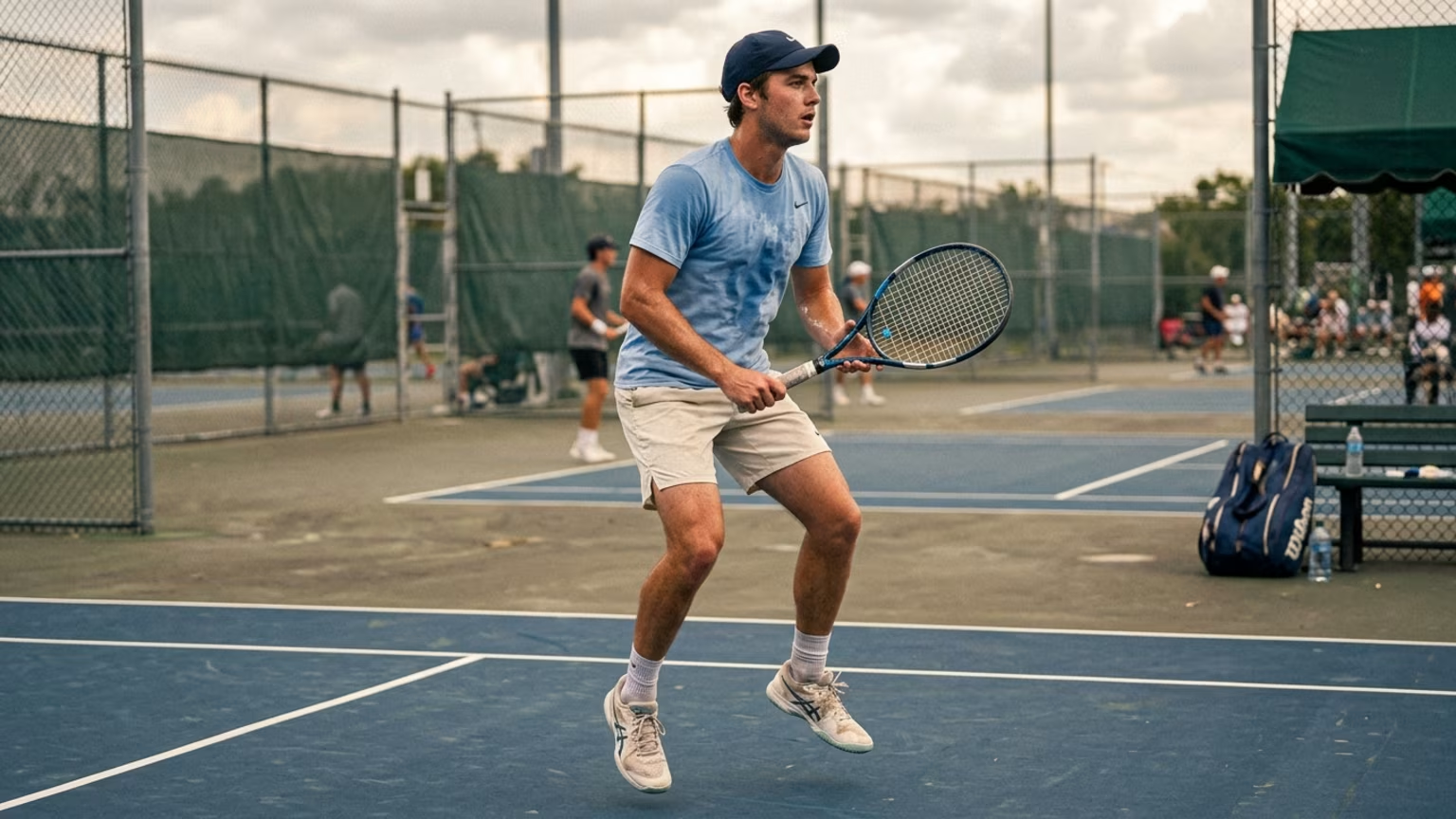

Master the split step to improve your tennis, pickleball and padel reaction time. Learn the timing, mechanics and science behind this essential movement skill.




A heavy forehand leaves the opposing baseline and speeds toward the service box. You have a fraction of a second to react. The split step is a small two-footed hop timed so the player lands just as the opponent makes contact. This movement serves as a vital timing and readiness skill rather than a generic fitness exercise.
Many players mistakenly view it as a way to jump higher or build endurance. In reality, it creates a balanced base that allows the player to move left, right, forward or backward once the shot direction is known. The central timing rule is surprisingly simple to understand but difficult to master. You must begin the hop just before the opponent strikes the ball. The objective is to land exactly as contact occurs.
Tennis, pickleball and padel require constant reading of unpredictable angles. These sports demand repeated bursts of acceleration and rapid changes of direction. Players cannot simply guess where the ball will go. They must wait for concrete information while staying completely mobile.
If a player lands too early, they become flat-footed and stuck. This error forces them to take a second adjustment step before reacting. If they jump too late, they are still airborne when the ball crosses the net. Both errors severely reduce the practical value of the movement.
Each sport places unique pressures on this timing sequence. Tennis players must absorb high speeds on serve returns. The returner should use the server's final forward action as the rhythm cue. Pickleball players need highly compact resets near the kitchen line due to the shorter distances.
In padel, wall rebounds force players to prepare for initial shots and subsequent redirections off the back glass. These continuous directional shifts tax the lower limbs heavily over a long match. Padel coaching material describes the movement as a light reset timed to the opponent's contact.
The mechanics of a proper landing are incredibly precise. Players should land quietly with soft knees and a balanced base. The feet should generally land around hip or shoulder width. An overly wide base can make lateral movement less fluid and increase the strain on the hips.
Your body weight should remain available to push off in any direction. The movement creates a brief reset between the opponent's contact and your first directional step. The hop itself does not carry you toward the ball. It simply prevents you from committing to the wrong direction before the ball's trajectory is clear.
Coaching and biomechanics sources describe this landing as a rapid loading action involving the stretch-shortening cycle. This physical mechanism helps the lower limbs store and release energy efficiently. Some coaching material suggests a jump height of 3 to 6 inches. However, that specific figure comes from instructional guidance rather than strong primary research.
Balance always takes priority over jump height. A large jump increases airtime and can make the player consistently late. A small hop that finishes in a stable ready position is usually much more useful for reacting. Players should feel pressure through both feet rather than leaning exclusively to one side.
The academic literature provides measured insights rather than sweeping performance guarantees. A secondary account of a 2009 study on skilled tennis players examined simulated choice-reaction movements. The study reported that participants completed a step-and-reach task in an average of 764 milliseconds when using a split step. Without the movement, that average slowed to 868 milliseconds.
This data illustrates the value of a balanced reset without proving it will double any player's speed. Timing also changes based on court position and the specific sport. Padel coaching guidance recommends adapting your timing when the ball is likely to rebound from the glass.
Some padel instructions claim a wall rebound reduces the reaction window by exactly half a second. Players should treat that specific number cautiously, as the accessible source is instructional rather than peer-reviewed. The practical takeaway is to scale the movement to the speed of the rally. Fast exchanges require a low, compact hop with minimal airtime.
For adult players focused on healthy aging, this fundamental habit offers excellent low-dose coordination practice. Training this movement is not about maximizing vertical jump height or exhausted repetitions. It is about maintaining the ability to lower the centre of mass without losing posture. Players can practice absorbing landing forces quietly and decelerating under control.
A recent change-of-direction study associated braking and force-production measures with several key physical factors. These factors include hip and knee flexion, centre-of-mass height and foot placement. While not entirely specific to racquet sports, these mechanics highlight the importance of controlled joint loading. Older players can preserve their playing ability by practicing quiet, balanced landings during their regular warm-up.
The most useful aging-related goal is simply to maintain essential movement capabilities. You need to push safely in either direction and turn securely when a ball goes behind you. The split step exposes limitations that may not be obvious during straight-line running. A player might have adequate speed but poor single-leg control or difficulty braking.
Improving these mechanics helps adult players stay on the court for years to come. Refining this timing skill does not require intense plyometric training. Practicing directional reactions and controlled deceleration at a manageable pace yields significant physical benefits. Consistency and balance remain far more important than explosive power.
Refining your court movement should always feel productive and relatively pain-free. If practicing small hops causes sharp pain in the knees, ankles or Achilles tendons, you must stop immediately. Recurring stiffness that prevents you from keeping your knees soft is another clear warning sign. Adult players returning from injury should progress gradually rather than rushing into intense footwork drills.
The inability to hop safely or balance evenly requires careful individual assessment. A qualified physiotherapist or sports medicine professional can evaluate your lower limb control and movement patterns. They can identify any specific weaknesses in your braking mechanics or joint mobility.
Proper pre-match preparation and targeted physical therapy can resolve many of these underlying issues. Addressing these limitations early helps ensure you can maintain your movement quality safely. Move well, play smart and keep your base balanced for the next shot.
Follow Evercourts for practical insights on tennis, pickleball and padel performance, movement, recovery and healthy ageing. Stay connected for new articles, research-led guidance and ideas to help you play well and keep playing for years.


Holger Rune withdrew from the European Open with a back problem. The facts behind his decision and a grounded perspective for recreational players.

The Dink’s October 17 guide emphasizes deep returns, ball-height decisions and positioning against faster pickleball opponents.

A new report outlines padel and tennis gear trends. Learn how to assess adjustable rackets, sensor feedback and smart-court claims.
Read practical guidance for better movement, smarter preparation and a game that keeps working for you.
explore the Blog
