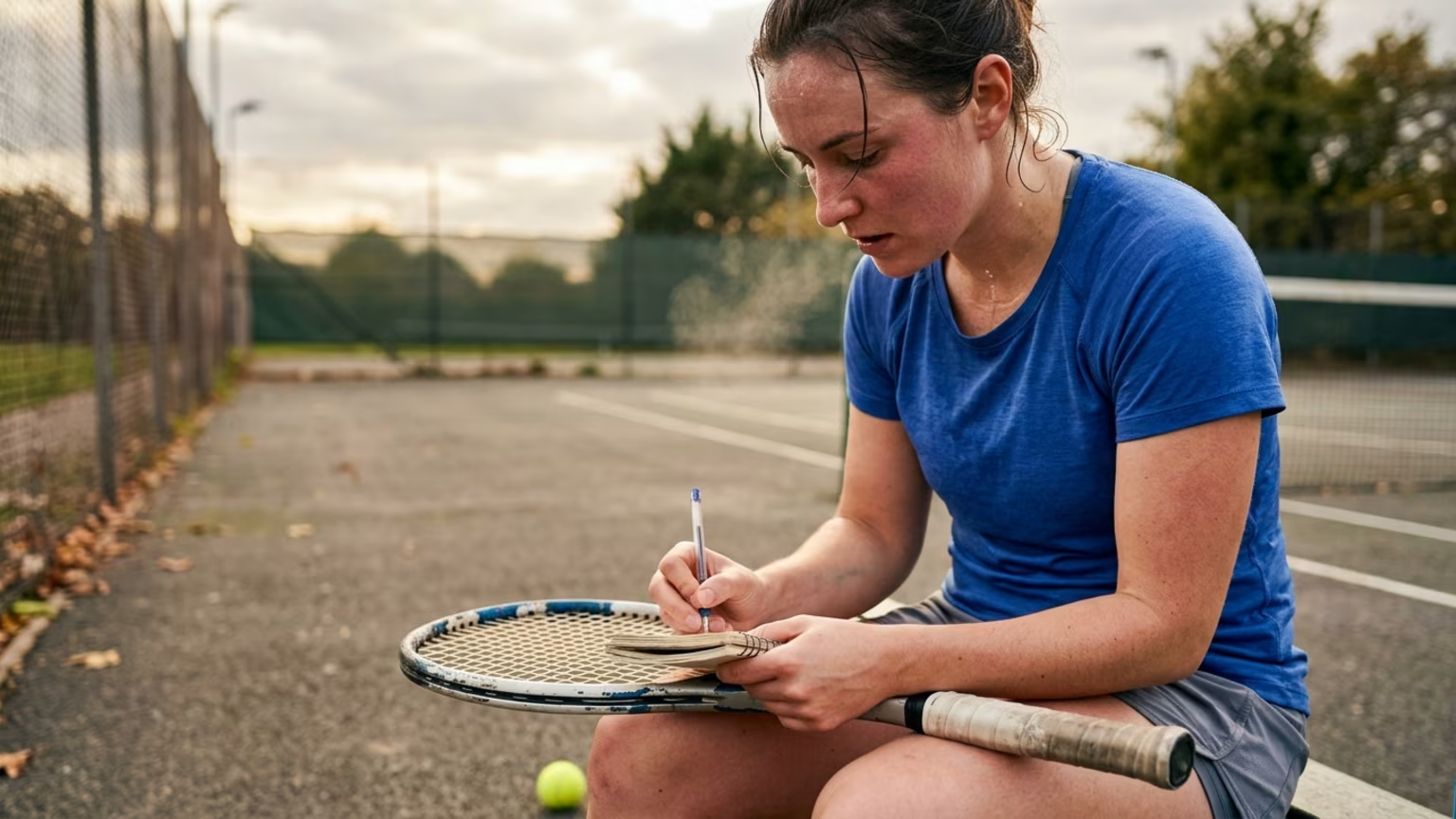

Learn how to manage your racquet sports training load safely. Track session difficulty and optimize recovery for healthy aging on the court.




More time spent sweating on the court does not automatically equal more athletic progress. Players frequently assume that endless hours of repetitive hitting are strictly required to advance their skills. This outdated mindset completely ignores how accumulated fatigue quietly degrades movement quality and tactical execution.
"How do I know if I am training hard enough to improve without pushing myself into an injury?" You manage your training load by tracking the actual difficulty of each session rather than just the time on the clock.
I remember finishing a tough two hour padel match on a cold Tuesday night and waking up the next morning feeling like my lower back was locked in concrete. For a long time, I just accepted this as the price of playing hard in my forties. But once I started spending just ten minutes on targeted hip mobility before heading to the club, the stiffness almost completely vanished. It taught me that we do not have to accept pain as a default state of aging.
Tracking your load is simply an extension of this proactive mindset. Many players treat every single court session as a maximum effort event. This approach becomes risky when participation surges and players suddenly increase their exposure. One report based on U.S. emergency-room estimates said pickleball injuries increased from approximately 8,304 cases in 2018 to 32,960 in 2024 before falling slightly to 31,463 in 2025.
This sharp rise partly reflects rapidly expanding participation and a sudden return to activity for many adults. By understanding your daily effort, you can safely scale your volume without crossing into chronic exhaustion. The goal is to build physical capacity while actively preventing the setbacks that keep you sidelined. If you want to understand how to adjust your training when you feel run down, a clear tracking system provides the objective data you need.
A practical training metric is session-RPE, which stands for rating of perceived exertion. This method does not require a wearable device, a heart rate monitor, or expensive laboratory testing. The player simply rates the overall difficulty of the session on a zero to ten scale. You then multiply that difficulty score by the total session duration in minutes.
For example, playing for 60 minutes at a perceived exertion of four produces a session load score of 240 arbitrary units. This number helps you identify personal trends rather than acting as a universal medical diagnosis. It captures your internal response to the workout. A session might feel much harder if you slept poorly or carried residual soreness from a previous match.
To maintain athletic longevity, you should categorize these scores based on the specific purpose of the session. Skill load involves stroke repetition and tactical drills, where the main objective is movement quality rather than exhaustion. Conditioning load includes vigorous point play or repeated court movement designed to challenge your physical limits. You also have competition load for actual matches, and recovery load for gentle hitting or mobility exercises.
Logging your sessions allows you to see if you are unintentionally turning every technical practice into a grueling conditioning workout. You might find it helpful to learn how to keep a recovery log that improves your racquet sports training. Doing so helps you balance intense court days with much lighter recovery activities.
The specific demands of your chosen sport dictate how you should distribute your weekly workload. Tennis, padel, and pickleball all require different types of physical preparation and recovery. A long tennis match involves significant high-speed deceleration and repetitive overhead serving. Padel demands frequent explosive jumps, deep lunges near the glass, and rotational power.
Pickleball requires short, rapid lateral bursts and constant crouched positioning near the kitchen line. Because these external loads vary so much, your complementary fitness routine must adapt accordingly. Public health guidance recommends that adults complete 150 to 300 minutes of moderate-intensity aerobic activity per week, or 75 to 150 minutes of vigorous activity. This guidance additionally recommends completing muscle-strengthening exercise on at least two days per week.
For older adults, guidelines emphasize multicomponent activity involving functional strength and balance on three or more days per week. Relying exclusively on match play is rarely enough to meet all these functional requirements safely. A well-rounded approach means stepping off the court to build specific resilience for your sport. You can read about building an aerobic base for racquet sports to support your specific on-court energy needs.
Monitoring movement quality provides an immediate performance brake during these diverse match formats. If your footwork becomes sloppy or your stroke mechanics begin deteriorating, your risk of joint overload increases. Players often begin subconsciously protecting a tired shoulder, aching elbow, or stiff knee as exhaustion sets in. When movement quality drops significantly, you should stop adding intensity even if your planned session time remains unfinished.
Consecutive match days force you to evaluate whether you can reproduce acceptable movement quality without escalating pain. A next-day readiness check acts as a simple, effective brake on your training schedule. You can use a basic traffic light system to determine your capacity for the upcoming session. Green means normal energy and manageable soreness, while amber signals unusual fatigue or reduced movement quality.
Red indicates worsening pain, marked stiffness, or an inability to perform basic movements normally. If you hit a red day, you should skip demanding court work and focus purely on recovery or rest. The health case for playing these sports consistently is highly promising, provided you avoid chronic injuries. A large British-cohort analysis has been widely reported as finding that racquet-sport participation was associated with a 47% lower risk of all-cause mortality compared with no participation.
Furthermore, a Copenhagen cohort of 8,577 adults was also reported as associating tennis participation with approximately 9.7 additional years of life expectancy compared with sedentary participants. These findings are observational associations, but they highlight the potential value of staying active over a lifespan. Preserving your ability to play requires a disciplined approach to recovery and readiness. By checking how you feel the morning after a match, you protect your body from unnecessary wear.
Ultimately, tracking your session difficulty proves that true progress requires measured intent rather than just blindly sweating for hours on the court. When you actively monitor your effort and adjust for fatigue, you protect your movement quality and ensure a lifetime of healthy play.
Follow Evercourts for practical insights on tennis, pickleball and padel performance, movement, recovery and healthy ageing. Stay connected for new articles, research-led guidance and ideas to help you play well and keep playing for years.


A recent live-play test of a silent pickleball highlights its value for practice, but standard balls still perform better for match play and power control.

An evidence check on sports supplements like tart cherry juice. Learn why racquet sports players should prioritize core nutrition over functional foods.
In late 2026, Oura analyzed wearable data to see how recreational tennis impacts heart health and recovery. Learn what this means for your athletic longevity.
Read practical guidance for better movement, smarter preparation and a game that keeps working for you.
explore the Blog
