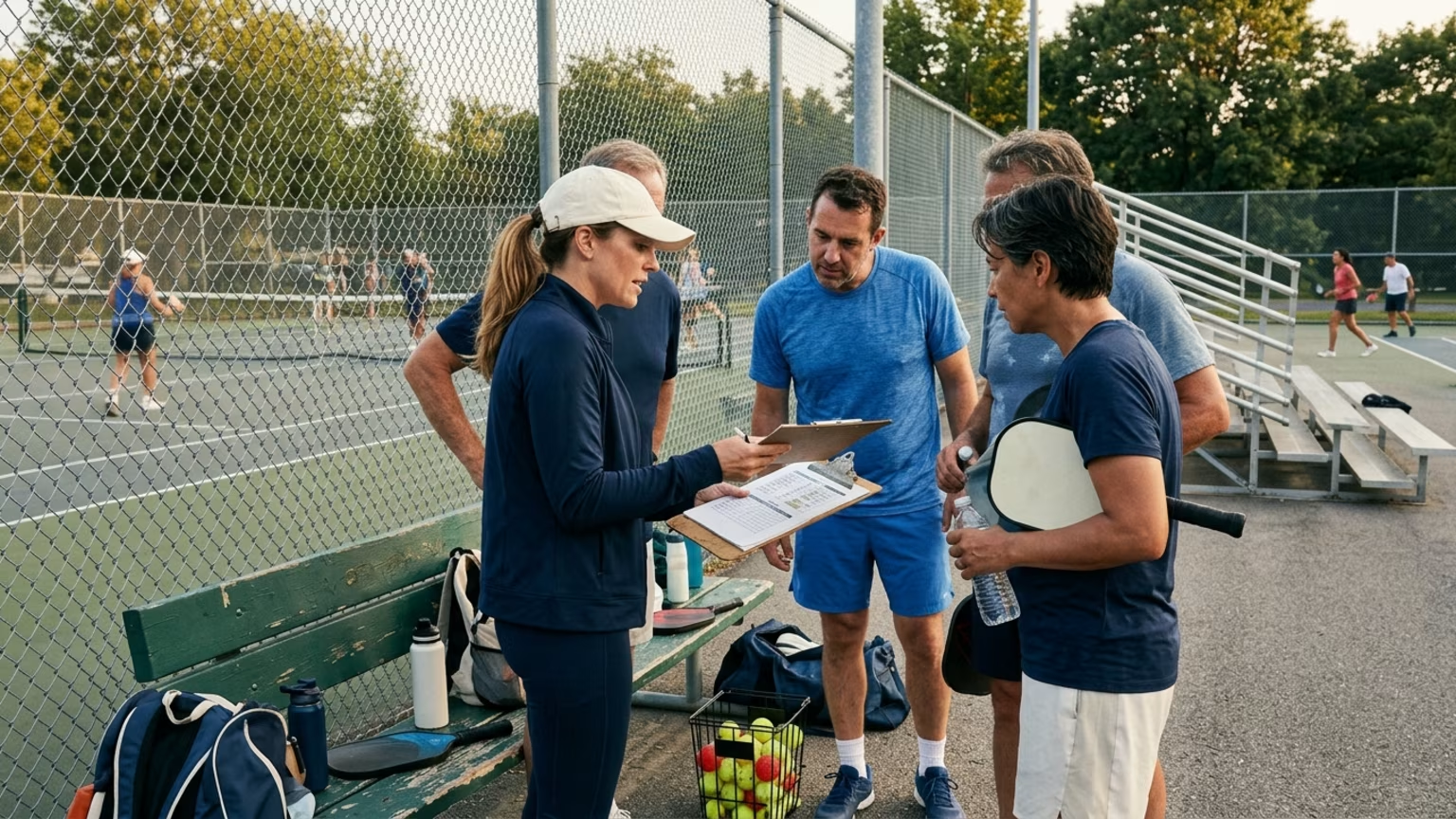

A practical guide to choosing your first racquet sports tournament. Learn how to navigate event formats, skill divisions, and match schedules for a great experience.




How do I choose my first racquet sports tournament without getting overwhelmed or risking exhaustion from playing too many unexpected matches? You choose your first event by matching the tournament format, expected schedule, and skill division to your personal goals.
A first event is not one standard experience. Pickleball tournaments use round robin and pool play alongside single or double elimination formats. Some events also include consolation and team structures. Their scoring and advancement rules can vary by event. For a first entry, compare the format and scoring with the experience you want. If your main goal is match experience, look for published information about guaranteed matches. You can also prioritize pool play, round robin scoring, or consolation brackets.
DUPR’s tournament guide notes that round-robin and pool-play formats may be appealing to first-time players. This is because they generally provide multiple opportunities to compete and face different opponents. In a round robin format, players or teams play others in their group. Pool play divides the field into groups, and qualifying players or teams advance to an elimination playoff.
More matches are not automatically easier on your body or your schedule. Round robin and pool play may involve limited downtime between matches. Single elimination can end a player’s championship run after one loss. Double elimination generally allows a competitor to continue after a first loss, but this can require more matches and a longer day.
Some tournaments add consolation matches, but not all events provide this option. Players should check whether losing the main draw match ends their competition entirely. Verify the details rather than assuming the format name guarantees a particular number of matches. Understanding how tennis, pickleball, and padel competition compare will help you navigate these varying structures. Making an informed choice prevents unexpected physical strain on the court.
Skill divisions are a practical way to look for opponents at a comparable playing level. DUPR’s tournament-format guide lists common amateur pickleball divisions such as 3.0, 3.5, 4.0, and 4.5. The guide also mentions advanced or open divisions. You should choose a playing level using the event’s specific criteria and your current ability.
Treating a rating as a promise about your results is a mistake. DUPR explains that amateur events commonly use skill divisions. Ratings can help players understand which division may reflect their level. However, the guide also notes that a rating does not automatically determine your tournament seeding.
Events may also group players by age. The USA Pickleball division information summarized by MyPickleballConnect describes skill and age as possible bases for divisions. These are examples, not a guarantee that every event offers those specific categories. Taking time to review the racquet sports tournament formats explained will clarify what each division expects.
Confirm how the event organizer assigns or verifies divisions before you finalize your registration. A division system can help orient players, but category names and available levels are event specific. By accurately assessing your abilities, you support your athletic longevity and manage your physical workload. Entering a suitable division ensures your first event feels appropriately challenging.
Match length can differ substantially even within a single sport. At one 2026 USTA Southwest Tri-Level tennis championship, the third set was replaced by a 10-point match tiebreak. At a 2026 USTA 55-and-over Section Championship, the listed format used two regular-scoring sets and a 10-point match tiebreak in place of a third set. These are event-specific examples, so players should verify the scoring format for their chosen tournament.
Schedules and travel commitments can matter as much as the draw itself. The USTA Southwest Tri-Level event page stated that teams should plan to play throughout the weekend. Their matches began on Friday morning and ended on Sunday afternoon. The USTA 55-and-over event advised participants to check schedules because match times could change.
Pacing yourself is crucial, and reading how to adjust your training when you feel run down can help you prepare for a tiring weekend. Check how many matches may be played in a day and how much rest may be available. DUPR notes that round robin and pool play can involve multiple matches with limited downtime. Double elimination can also extend the competition day significantly.
Before registering, check the stated match scoring and the likely schedule window. You must also consider the venue location and any travel requirements. Event organizers may change match times without warning, and the final schedule might only be published one week before the championships. Balancing your competitive drive with adequate recovery is the best way to maintain healthy aging on the court. Taking control of your schedule ensures you arrive at the venue fully prepared.
Set a goal that remains achievable regardless of your final bracket result. You could aim to get several match opportunities, learn how competition feels, or enjoy a team event. A research chapter on sport and physical-activity motives identifies achievement, affiliation, and autonomy as key motives. The chapter associates these motives with sport performance, wellbeing, and physical-activity motivation.
Team formats may suit players who value a shared competition experience. DUPR describes team pickleball as competition in which individual match results contribute to the team result. That makes the team’s overall performance, rather than one player’s individual result alone, the relevant frame for the event. This shared environment often reduces the pressure on first-time competitors.
A podium finish can be one possible outcome, but it need not be the sole measure of success. Process goals ensure the day feels worthwhile even if you face tough opponents early in the draw. Focusing on proper technique and strength that transfers to the court will yield long-term benefits. Measuring your progress through personal milestones builds a healthier relationship with competition.
Refining your approach to winning and losing helps maintain your enthusiasm for racquet sports. Enjoying the social aspects of the tournament can be just as rewarding as advancing through the bracket. Your first tournament is simply a stepping stone in your playing career.
Entering your first tournament is about testing your skills and gaining practical match experience in a structured environment. Thoughtful planning and realistic goal setting will help you enjoy the competition and support your athletic longevity for years to come.
Follow Evercourts for practical insights on tennis, pickleball and padel performance, movement, recovery and healthy ageing. Stay connected for new articles, research-led guidance and ideas to help you play well and keep playing for years.


Holger Rune withdrew from the European Open with a back problem. The facts behind his decision and a grounded perspective for recreational players.

The Dink’s October 17 guide emphasizes deep returns, ball-height decisions and positioning against faster pickleball opponents.

A new report outlines padel and tennis gear trends. Learn how to assess adjustable rackets, sensor feedback and smart-court claims.
Read practical guidance for better movement, smarter preparation and a game that keeps working for you.
explore the Blog
