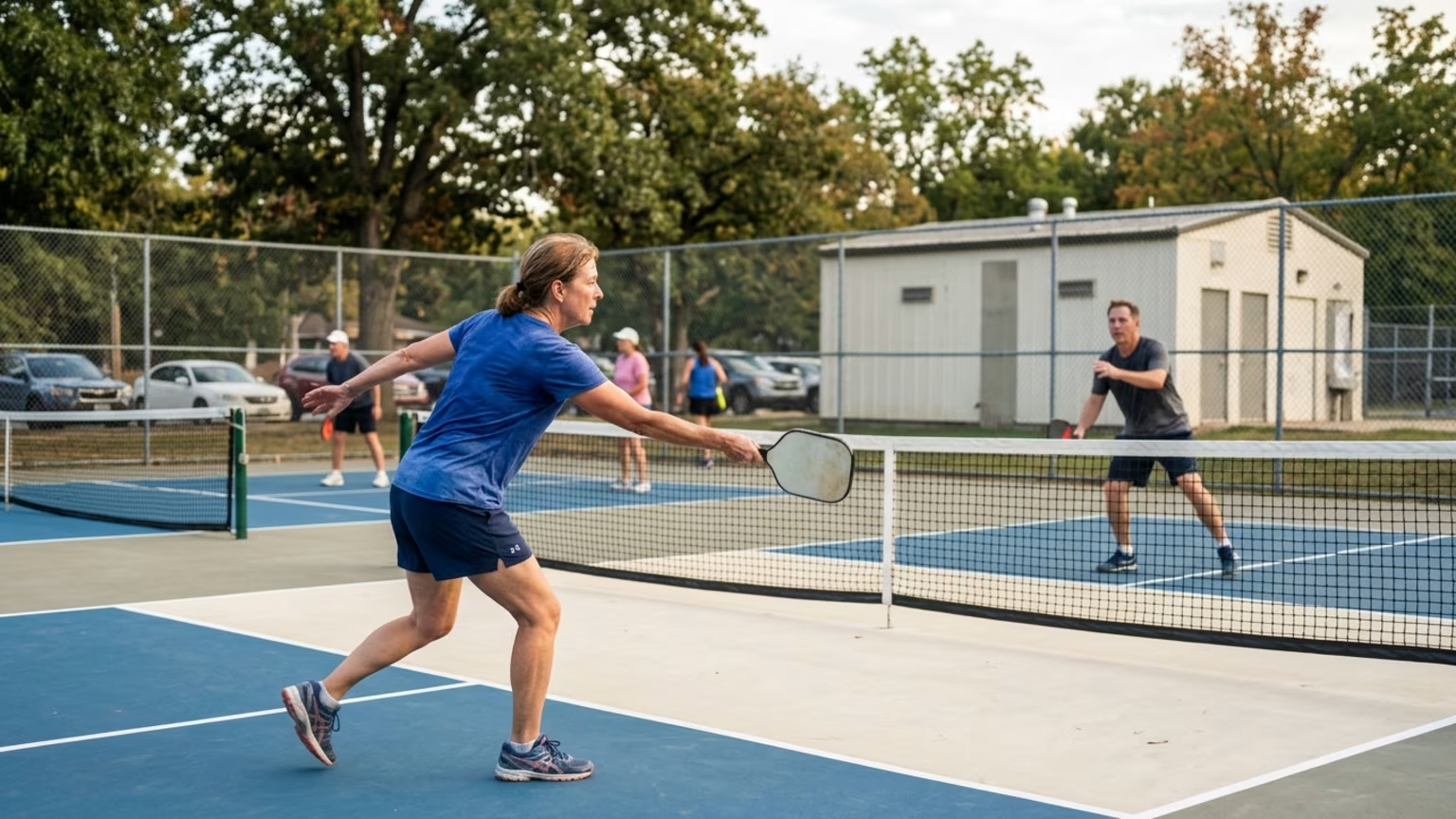

A new systematic review highlights how different physical activity types, including leisure sports, impact dementia risk for older adults.




In September 2026, researchers published a systematic review and meta-analysis in The Lancet Public Health examining how the context of physical activity affects dementia risk. Natan Feter, Päivi Iso-Markku, Talia Markarian and colleagues authored the study on domain-specific activity. The research team analyzed whether the relationship between physical activity and dementia depends on where and why the activity occurs. Researchers searched six major databases for cohort and case-control studies published through May 2, 2026.
Eligible studies included adults aged 20 or older who had baseline cognitive-function assessments. The studies also required physical activity measurements and at least one year of follow-up. This publication shifts the focus from total daily movement to the specific domains in which older adults are physically active. The resulting review included 74 studies and 4,227,297 participants.
The median participant age was 67.3 years. The median follow-up period was 10 years. The interquartile range was broad, spanning from 5.1 to 21.3 years. Across the full evidence base, higher physical activity was associated with lower risks of all-cause dementia, Alzheimer's disease and vascular dementia.
For all-cause dementia, the pooled relative risk was 0.80. This corresponds to an association with approximately 20 percent lower risk among higher-activity groups compared with lower-activity groups. The corresponding pooled relative risks were 0.79 for Alzheimer's disease and 0.71 for vascular dementia. These findings indicate associations rather than proof that exercise directly prevents dementia.
When the researchers separated activity into specific domains, the results changed substantially. Leisure-time physical activity was associated with a relative risk of 0.76 for all-cause dementia. This represents an approximately 24 percent lower risk, with a 95 percent confidence interval of 0.65 to 0.88. The review included 20 studies examining leisure-time activity.
Household physical activity was also associated with lower all-cause dementia risk. This category carried a relative risk of 0.85 and a 95 percent confidence interval of 0.74 to 0.98. However, the household estimate came from only one study, so researchers advise interpreting it cautiously.
Conversely, occupational physical activity was associated with a higher all-cause dementia risk. The relative risk for occupational activity was 1.20, with a 95 percent confidence interval of 1.01 to 1.42. Commuting-related physical activity was similarly associated with a relative risk of 1.10. This finding showed a 95 percent confidence interval of 1.03 to 1.18.
The review included five occupational-activity studies and two commuting-activity studies. In contrast, researchers examined 20 studies for leisure-time activity. This difference in evidence volume is important when interpreting the apparent contrast between recreational exercise and work-related movement. Researchers urge caution before drawing absolute conclusions from the smaller pools of data.
The publication argues that the context, domain and likely characteristics of movement may matter. Possible explanations for the occupational finding include differences in exercise intensity, recovery time, chronic physical strain and work stress. Other hypothesized factors include socioeconomic conditions and the amount of control a person has over the activity. However, these mechanisms were not established by the meta-analysis itself. They should therefore be treated as hypotheses rather than definitive conclusions.
Professional athletes often view physical activity as mandatory labor, whereas adult recreational players treat court time as voluntary leisure. The September 2026 publication highlighted this critical distinction for everyday players. The study found that leisure-time activity was associated with lower dementia risk, while occupational physical activity was associated with higher risk. For the recreational racquet sports player, this means that physically demanding jobs do not automatically provide the same long-term health exposure as a planned tennis or pickleball session.
Medical reporting on this physical-activity paradox distinguished leisure-time sports from physically demanding work. Tennis, pickleball and padel fit naturally within the study's leisure-time physical-activity category when played recreationally. These sports offer an enjoyable way to maintain physical function, but they are not a guaranteed medical shield. The primary publication does not identify tennis, pickleball or padel as separate exposure categories.
The study also does not provide sport-specific risk estimates for racquet-sport players. The most grounded interpretation is that regular recreational racquet sports align with the voluntary leisure activity associated with better outcomes in this meta-analysis. Older players can apply these findings by maintaining a regular, enjoyable court schedule. A structured playing routine is often more sustainable than an abstract goal to simply move more.
The study found that leisure-time activity was associated with lower dementia risk, but it did not establish that racquet sports specifically reduce dementia risk. Players should view their court time as a practical way to integrate movement, rather than treating it as a medical intervention. A regular tennis, pickleball or padel schedule helps make physical activity consistent across the year. Players are more likely to stick with an activity when they enjoy the format and have regular partners.
A normal session combines physical movement, repeated decision-making, visual tracking and social interaction. A separate 2026 systematic review of exercise and cognitive aging found that structured exercise was associated with better global cognitive performance in community-dwelling older adults. That review reported that effects were generally small, heterogeneous and statistically uncertain, which reinforces a balanced approach. Organised exercise is useful for healthy aging, but no single activity guarantees specific results.
Players should focus on building a sustainable weekly schedule that prioritizes consistency and appropriate recovery. The meta-analysis provides extensive statistical context, but the authors rated the certainty of evidence as very low to low across activity domains. Study heterogeneity was substantial for the overall all-cause dementia analysis and for leisure-time activity. The I-squared values were 97.4 percent and 96.6 percent, respectively.
This high heterogeneity means that study results varied considerably. The pooled estimate should not be treated as a precise prediction for any individual player. The researchers also reported non-linear dose-response associations for leisure-time and occupational activity. The relationship was not a simple pattern where more movement automatically equals proportionally more benefit.
Other recent research provides additional perspective on activity habits. A 2026 study of lifestyle-activity variety reported that greater activity variety was associated with a lower risk of incident dementia during a 15-year follow-up. This was marked by a hazard ratio of 0.94 per additional activity and an estimated six-month delay in diagnosis per additional activity. While these findings focus on variety rather than specific sports, they support a diverse approach to movement.
Recent research into pickleball has also examined related well-being metrics. A report on a 2025 study involving 1,667 pickleball players described a dose-response relationship between playing frequency, session duration and self-reported mental well-being. Another 2026 report described recreational doubles pickleball among adults aged 60 and older in relation to stronger flow states. These psychological experiences are distinct from improved cognition or reduced dementia incidence, but they highlight the broad value of sport participation.
A separate study of supervised pickleball intensity coaching in older adults examined functional fitness and psychological well-being. These studies underscore the importance of adapting sports training to maintain physical function. Over the next season, the conversation around athletic longevity will likely shift toward analyzing movement quality and context rather than tracking raw step counts. Researchers will likely investigate the specific mechanisms that make leisure activity beneficial, such as voluntary participation, social connection or built-in recovery time.
The contrast between occupational strain and recreational exercise will prompt deeper investigations into how chronic physical stress affects long-term health. Until domain-specific data for individual sports becomes available, adult players should maintain their regular court schedules. Racquet sports alone may not adequately train every physical component needed for later-life function. Older players should pair their court play with dedicated lower-body strength work, trunk control and balance exercises.
This approach is a practical extension for injury prevention and capacity maintenance, rather than a sport-specific conclusion from the dementia study. By pairing consistent play with appropriate strength training, injury prevention and recovery, players can support their movement capabilities for years to come.
Evercourts encourages players to view sport as one piece of a comprehensive athletic longevity strategy. Continued sport participation remains a sensible investment in movement, fitness and social engagement. Players should avoid framing their weekly match as a guaranteed way to prevent cognitive decline. Until domain-specific data for individual sports becomes available, adult players should confidently maintain their regular court schedules.
Follow Evercourts for practical insights on tennis, pickleball and padel performance, movement, recovery and healthy ageing. Stay connected for new articles, research-led guidance and ideas to help you play well and keep playing for years.


Zheng Qinwen’s early finish to 2026 puts fatigue and recovery in focus. Here is the practical lesson for adult racquet-sport players.

Build toward pickleball match pace with easy movement, court footwork and controlled hitting, plus a short-format option and guidance after a break.
Understand single-leg control, lateral movement, rotation and braking in tennis strength training, with an illustrative week and clear evidence limits.
Read practical guidance for better movement, smarter preparation and a game that keeps working for you.
explore the Blog
