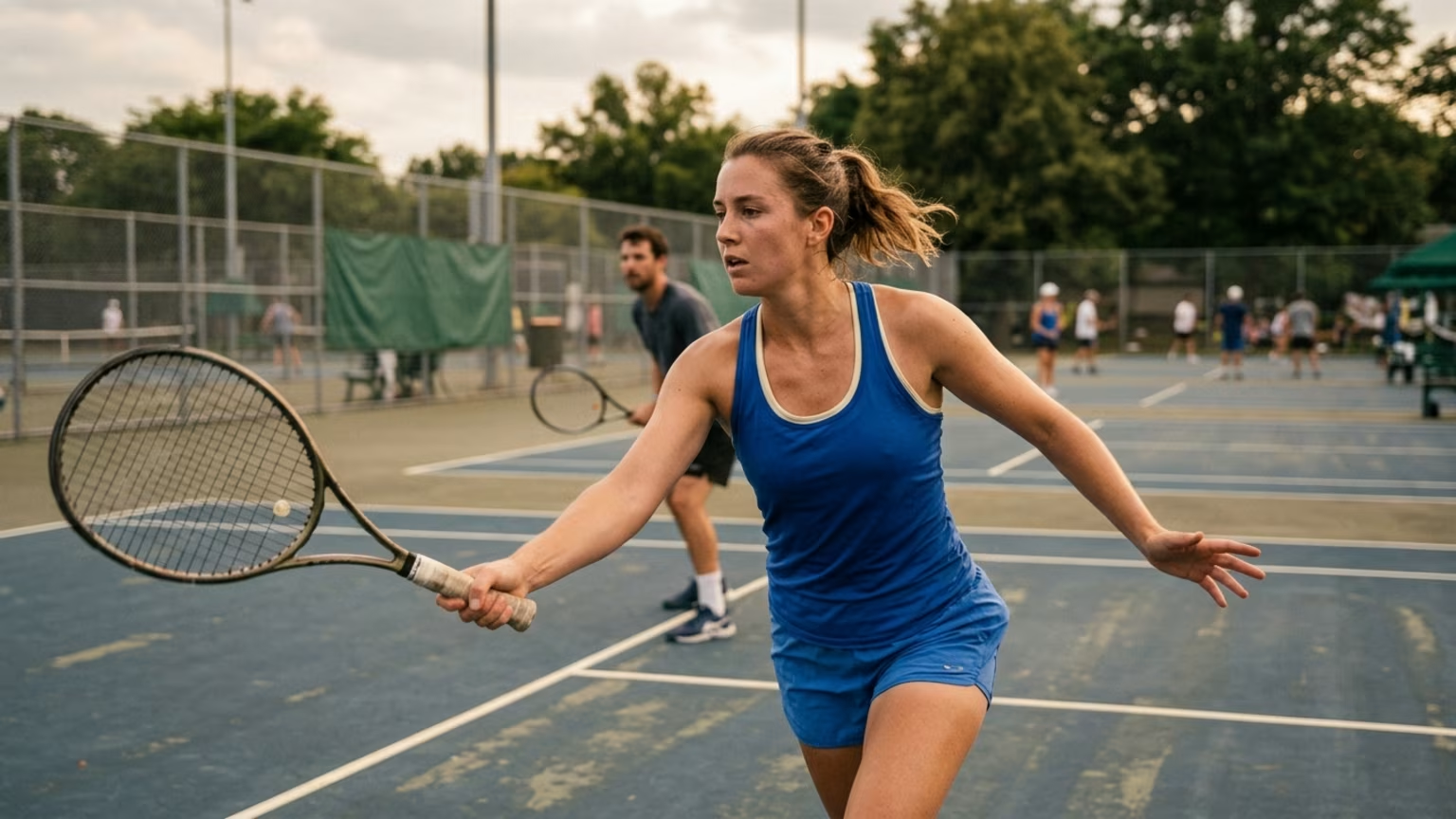

Learn how ambidextrous tennis players safely develop two forehands. We review PlayYourCourt's hand-switching progression, injury prevention and load management.




A player moves aggressively toward the doubles alley to track down a wide ball. Instead of preparing for a defensive backhand, they switch the racket to their left hand. They plant their outside foot and rip a heavy topspin forehand crosscourt. In 2025, PlayYourCourt published a detailed coaching feature on how ambidextrous tennis players can safely develop two forehands.
The publication defines ambidextrous tennis as switching the racket between hands during live points. This allows a player to hit forehands from both sides rather than relying on a conventional backhand. The approach is associated with the playing style of junior player Teodor Davidov. He is identified by PlayYourCourt as an example of a player who constantly switches hands between shots.
The tactical appeal revolves around turning difficult defensive shots into offensive opportunities. This is particularly useful on wide balls, passing shots and high-bouncing returns. PlayYourCourt cautions that this method introduces additional demands on timing and coordination. The feature emphasizes that most players should not completely convert their games.
Translating high-performance junior techniques to the adult recreational game requires careful consideration. A new forehand requires coordination among the shoulder, trunk, elbow and wrist. The newly trained arm must adapt to unfamiliar force and coordination demands. Poor timing can shift stress toward smaller distal joints.
Adult players often underestimate the physical demands of learning a new racquet movement. When I first started playing pickleball, I noticed how many people skipped warming up entirely. They would jump straight out of their cars and right up to the kitchen line. I tried doing that and immediately pulled a calf muscle.
Pickleball requires just as much explosive lateral movement as tennis, just in a tighter space. Since then, I always spend five minutes doing dynamic lunges and ankle rolls. It changes everything about how confident I feel pushing off the baseline. That same caution applies when adding off-hand strokes to your tennis routine.
PlayYourCourt recommends that adult recreational players add non-dominant-hand drills one or two times per week alongside normal play. They also suggest incorporating bilateral shoulder and wrist exercises as part of physical conditioning. This approach can help manage the hidden physical toll of repetitive swinging motions. Redistributing strokes between arms is not the same as reducing total workload.
Mass General Brigham notes that tennis overuse problems commonly affect the shoulder, elbow, wrist and hand. Adding off-hand forehands while maintaining the same dominant-hand volume may simply increase your total hitting volume. The safest interpretation is that any potential reduction in dominant-side repetition depends on deliberately replacing some strokes. Adult players stuck in a recurring injury cycle should consult a qualified coach before making major technical changes.
Monitor more than just pain when adding new motions. Track whether the new side develops soreness in the wrist, elbow, shoulder or hand. You should also watch for grip tension, late preparation, loss of balance and repeated mishits. Persistent shoulder or elbow symptoms warrant professional assessment rather than simply switching back and forth more often.
The U.S. tennis market is currently operating against a backdrop of massive participation expansion. The USTA reported more than 27.3 million U.S. players in 2025. That 2025 total was 1.6 million higher than the previous year. This marked a sixth consecutive year of growth for the sport.
Accessible recreational coaching is reaching a broader audience than ever before. Nearly 40% of those 2025 players played in public parks. This expanding base highlights why finding safe ways to manage training load is so critical. One recent meta-analysis in team sports found a statistically significant association between an elevated acute-to-chronic workload ratio and injury risk.
That study reported a Hedges’ g of 0.35 and a 95% confidence interval of 0.16 to 0.54. Racquet sports are highly relevant for adults focused on healthy aging. A cohort study of 80,306 British adults found that racquet-sport participation was associated with a 47% lower risk of all-cause mortality compared with inactivity. The same study reported a 56% lower risk of cardiovascular mortality.
These are observational associations rather than proof that playing tennis directly causes a specific lifespan extension.
If you decide to experiment with hand-switching, start with the off-hand stroke itself rather than the switch. The recommended technical progression begins completely without hand-switching. Players should start with mini-tennis using only the non-dominant hand. This is followed by low-speed cooperative crosscourt rallies using only the off-hand forehand.
PlayYourCourt suggests introducing occasional hand changes during regular drills only after mastering the basics. The final step is testing the technique in fuller rally play. The article also recommends starting at half speed before increasing pace. Late racket transfers can easily cause mishits and throw off your balance.
Specific switching cues can help maintain technical stability while you build new essential footwork skills. PlayYourCourt recommends deciding to switch shortly after the split step. Keep the non-hitting hand ready to receive the racket around chest or head height. It is also critical to mirror the unit turn rather than abbreviating rotation on the weaker side.
To support this symmetry, the article recommends using the same grip family on both hands. A semi-Western forehand grip is presented as one possible symmetrical option. PlayYourCourt recommends drilling split steps, unit turns, crossover steps and shuffle steps on both sides. This mirrors the movement demands of the court geometry symmetrically.
The source also suggests that players experimenting with the style train serves with both arms. This includes mirroring the toss, body rotation and follow-through. However, serving is a highly demanding movement, and adult players should approach bilateral serving with extreme caution. You do not need to learn a second serve to benefit from a non-dominant forehand.
The article gives a much more restrictive recommendation for children under 12. For younger athletes, non-dominant-hand volume should be capped at 20 to 25% of total shots. Sessions should remain playful and focused on balanced physical development. Adults should not assume this specific percentage cap is a medically validated universal limit for older players.
A practical adult sequence starts entirely off the court with toss-and-catch drills. You can also utilize wall throws and shadow swings to build basic coordination. The goal should be to expand your movement options without sacrificing reliability or comfort. By taking this slow approach, you can experiment with hand-switching safely.
Over the next season, expect more adult players to incorporate non-dominant drills into their warm-ups and practice sessions. The tactical benefits of a two-forehand game are intriguing for competitive club players. However, most adults will find that the best outcome is supplementing a conventional backhand rather than replacing it. Learning to hit an off-hand forehand will likely become a common tool for building coordination and body awareness.
As participation continues to grow, coaching methodologies will increasingly prioritize athletic longevity and workload management. The focus will shift from aggressive technical overhauls to smart adaptations that respect the physical limits of the adult body. Keep training smart, prioritize your warm-up routine and stay ready for your next match.
Follow Evercourts for practical insights on tennis, pickleball and padel performance, movement, recovery and healthy ageing. Stay connected for new articles, research-led guidance and ideas to help you play well and keep playing for years.


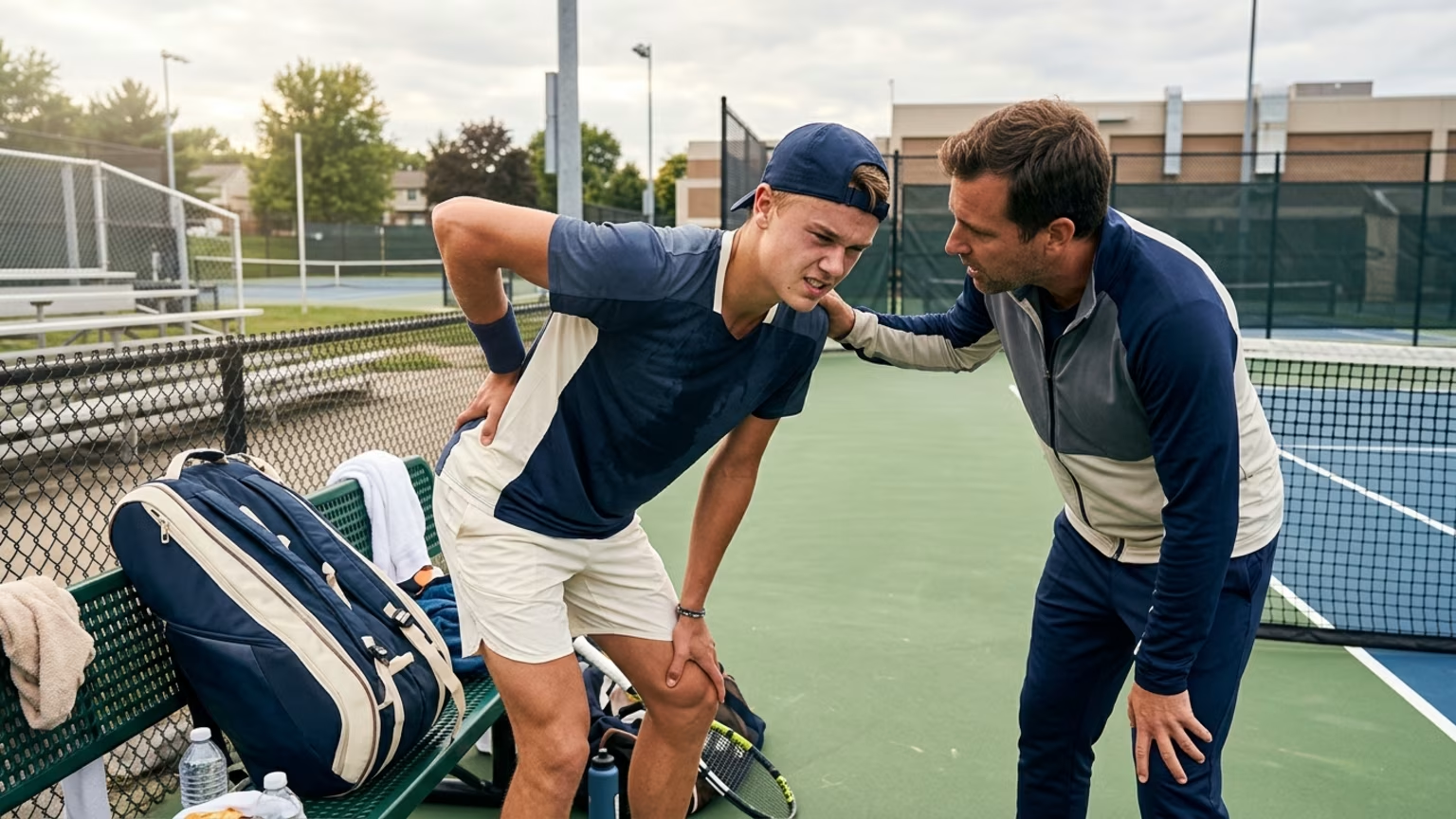
Holger Rune withdrew from the European Open with a back problem. The facts behind his decision and a grounded perspective for recreational players.

The Dink’s October 17 guide emphasizes deep returns, ball-height decisions and positioning against faster pickleball opponents.

A new report outlines padel and tennis gear trends. Learn how to assess adjustable rackets, sensor feedback and smart-court claims.
Read practical guidance for better movement, smarter preparation and a game that keeps working for you.
explore the Blog
