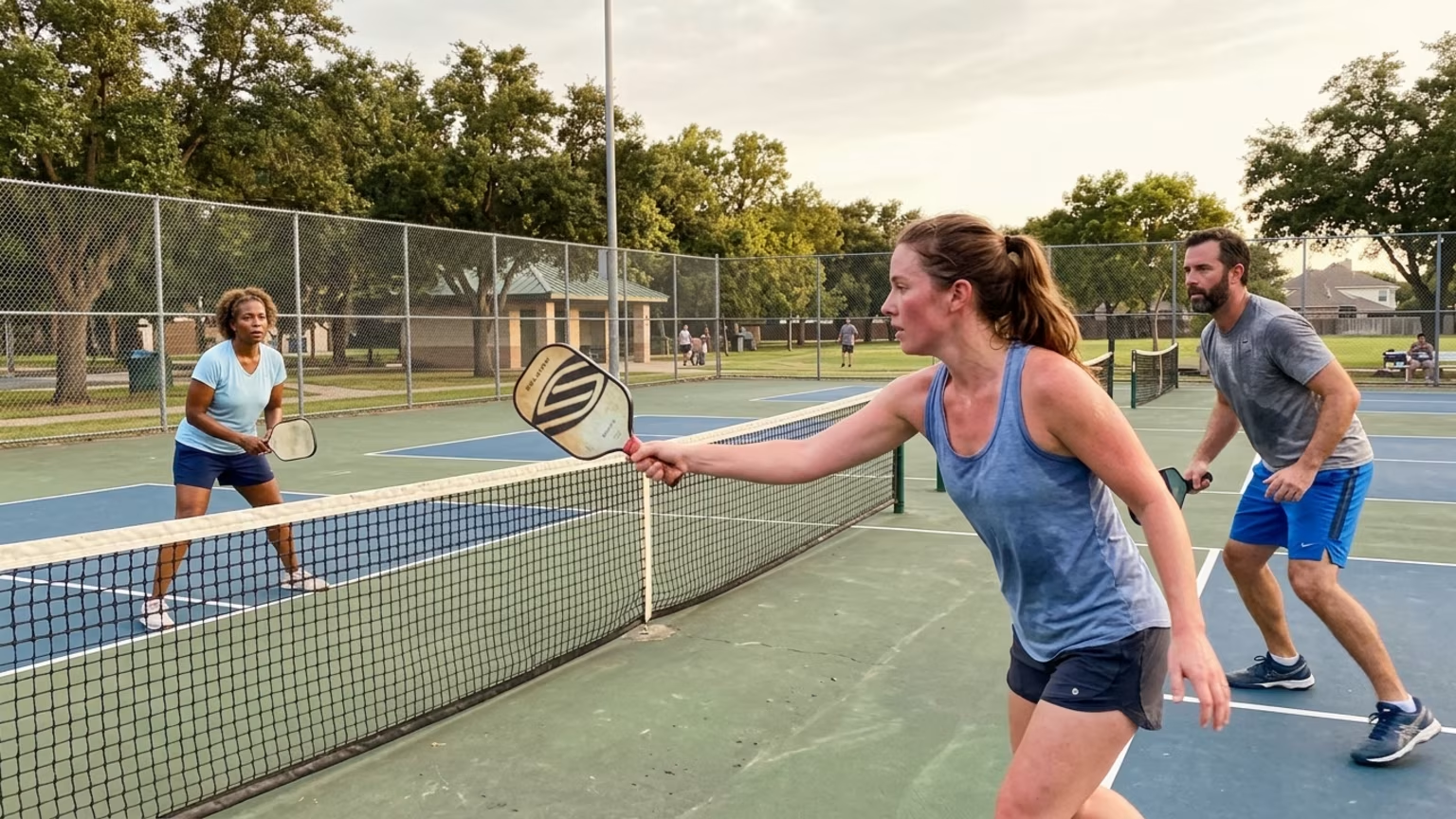

Discover how the APP Fall 2026 Player Development Program provides a structured training model that helps adult pickleball players improve without overtraining.




A determined amateur steps off the court after a fourth day of frantic matches, nursing a tender knee and wondering why their skills have stalled. We are constantly told that grinding through endless competitive games is the only way to improve. But playing more matches is actually the slowest and most damaging way to develop your game. The Association of Pickleball Players (APP) recently highlighted this reality by structuring their Fall 2026 Player Development Program around distinct training blocks.
Fitness influencers often sell the idea that exhaustion equals progress. They promote programs built on maximum effort, relentless repetition and the false promise that working harder automatically translates to better court skills. For the adult racquet sports player, this approach usually leads straight to a physical therapist. We do not need an overwhelming volume of random competitive games. We need deliberate practice that respects our physical limits.
I remember finishing a tough two hour padel match on a cold Tuesday night and waking up the next morning feeling like my lower back was locked in concrete. For a long time, I just accepted this as the price of playing hard in my forties. But once I started spending just ten minutes on targeted hip mobility before heading to the club, the stiffness almost completely vanished. It taught me that we do not have to accept pain as a default state of aging.
The Association of Pickleball Players (APP) addresses this tension directly in their Fall 2026 Player Development Program. Running from August 31 through December 19, this 16-week semester separates development into distinct buckets. The published schedule separates morning and afternoon training with a two-hour midday block for lunch, studies, appointments and administration. This structured model stands in sharp contrast to the chaotic, unregulated volume that most amateurs subject themselves to every week.
Many modern coaching channels suggest that the only barrier to athletic mastery is a lack of effort. This perspective ignores the reality of adult physiology. When we try to emulate the highlight reels of touring professionals by playing aggressively every single day, we bypass the foundational preparation that actually keeps those athletes healthy. We end up substituting intelligent programming for pure exhaustion. This is why so many enthusiastic amateurs spend their seasons battling recurring shoulder strains and knee pain.
The physical demands of racquet sports require a baseline of functional fitness that continuous match play alone cannot build. A report citing Sports & Fitness Industry Association data says an estimated 24.3 million Americans played pickleball in 2025. This represented an increase of 22.8% in one year. However, SFIA’s 2026 first-half update reported that pickleball participation increased 1.3% in the first half of 2026, signaling that growth is moderating. With so many adults picking up paddles, the science of healthy aging has never been more relevant.
Research confirms that structured, supervised participation yields measurable physical benefits. In a randomized study summarized by The Chinese University of Hong Kong, 42% of participants in a supervised pickleball group moved from pre-frailty to non-frailty after eight weeks. This was compared with just 8% in the control group. The Hong Kong study reported improvements in several functional-fitness measures, including chair stands, arm curls, flexibility and six-minute walking distance. Specifically, the reported between-group coefficients were β = 4.89 for chair stands and β = 3.70 for arm curls.
The reported between-group coefficients were also β = 3.27 for the back-scratch test and β = 31.10 for six-minute walking distance. This data confirms that supervised, structured racquet sport activity yields substantial improvements in functional fitness. But we must be careful not to misinterpret these results as a blanket endorsement for playing as much as possible. The intervention was carefully supervised, ensuring that participants were not overwhelmed by excessive physical stress.
These findings highlight the value of supervised, deliberate physical activity for older adults. However, the study focused on pre-frail participants over a brief eight-week window. It proves that targeted, carefully measured movement creates the foundation for athletic longevity. We must view our time on the court as just one part of a broader physical system. By managing your training load appropriately, you can build a sustainable routine.
Recreational players can borrow the organizational framework of the APP Fall 2026 Player Development Program without matching its professional volume. APP invites players rated 3.5 or higher and says eligibility can be assessed through a 30-minute evaluation. The full-time option costs $550 per week and features a 6:1 coach-to-player ratio. A part-time Fall package provides 50 hours of training for $1,500 with flexible scheduling at $30 per hour. APP lists a drop-in rate of $90 per daily session, while AM and PM options cost $300 and $250 respectively.
You do not need to enroll in a high-performance academy to organize your week like a professional. Start your week with a dedicated technical session focusing purely on skill execution without the pressure of scoring. Follow this with an off-court day dedicated to lower-body strength, trunk stability and controlled mobility. APP presents development as a combination of court work, strength and conditioning, academics and competition. This holistic approach ensures that athletes build the resilience required for sustained performance.
The managing owner of the APP Player Development Program, Ken Herrmann, stated his belief that their coaches could make the academy one of the best worldwide training opportunities. While this reflects an ambitious internal vision, the organizational logic remains highly applicable for amateurs. The fact that an elite program strictly schedules a 9:45 p.m. curfew and 10:30 p.m. lights out speaks volumes. Elite performance requires enforced recovery. Adult amateurs should take this as a cue to prioritize sleep just as fiercely as they prioritize their time on the court.
Protecting your rest days is equally critical to this structure. Treat recovery as a mandatory training block rather than an optional afterthought. If you play a taxing tournament on Saturday, Sunday should involve gentle walking or complete rest. Adult players looking for a sustainable training week must avoid stringing high-intensity matches together on consecutive days. Keeping at least one block genuinely easy allows your tissues to adapt, recover and prepare for the next technical session.
Adding a sensible functional strength program on your off days will fortify your joints against repetitive stress. When you combine technique practice with competitive scoring, your body defaults to its most ingrained habits to win the point. This prevents you from actually learning new mechanics or refining your movement patterns. By separating these sessions, you give your nervous system the space to adapt without the stress of competition. This separation is the core philosophy behind professional development environments.
APP says its National Pickleball Series will create additional competition opportunities for emerging professionals and high-level local players. This expansion of the tournament ecosystem is a massive positive for the sport. But it also presents a potential trap for enthusiastic amateurs who feel compelled to register for every available event. Participating in continuous weekend tournaments without scheduled rest phases inevitably leads to burnout and joint irritation. You must learn to carefully select your events and build a balanced training block around them.
The professional environment at The Fort underscores the importance of proper facilities in executing a structured plan. With 43 lighted courts and 14 covered courts, the venue is built to handle significant training volume in varied conditions. Adult amateurs do not always have access to premium covered courts or an on-site fitness facility. However, we can adopt the mindset that our physical environment influences our training quality. Choosing to practice on well-maintained surfaces and wearing proper footwear are simple ways to protect your lower body from unnecessary wear.
You can apply this concept by dedicating one day a week entirely to constraint-based games. Instead of playing a standard match, you might play a game where only drop shots are allowed. This allows you to test skills under mild pressure without the physical toll of an all-out competitive clash. By doing this, you ensure that the strength you actually use on court translates into better mechanics. Over time, this disciplined separation of practice and play creates a far more capable and durable athlete.
Take ten minutes today to review your weekly schedule and replace one competitive match with a focused technical session to protect your body and improve your skills.
Follow Evercourts for practical insights on tennis, pickleball and padel performance, movement, recovery and healthy ageing. Stay connected for new articles, research-led guidance and ideas to help you play well and keep playing for years.


Holger Rune withdrew from the European Open with a back problem. The facts behind his decision and a grounded perspective for recreational players.

The Dink’s October 17 guide emphasizes deep returns, ball-height decisions and positioning against faster pickleball opponents.

A new report outlines padel and tennis gear trends. Learn how to assess adjustable rackets, sensor feedback and smart-court claims.
Read practical guidance for better movement, smarter preparation and a game that keeps working for you.
explore the Blog
