

Discover how adult racquet sports players can apply the New York Post's healthy aging survey insights to prioritize sustainable habits over extreme biohacking.




Secondary reports of a British Journal of Sports Medicine analysis say racquet-sport participation is associated with 47% lower all-cause mortality. But when you have just finished a brutal three-setter and your knees are barking on the walk to the car, population-level observational estimates offer little comfort. What matters in that moment is knowing how to recover so you can safely step back onto the court tomorrow.
Our goal at Evercourts is to help you maintain your physical capabilities and enjoy healthy aging without falling for fitness influencer hype. A recent New York Post feature based on an annual Healthy Aging Survey consulted 63 professionals. These experts included physicians, clinical researchers, registered dietitians, and aging specialists. The professionals consulted by The Post emphasized regular activity, a nutritious diet, and quality sleep over complex optimization systems.
This protocol outlines how adult racquet players can apply that grounded medical consensus to their weekly court schedule. We want to keep you playing strong while leaving the anxiety-inducing tools behind. You do not need an expensive laboratory setup to maintain your court movement. A sustainable routine offers more defensible value than repeatedly changing equipment, supplements, or fasting schedules.
The New York Post reports that its annual survey participants favored repeatable behaviors over aggressive self-experimentation. You should schedule a realistic number of court sessions that you can maintain through work and family obligations. The reported 56% lower cardiovascular mortality association for racquet sports is an observational finding rather than a clinical guarantee. Casual court participation provides substantial movement, but you should also include strength and mobility work in your routine.
"I remember finishing a tough two hour padel match on a cold Tuesday night and waking up the next morning feeling like my lower back was locked in concrete. For a long time, I just accepted this as the price of playing hard in my forties. But once I started spending just ten minutes on targeted hip mobility before heading to the club, the stiffness almost completely vanished. It taught me that we do not have to accept pain as a default state of aging."
This practical approach to managing your weekly court time builds true resilience. Progress gradually after any travel or illness instead of trying to force extra training sessions. Secondary coverage reports that racquet sports were associated with particularly favorable mortality outcomes. However, people who play racquet sports may differ from non-players in baseline health and access to care.
Circadian disruption and unmanaged low-grade stress ranked next in the survey at 19% and 18%. The Post article specifically identified circadian disruption as a major blind spot and emphasized sleep quality as a vital habit. The surveyed experts view a consistent nightly sleep routine as optimal for long-term health and athletic performance. Players who routinely travel across time zones or sacrifice sleep for early court bookings must plan better.
You should treat sleep planning as an essential part of your training rather than leftover time. When traveling for leagues or club events, prioritize a stable bedtime and proper hydration. Do not treat travel-related sleep loss as a normal cost of doing business on the court. Building a tournament calendar requires making sleep a non-negotiable priority.
When traveling for tournaments, incorporate light movement after long periods of sitting in cars or airplanes. A gradual warm-up is much better than immediately playing at maximum intensity after a long travel day. These are practical applications of the medical emphasis on sustainable habits.
Social isolation was the leading blind spot in The Post’s survey, selected by 59% of respondents. The quoted physicians connected isolation with reduced purpose, poorer mental well-being, higher stress, and impaired sleep. Regular club play can directly address this issue when it creates consistent contact with teammates, opponents, coaches, and friends. You should rotate partners, attend group sessions, and join leagues suited to your current playing level.
The social structure around your matches is a crucial part of the value proposition for healthy aging. Participating in a club environment keeps you engaged and accountable. This frequent interaction helps you manage the low-grade psychological stress that experts flagged in the survey. If work pressure is undermining your sleep, the social support of a club can provide needed relief.
The professionals consulted by The Post emphasized a nutritious diet as a foundational habit. Treat your nutrition as routine fuel rather than a punishment cycle. The Post reports that 26% supported intermittent fasting and 16% supported full-body imaging or continuous glucose monitoring use by non-diabetics. This indicates that most respondents did not select these extreme tools as their preferred strategy.
The article quoted endocrinologist Ay Dixit warning that continuous glucose monitors may cause anxiety over normal glucose fluctuations. Internist Sad Elisse also noted that these devices can generate substantial data without strong evidence that they improve outcomes. You should seek clinical advice when symptoms warrant it rather than testing yourself constantly.
You should manage chronic stress before you attempt to increase your weekly court volume. Listen to your body and prioritize recovery when your daily life becomes demanding.
Among the tools listed in the survey, wearable health and sleep trackers received the strongest support. A wearable may help you notice sleep regularity, activity patterns, or recovery trends. However, The Post reports that 31% of respondents selected "none of the above" to reflect skepticism about some longevity tools. You should use technology as feedback rather than escalating a single poor score into unnecessary anxiety.
A player should not treat a wearable’s recovery score or heart-rate estimate as a clinical diagnosis. These consumer devices do not establish that you are guaranteed to extend your lifespan independently. They simply help you stay accountable to your baseline fitness and sleep routines.
Different court sports place distinct biomechanical demands on your body as you age. Tennis players experience significant overhead serving loads and require dedicated shoulder care to avoid chronic impingement. You must also prepare your hips for the wide lateral strides required to cover a full tennis court. Adjusting your routine for these specific demands is essential for athletic longevity.
Pickleball requires rapid changes of direction in a very confined space near the kitchen line. This constant starting and stopping places heavy demands on the Achilles tendon, knees, and lower leg. You should prioritize calf strength and lateral ankle stability to handle these sharp movements. Fast reactions are required, but your lower body must be conditioned to support those sudden lunges safely.
Padel players deal with heavy rotation forces from playing off the glass and executing repetitive smashes. A padel routine must prioritize thoracic spine mobility and core rotational strength to protect the lower back. Building a performance framework for healthy aging requires adjusting your off-court work to match your primary sport. If you play multiple sports, you must balance these specific loads when planning your tournament calendar.
Review this quick checklist before you pack your bag and head to the club.
If you implement these foundational habits, the next time you finish a brutal three-setter, your knees will recover much faster. You will walk to the car knowing your body is ready for another great day on the court.
Follow Evercourts for practical insights on tennis, pickleball and padel performance, movement, recovery and healthy ageing. Stay connected for new articles, research-led guidance and ideas to help you play well and keep playing for years.


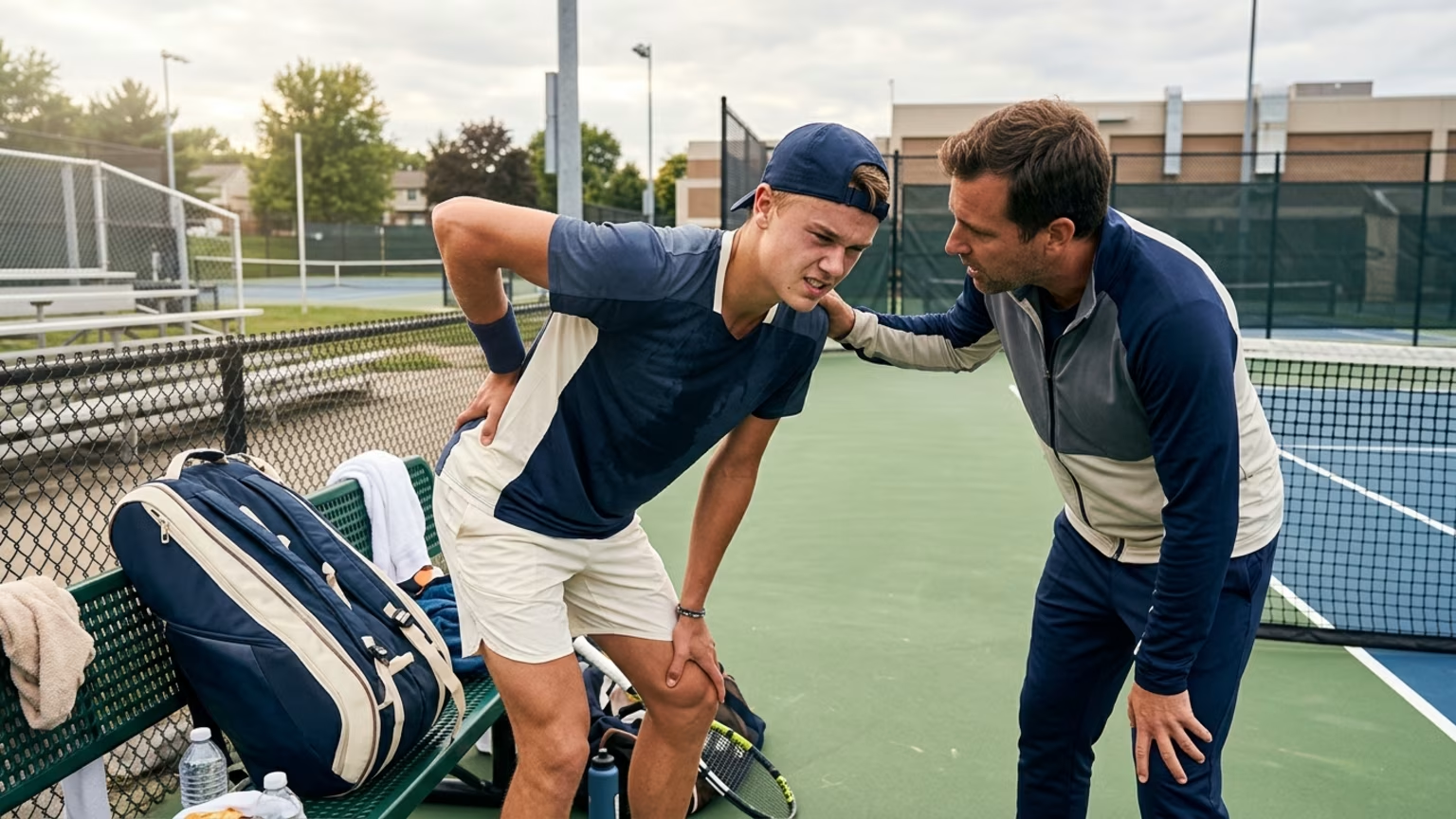
Holger Rune withdrew from the European Open with a back problem. The facts behind his decision and a grounded perspective for recreational players.

The Dink’s October 17 guide emphasizes deep returns, ball-height decisions and positioning against faster pickleball opponents.

A new report outlines padel and tennis gear trends. Learn how to assess adjustable rackets, sensor feedback and smart-court claims.
Read practical guidance for better movement, smarter preparation and a game that keeps working for you.
explore the Blog
