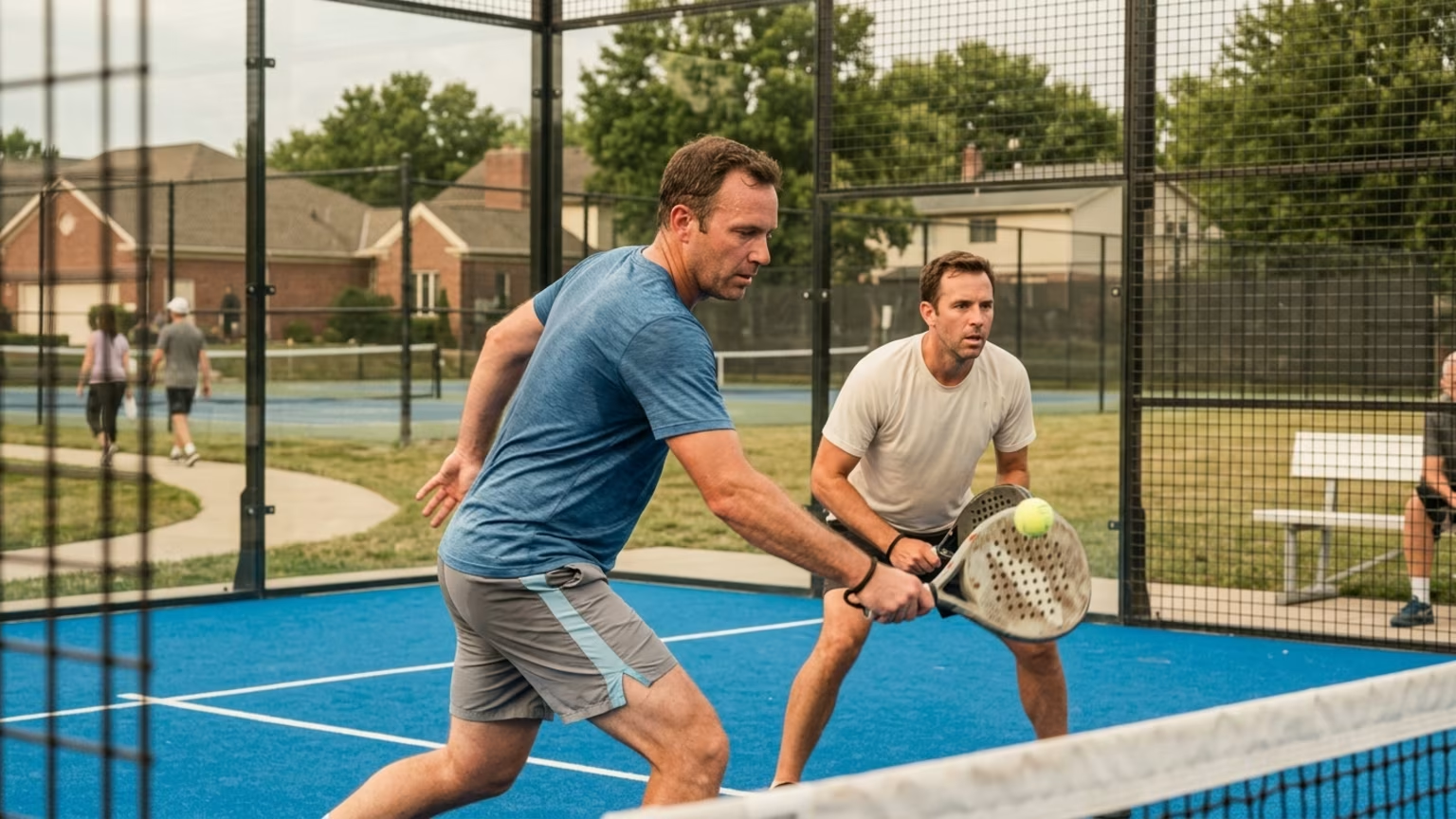

The FIP Senior World Cup in Buenos Aires reached the quarter-finals. Learn how adult recreational players can use the broadcasts to study veteran match pacing.




On September 17, 2026, the International Padel Federation Senior World Cup officially moved into the quarter-final phase in Buenos Aires. The primary highlight of the knockout round was a women's tie featuring defending champions Spain against host nation Argentina. The International Padel Federation labeled this specific matchup as a women's El Clasico. To ensure fans could watch the action, the federation streamed this highly anticipated tie live on its official YouTube channel.
The Argentinian Padel Association organized both the men's and women's competitions for this major event. The tournament structure separates athletes into dedicated veteran age categories instead of relying on a single open-age format. This structure provides a unique platform for older athletes to compete fairly. These specific age brackets include over-40 and over-45 as well as over-50 matches. The schedule also features over-55 and over-60 categories.
To accommodate the extensive field of international players, FIP scheduled 29 matches across the courts for the quarter-final day. The scheduling required strict adherence to session times. The women's morning session began promptly at 9 a.m. local time. Tournament organizers set the afternoon session to start no earlier than 3 p.m. local time.
The broader women's quarter-final draw included several competitive regional matchups alongside the primary Spain and Argentina fixture. Sweden played the Netherlands to secure a path forward in the bracket. Brazil faced Belgium on the neighboring courts. The United States played against France to round out the women's knockout stages.
The men's broadcast schedule gave viewers similar access. It featured Italy against Sweden and Argentina against Finland as the selected live matches. This event proves that international padel competition is not limited exclusively to the professional open-age circuit. The tournament media model combines live video broadcasts of selected premium matches with a comprehensive website livescore service covering all remaining courts.
Adult recreational players can use these tournament streams as a highly practical observation tool. Watching experienced competitors construct points often provides more immediate value than studying younger professional athletes. These veteran players prioritize smart court positioning and intelligent shot placement over maximum power. They manage the pace of play actively and only choose specific moments to accelerate their movement.
We often see amateur players rush between points when late-stage fatigue sets in. In contrast, veteran international competitors utilize careful routines before serving or returning. Recreational players should experiment with deliberate between-point routines during casual weekend matches to manage their energy better. Age-bracketed competition highlights how tactical skill and strategy outlast pure athleticism over a long tournament week.
I remember finishing a tough two hour padel match on a cold Tuesday night and waking up the next morning feeling like my lower back was locked in concrete. For a long time, I just accepted this as the price of playing hard in my forties. But once I started spending just ten minutes on targeted hip mobility before heading to the club, the stiffness almost completely vanished. It taught me that we do not have to accept pain as a default state of aging.
Taking time to prepare physically directly mirrors how top senior athletes manage their tournament workloads. They focus on continuous physical care rather than waiting for severe injuries to force a period of rest. Proper preparation is exactly what allows them to handle multiple competitive matches across a demanding tournament schedule.
I used to think a tough conditioning block was the only way to improve my court endurance. Then I started tracking my sleep. I noticed that on days I slept less than six hours, my reaction time at the net was noticeably sluggish, and I felt gassed by the second set. Prioritizing consistent rest did more for my late match stamina than any extra sprints ever did.
Recovery is the true foundation of performance. Recreational players returning from a long break should always seek individualized guidance before adopting heavy match schedules. You do not need to replicate a professional training volume to enjoy the sport safely. It is more about finding the right events without overplaying to sustain your season. Developing a consistent tactical shot selection keeps you on the court longer without unnecessary strain.
The Italian Tennis and Padel Federation provided specific operational details about the men's knockout rounds. The men's Italian team reached the semifinals after they defeated Sweden 3-1 in the quarter-finals. The sequencing of these team ties is critical for team strategy and energy management. The reported match order for this tie began with the over-55 players taking the court first.
Following the over-55 opener, the teams played the over-50 and over-45 ties. The over-40 and over-60 matches completed the sequence. Italy earned its place in this knockout stage following strong group-stage performances. Their route included early victories over Japan, Ireland, and the United States.
Host nation Argentina advanced to the men's semifinals after defeating Finland 3-0. The remaining medal positions featured deep international talent pools. Reports listed the other men's semifinal as a clash between France and Spain. The women's medal semifinals matched Spain against the Netherlands and Belgium against the United States.
While these tournament results are inspiring, the broader science around athletic longevity requires careful reading. A 2026 study looked at adults aged 60 to 94 to assess the physical benefits of exercise on the brain. Researchers found clear associations between higher aerobic fitness and greater total gray-matter volume. They also noted a thicker medial temporal-lobe cortex in these active older participants.
However, the researchers found no significant association with global cognition or episodic memory. Another recent randomized trial followed 52 healthy adults aged 45 to 65. The NeuroFit trial reported measurable mood benefits after a three-month exercise intervention. It did not find any improvement in its primary cognitive-performance outcome. These distinct studies remind players that regular exercise supports mood and physical structure, but it is not a guaranteed method for specific cognitive enhancements.
The successful execution of the FIP Senior World Cup proves that age-bracketed formats work brilliantly at the highest competitive levels. We expect international federations to expand these dedicated veteran events across more regions over the coming season. Media coverage will likely follow, offering recreational players even more opportunities to study practical pacing strategies. This steady growth confirms that competitive racquet sports have a permanent place in adult athletic routines.
Follow Evercourts for practical insights on tennis, pickleball and padel performance, movement, recovery and healthy ageing. Stay connected for new articles, research-led guidance and ideas to help you play well and keep playing for years.


An evidence check on sports supplements like tart cherry juice. Learn why racquet sports players should prioritize core nutrition over functional foods.
In late 2026, Oura analyzed wearable data to see how recreational tennis impacts heart health and recovery. Learn what this means for your athletic longevity.
Recent guidelines emphasize gradual progression, dynamic warm-ups, and scheduled recovery to help adult racquet sports players maintain athletic longevity.
Read practical guidance for better movement, smarter preparation and a game that keeps working for you.
explore the Blog
