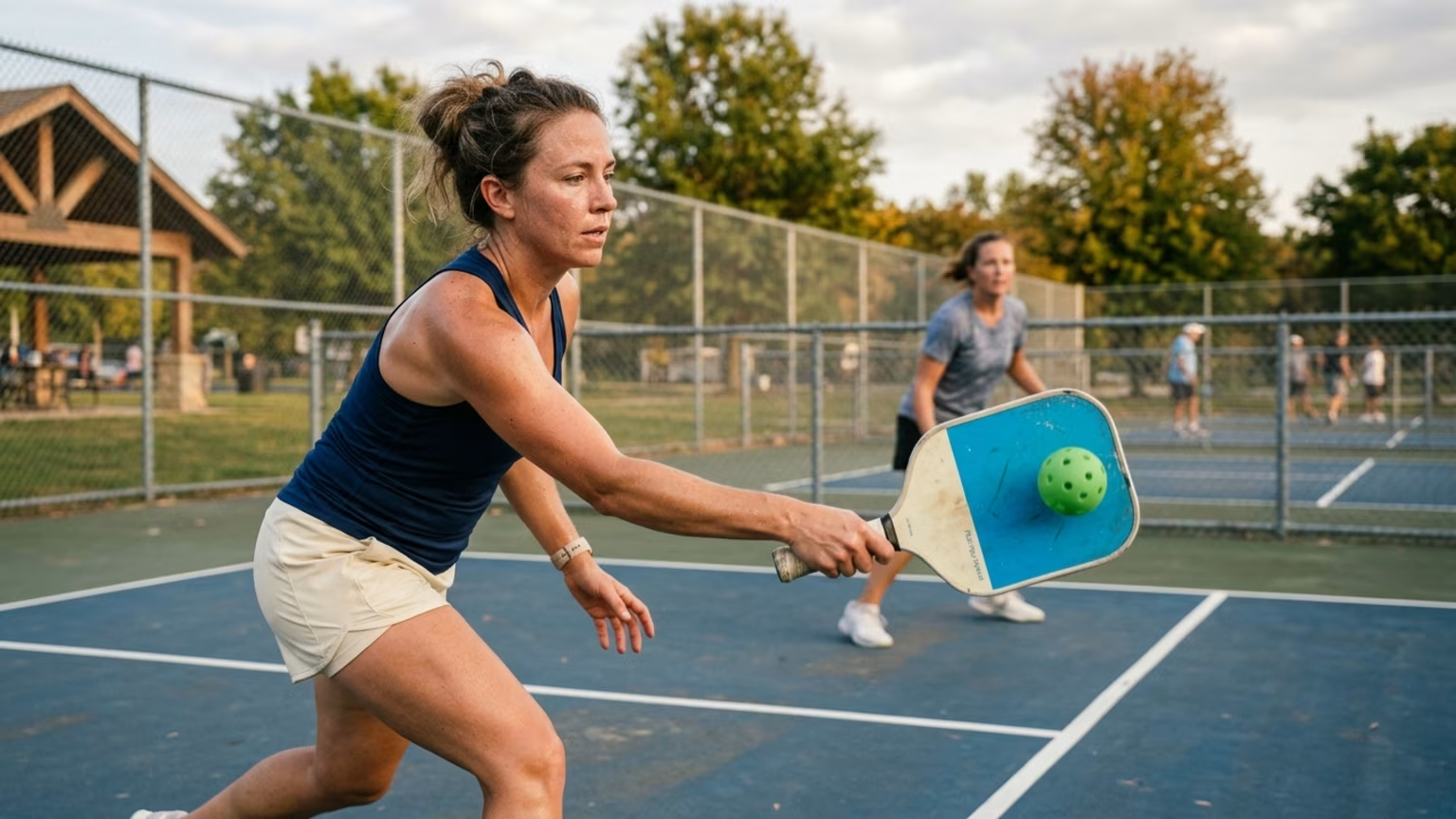

The Dink reports a rising trend in flat-top hybrid pickleball paddles. Learn how the squared-off shape impacts reach, handling, and recreational play.




On September 25, 2026, The Dink Media Team published a report on the rising visibility of flat-top hybrid pickleball paddles. Their article suggests that a growing number of players are switching to this squared-off paddle shape. However, the publication provides no paddle-specific sales data or player surveys to quantify the actual market shift. The coverage frames the design as an emerging topic of interest rather than a proven industry-wide change.
The conversation around equipment evolution often moves faster than verifiable market data. While professional players might adopt new shapes rapidly, the broader adoption rate remains unmeasured. The Dink identifies Pickleball Studio as the source for their design breakdown. This lack of concrete adoption data means the trend is currently driven by reported attention rather than measured consumer behavior.
The hybrid paddle shape occupies a deliberate middle ground between standard and elongated profiles. According to The Dink, the latest iteration features a squared-off top edge that replaces the tapered arrow curve found on earlier hybrid models. The publication argues that this flatter profile leaves more usable face near the top of the paddle. This specific geometry aims to maximize the surface area without extending the paddle to a fully elongated length.
The publication attributes this design shift to lighter foam construction and newer generation paddle technology. Lighter materials theoretically allow manufacturers to add mass near the top edge without sacrificing a quick feel. However, the article does not provide comparative weight or swingweight measurements to verify this claim. The benefit relies entirely on the idea that modern core materials can offset the extra mass.
The current discussion heavily credits the JOOLA Kosmos paddle for bringing the flat-top shape to broader attention. JOOLA leveraged professional partnerships and extensive marketing reach to increase awareness of the squared-off design. The Dink notes that brands like Gearbox and Chorus offered flat-top hybrid versions long before the Kosmos arrived. The renewed focus on the shape shows how manufacturers continue to adjust outlines to capture player interest.
The Dink suggests that a flat top may make high or slightly off-center contact more forgiving. They also argue the shape improves stability on hard contact. However, the publication provides no controlled test results or measured twisting data to establish the size of these effects. Recreational players should treat the flat-top hybrid as a profile to test rather than an automatic performance upgrade.
New equipment cannot replace good court movement and solid mechanics. When I first started playing pickleball, I noticed how many people skipped warming up entirely. They would jump straight out of their cars and right up to the kitchen line. I tried doing that and immediately pulled a calf muscle.
Pickleball requires just as much explosive lateral movement as tennis, just in a tighter space. Since then, I always spend five minutes doing dynamic lunges and ankle rolls. It changes everything about how confident I feel pushing off the baseline. A new paddle shape will not fix poor positioning or a lack of physical preparation.
As The Dink explicitly notes, an elongated paddle still offers more total length. A player's individual technique ultimately determines how much any paddle can help. Adult players looking for consistent athletic longevity should prioritize their physical conditioning before relying solely on equipment changes. Often, improving your movement for singles and doubles yields better results than a slight change in paddle geometry.
Different paddle outlines involve clear design trade-offs within overall size limits. A paddle shape guide from Pickler Junction lists typical hybrid dimensions at roughly 16.1 to 16.3 inches long. This sits squarely between a traditional widebody paddle at 15.5 to 16 inches and an elongated paddle at approximately 16.5 inches. These figures represent common reference ranges on the market rather than official technical categories.
USA Pickleball enforces strict dimensional boundaries for sanctioned play. The Novair summarizes these equipment rules as limiting the combined length and width to a maximum of 24 inches. The rules also enforce a maximum total length of 17 inches. This creates a clear boundary for paddle designers seeking to optimize the hitting surface.
The flat-top hybrid attempts to manipulate this dimensional equation by squaring off the corners. Players considering a switch must verify that their chosen model meets these specific requirements before competing. Evaluating how these dimensional shifts affect training load management is essential for players trying heavier or longer paddles. A poorly balanced paddle can introduce unexpected stress to the wrist and elbow over long tournament weekends.
The flat-top hybrid paddle represents a clear attempt to balance reach and usable face area. Moving forward, players will likely see more manufacturers experiment with squared-off profiles to capture this market interest. However, the true test of this design will come from widespread adoption in local leagues rather than marketing claims. Players should focus on their own contact quality during extensive demo sessions.
When evaluating a new shape, pay attention to how it handles during dinks and resets. Test the paddle in the specific match situations you actually face on the court rather than just hitting hard drives. Weigh the potential handling preference of a hybrid against the pure reach of a fully elongated model. True court performance relies on finding the right match for your physical style and committing to a solid training routine.
Equipment trends will continue to shift as manufacturers look for new competitive advantages. Players who focus on foundational movement and healthy aging will always have an edge over those chasing paddle specifications. Treat equipment changes as minor adjustments to an already solid game plan. A new paddle profile can support your play, but it will never replace the work you do in practice.
Follow Evercourts for practical insights on tennis, pickleball and padel performance, movement, recovery and healthy ageing. Stay connected for new articles, research-led guidance and ideas to help you play well and keep playing for years.


An evidence check on sports supplements like tart cherry juice. Learn why racquet sports players should prioritize core nutrition over functional foods.
In late 2026, Oura analyzed wearable data to see how recreational tennis impacts heart health and recovery. Learn what this means for your athletic longevity.

Recent guidelines emphasize gradual progression, dynamic warm-ups, and scheduled recovery to help adult racquet sports players maintain athletic longevity.
Read practical guidance for better movement, smarter preparation and a game that keeps working for you.
explore the Blog
