

Learn how to build a progressive pickleball warm-up that replaces static stretching with active movement, specific footwork, and paddle drills for better play.




Stepping onto the court cold and relying on stationary holds leaves players unprepared for the sudden lunges and rapid directional changes of racquet sports. By replacing passive holds with a progressive movement routine, players bridge the gap between their resting state and competitive play for better court performance.
The primary objective of an effective pre-match routine is to rehearse the exact biomechanical demands of the sport before keeping score. For active adults focused on healthy longevity, a gradual ramp-up builds the physical capacity to handle match intensity. Traditional routines often involve holding a static position and then expecting the body to instantly perform explosive split steps. This abrupt transition rarely serves the player well.
CNN reports that a 2024 review found the clearest strength deficits occur after static stretches lasting at least 60 seconds. Long-held static positions do not provide complete preparation for dynamic athletic activity. Instead of passively lengthening muscles, a practical protocol actively prepares the joints and improves dynamic balance. It systematically reinforces the specific footwork patterns you need on the court.
Understanding the impact of static stretching alone helps players make better preparation choices. Passive stretching does not adequately raise the core body temperature. It also fails to prepare the nervous system for rapid reaction times. Active movement solves both of these preparation gaps simultaneously.
A smart protocol focuses on moving through a full range of motion rather than simply holding a position. This approach effectively prepares your body without introducing unnecessary fatigue. Players who rely solely on static routines often miss the opportunity to prime their central nervous system. Evaluating your everyday exercise habits ensures you are genuinely ready for the first point.
While specific pickleball protocols have not been tested head-to-head in clinical trials, sports media outlines very clear practical frameworks. The Dink suggests an approximately eight-minute sequence organized into three distinct phases. A 2026 pickleball media article also describes an increasingly sport-specific approach to pre-match routines. The sequence consistently moves from easy general motion to active mobility and finally to specific paddle work.
You should always start with general aerobic activity to gently raise your body temperature. In The Dink's published routine, this initial two-minute phase includes easy walking or jogging. A top-10 professional player highlighted in a separate piece from The Dink similarly recommends starting with basic laps around the court. Moving at a comfortable pace allows your body to adjust to the physical environment.
Once you are moving comfortably, you can add arm circles and leg swings to the routine. These specific actions introduce a dynamic range of motion to your shoulders and hips. The goal is to loosen up the major joints before applying heavy force. This gentle transition acts as the foundation of any graduated movement sequence for racquet sports.
Taking the time to perform arm circles prevents early shoulder stiffness. Leg swings ensure your hips are ready for lateral steps. Rushing this stage often leads to sluggish footwork during the first match. The initial warmth makes the subsequent loading phase much safer and far more effective.
The next step transitions your body into the active footwork required for court sports. This three-minute phase introduces walking lunges and single-leg balance exercises. CNN notes that lateral shuffles and split steps are excellent sport-specific preparation for both pickleball and tennis. Adding split-step hops and lateral shuffles replicates the lateral movement you will need at the kitchen line.
Building dynamic balance is a critical component of this loading phase. The walking lunges prepare your lower body for the deep knee bends required to dig out low shots. Rehearsing these specific motions helps you maintain a strong base of support during actual play.
Completing a complete dynamic warm-up reduces the shock of sudden directional changes. The single-leg balance exercises engage the stabilizing muscles around your ankles and knees. This targeted loading process directly translates to better court coverage. You will find it much easier to stop and change direction quickly.
The final phase brings in the paddle and gradually increases your hitting intensity over three minutes. The Dink recommends starting this segment with light dinks and drops. You can then progress to moderate-paced volley exchanges near the net. The top-10 professional routine also favors moderate-paced volleying at the kitchen line after active stretching.
Players should conclude the routine by hitting deeper drives, serves, and returns before beginning full-speed points. CNN also recommends incorporating controlled rotational swings during this phase to prime the torso. Striking the ball at incrementally higher speeds builds timing and visual tracking capability. By the end of this phase, you are fully prepared for competitive rallies.
The core progression applies across all racquet sports, but the final active phases should reflect the specific court dimensions of your game. The biomechanical demands shift significantly depending on the surface size and the required shot selection. Adjusting the loading and playing phases ensures you are rehearsing the exact stressors of your chosen sport. Small changes in footwork preparation yield better readiness.
The emphasis in pickleball belongs heavily on short-burst lateral agility and rapid changes of direction. Players should spend extra time on split-step hops and lateral shuffles to prepare for quick transitions. The non-volley zone requires constant horizontal shifting and precise balance control. The final paddle phase should heavily feature dinks and short volley exchanges rather than deep baseline drives.
The larger tennis court requires longer sprinting phases and greater rotational force on heavy groundstrokes. One tennis study utilized a 13-minute protocol, dedicating five minutes to low-intensity running and five minutes to dynamic stretching. That study concluded with three minutes of tennis-specific drills like short rallies and serve-return practice. Tennis players should expand the initial jogging phase to cover more distance and prioritize controlled rotational swings.
Playing off the glass in padel demands constant multi-directional pivoting and frequent overhead transitions. Padel players must ensure their leg swings and walking lunges account for backward and diagonal movement patterns. The enclosed court forces players to react to rebounds, which requires exceptional rotational flexibility. The final hitting phase should incorporate specific glass-recovery footwork and controlled overheads rather than just linear drives.
Follow Evercourts for practical insights on tennis, pickleball and padel performance, movement, recovery and healthy ageing. Stay connected for new articles, research-led guidance and ideas to help you play well and keep playing for years.


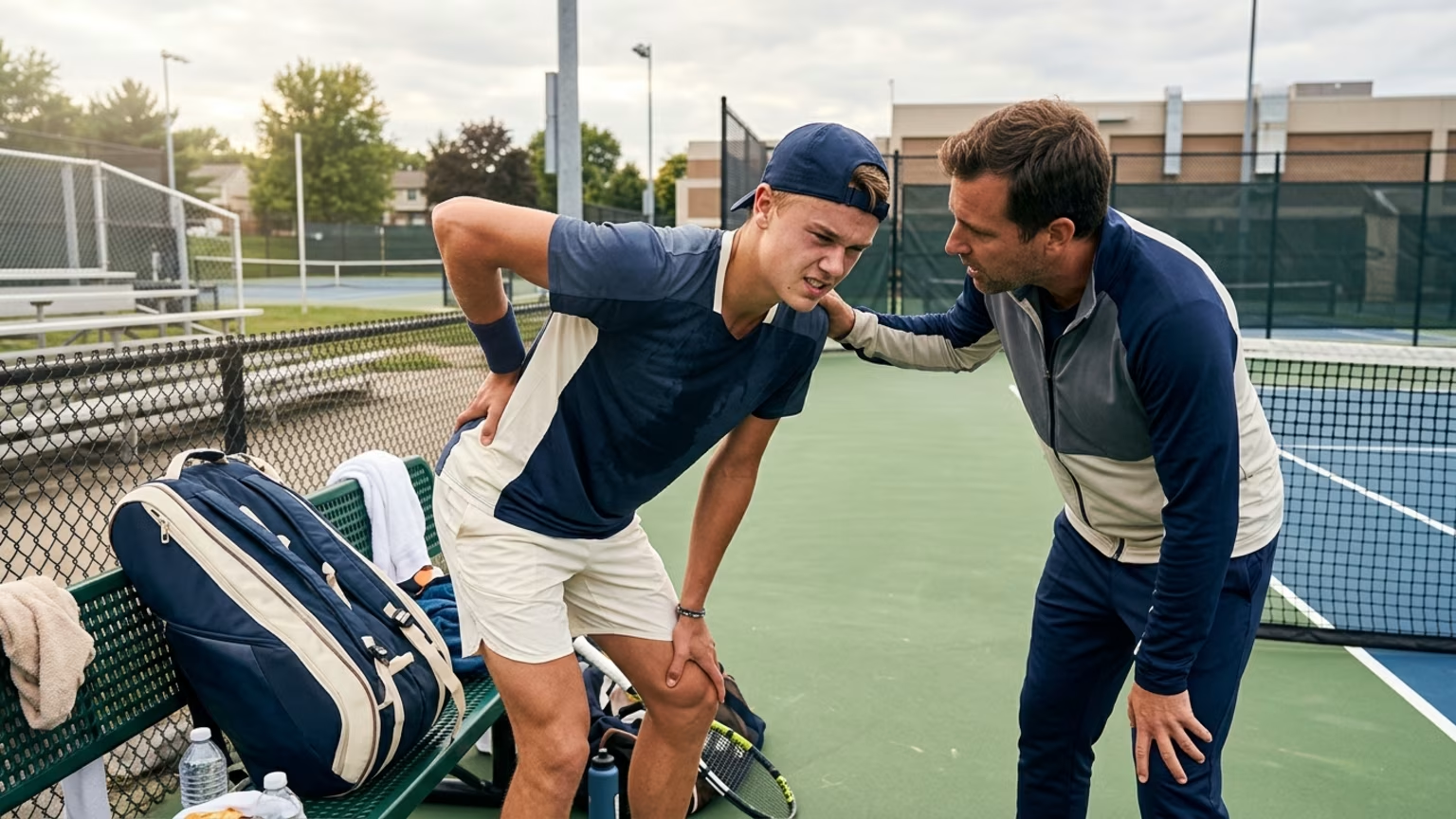
Holger Rune withdrew from the European Open with a back problem. The facts behind his decision and a grounded perspective for recreational players.

The Dink’s October 17 guide emphasizes deep returns, ball-height decisions and positioning against faster pickleball opponents.

A new report outlines padel and tennis gear trends. Learn how to assess adjustable rackets, sensor feedback and smart-court claims.
Read practical guidance for better movement, smarter preparation and a game that keeps working for you.
explore the Blog
