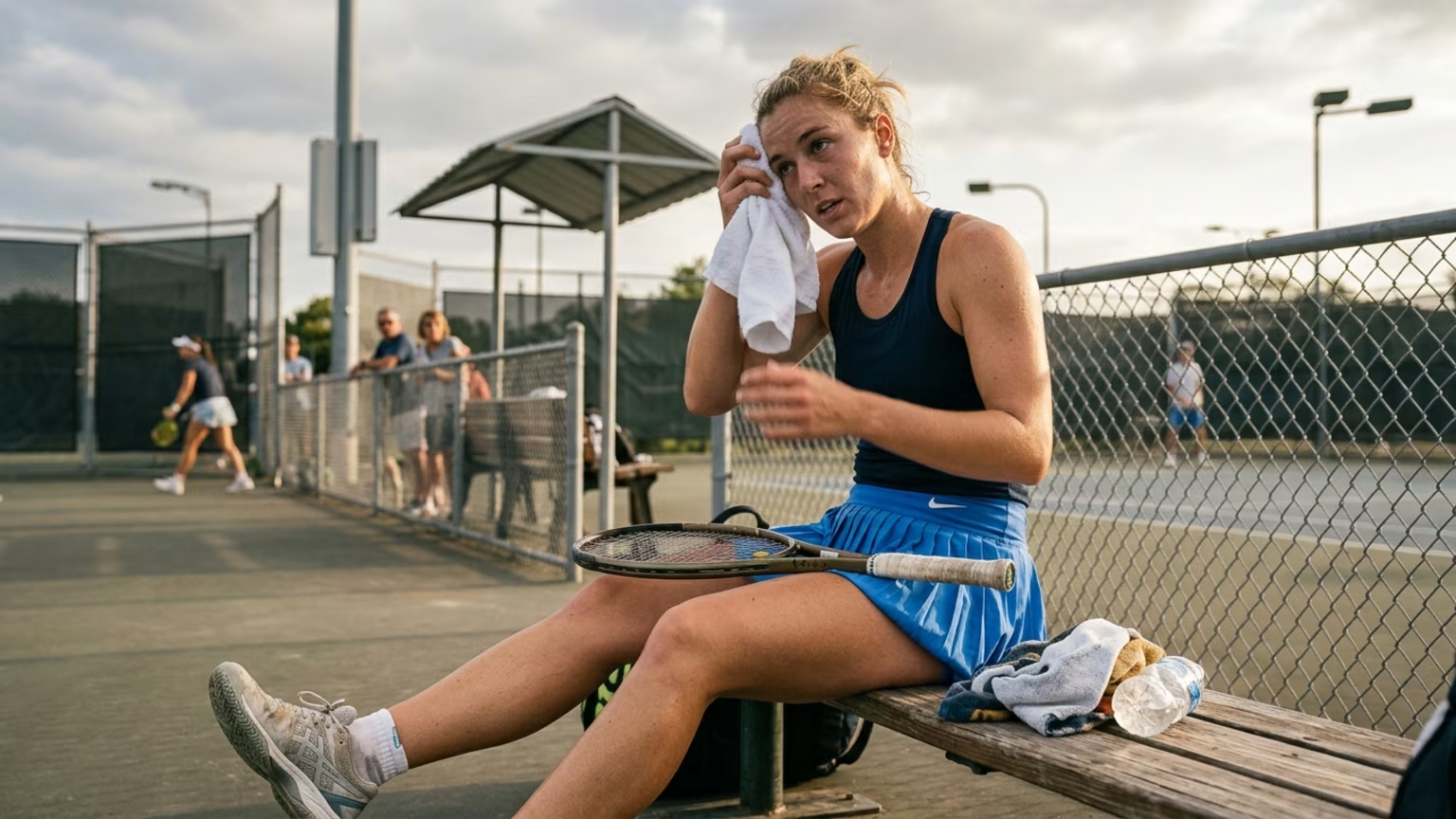

Iva Jovic's consecutive Guadalajara Open titles highlight the physical demands of hard-court tennis. Learn how adult players can build sustainable schedules.




On September 20, 2026, Iva Jovic successfully defended her Guadalajara Open title by defeating fellow American Peyton Stearns 6-4, 6-2 in the final. The straight-sets victory secured the 18-year-old her second consecutive championship at the WTA 500 hard-court event in Mexico. This repeat performance highlights the physical demands required to sustain high-level output on hard surfaces over multiple seasons. Jovic returned to the exact site of her first WTA Tour title and replicated her success with remarkable consistency.
Jovic entered the tournament as the number two seed and managed her workload with absolute efficiency. She completed the entire event without dropping a single set. The final match lasted exactly 86 minutes. Jovic secured the opening set in 46 minutes after breaking Stearns for a 5-4 lead and confidently serving it out.
Her momentum continued immediately into the second set. She broke serve in the opening game and added another crucial break at 5-2. Jovic then closed out the championship on her third match point. This victory came exactly one year after she won her first WTA Tour title at the same venue at age 17.
The route to the final required navigating challenging opponents. Jovic defeated sixth-seeded Cristina Bucsa 6-4, 6-1 in the semifinals. Stearns earned her spot in the championship match by defeating eighth-seeded Liudmila Samsonova 7-6(7), 6-2 in the other semifinal. These results confirm a highly competitive field on a demanding surface.
Watching a young professional secure consecutive hard-court titles offers a valuable perspective on athletic longevity. Hard courts are notoriously unforgiving on the lower body, offering minimal shock absorption during explosive lateral movements. Returning to a demanding event and reproducing high-level results requires excellent structural preparation. However, adult recreational players must remember that elite athletes rely on extensive off-court conditioning and dedicated medical support teams.
A successful title defense is evidence of an elite result, not a complete guide to the training, travel, and sleep protocols behind it. Adult players planning their annual calendars should use this news as a prompt to examine their own schedules. You must verify whether your year contains enough lighter periods between intensive competitive blocks. In our experience, managing court impact and avoiding excessive wear on the joints is entirely possible with the right approach.
I remember finishing a tough two hour padel match on a cold Tuesday night and waking up the next morning feeling like my lower back was locked in concrete. For a long time, I just accepted this as the price of playing hard in my forties. But once I started spending just ten minutes on targeted hip mobility before heading to the club, the stiffness almost completely vanished. It taught me that we do not have to accept pain as a default state of aging.
The core lesson for adult players involves deliberate calendar management. We must build conditioning progressively before tournament-heavy months begin. Strength, lower-body capacity, and movement quality should be established before the busiest competitive periods. When weekly court time or tournament frequency rises, players should reduce other training stressors to manage the total physical load. This strategy helps prevent sudden workload spikes that commonly lead to joint stiffness.
Separating performance goals from health goals is also crucial for adult competitors. Reaching a final or winning a club event is a specific performance objective. Remaining able to train and compete later in the season is a separate health objective. Treat any persistent joint or muscle pain as a clear signal to adjust your workload and seek professional assessment.
Using recovery as a deliberate scheduling tool is essential for sustained success on hard courts. Place rest or low-intensity days immediately after demanding matches. Do not assume that a quick two-set win means your body requires zero recovery time. Proper management of court impact forces dictates how well you will perform in your next scheduled session.
The statistics from Jovic's championship run emphasize the value of match efficiency on hard courts. In her semifinal match against Bucsa, Jovic saved 11 of 12 break points. She also converted half of her own eight break opportunities during that same match. Finishing the final in 86 minutes further reduced her total accumulated time on court.
While these specific metrics illustrate an elite competitive outcome, they highlight a universal principle for all players. Minimizing unnecessary court time through efficient play helps preserve joint health and energy for later matches. A shorter match does not automatically mean complete physical recovery is unnecessary. Players still accumulate practice, warm-up, and match demands across the preceding rounds of any tournament.
Tracking repeatability is a highly effective way to monitor your own match efficiency. Logging weekly court time, match intensity, and sleep quality provides invaluable data. This information helps adult players identify whether their performance is holding steady or deteriorating across a demanding season. Without this data, players often guess about their recovery needs and risk accumulating too much fatigue.
Looking ahead to the next competitive cycle, the focus for adult players should remain on sustainable scheduling rather than mirroring professional frequency. The ability to return to a demanding hard-court event and perform well requires long-term planning. It demands an understanding of how workload spikes affect the body over time.
We anticipate that more recreational athletes will begin treating their structured annual calendars with the same respect they give their on-court tactics. Proper planning ensures that rest periods are prioritized just as highly as competition weeks. By balancing intensity with targeted recovery, players can maintain their physical capabilities and continue enjoying racquet sports for years to come.
Follow Evercourts for practical insights on tennis, pickleball and padel performance, movement, recovery and healthy ageing. Stay connected for new articles, research-led guidance and ideas to help you play well and keep playing for years.


A recent live-play test of a silent pickleball highlights its value for practice, but standard balls still perform better for match play and power control.

An evidence check on sports supplements like tart cherry juice. Learn why racquet sports players should prioritize core nutrition over functional foods.
In late 2026, Oura analyzed wearable data to see how recreational tennis impacts heart health and recovery. Learn what this means for your athletic longevity.
Read practical guidance for better movement, smarter preparation and a game that keeps working for you.
explore the Blog
