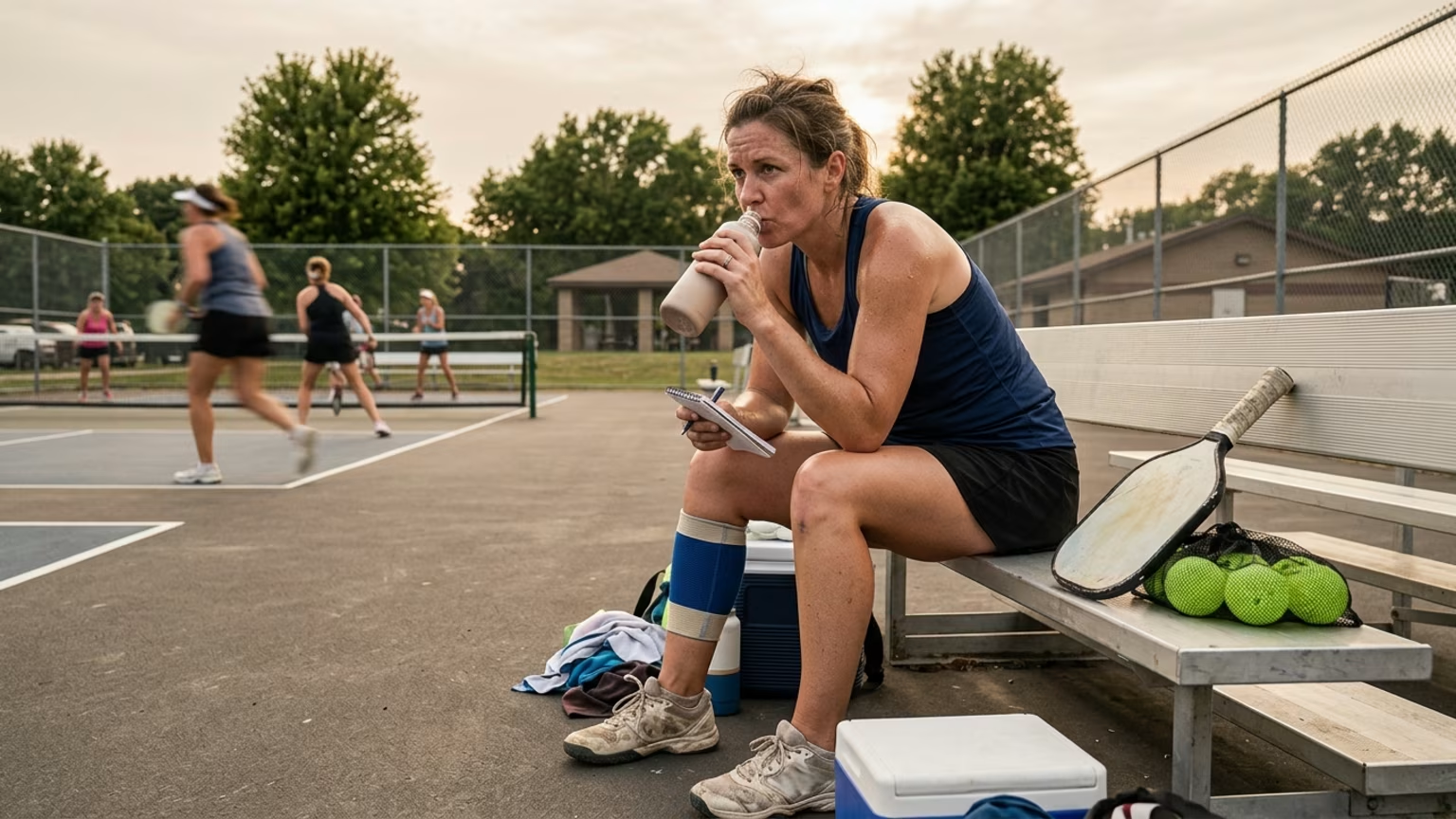

Explore how the Leapmotor Kuala Lumpur Cup 2026 schedule highlights the physical demands of multi-day pickleball tournaments and back-to-back matches.




Standard recreational play provides a controlled environment for adult athletes. Players usually know their exact start times, court assignments and opposition well in advance. This predictability allows for a highly structured approach to physical preparation. A player can arrive fresh, complete a dedicated warm-up and focus entirely on a single burst of effort.
This predictable format aligns perfectly with recent scientific findings on athletic longevity. A Chinese University of Hong Kong research summary reports that an eight-week pickleball intervention improved pre-frailty, functional fitness, and quality of life among study participants. These benefits are most safely acquired when players carefully manage their physical load. Playing a single match allows you to harvest these health rewards without overtaxing your system.
This format is highly protective of your physical capabilities over time. You only need to peak once during the day, which keeps cumulative fatigue relatively low. After the match ends, you have hours or even days to prioritize rest and nutritional recovery. The single-match approach is a reliable baseline for building healthy aging habits on the court.
Preparation remains straightforward when you only play one match. You can easily calculate your fluid needs without worrying about continuous depletion. You arrive at the venue, execute your strategy and leave enough energy in the tank for your next scheduled session.
A dense tournament schedule creates an entirely different physical challenge. The Leapmotor Kuala Lumpur Cup 2026 is scheduled for September 9 through September 13 at The Hood in Kuala Lumpur. This five-day PPA Tour Asia event demonstrates how elite competition compresses multiple matches into tight windows. PPA Tour Asia notes that the event is a PPA Asia 1000 tournament.
These extended events demand more than just tactical skill. The official preview lists Gabe Tardio alongside Noe Khlif in men's doubles and Jessie Irvine in mixed doubles. PPA Tour Asia identifies Gabe Tardio as the world No. 2 and says the Kuala Lumpur Cup will be his Malaysia debut. His appearance highlights a broader Asia swing that includes Singapore and the Philippines.
Managing physical stress during these days is a continuous process. Competitors must maintain their readiness across unpredictable waiting periods between matches. The event combines professional competition with a festival-style fan village, reflecting the sport's effort to grow. Even with these off-court distractions, athletes must prioritize their active recovery.
Those who cannot attend in person will still follow the physical demands closely. New Straits Times reports that the action will also be available live on Tonton. The continuous broadcast will capture how players handle the fatigue of repeated competition. Watching these matches provides excellent insight into professional endurance.
Each racquet sport places unique stresses on the body during competition. Tennis demands heavy rotational power and sustained aerobic capacity during long baseline rallies. Padel requires frequent overheads, fast multidirectional changes and patience during extended defensive sequences. Pickleball compresses intense reaction times and sudden accelerations into a much smaller footprint.
In our experience at Evercourts, skipping preparation is a major mistake. As one team member recalls, "When I first started playing pickleball, I noticed how many people skipped warming up entirely. They would jump straight out of their cars and right up to the kitchen line. I tried doing that and immediately pulled a calf muscle."
Our team member adds, "Pickleball requires just as much explosive lateral movement as tennis, just in a tighter space. Since then, I always spend five minutes doing dynamic lunges and ankle rolls. It changes everything about how confident I feel pushing off the baseline." This deliberate physical preparation is even more important during a multi-day tournament.
Players navigating dense schedules must adopt aggressive and structured hydration plans. Smithsonian's report on tennis heat management cites USTA guidance to hydrate before competition and drink during changeovers. Fueletics recommends scheduled drinking and gives 400 to 600 millilitres per hour as a general starting range in mild conditions, with adjustments for heat and sweating. This proactive approach is essential because you cannot rely on thirst alone.
Understanding how to prepare your body for shorter courts is a critical step. A solid foundation helps you adjust your footwork between different formats without risking sudden injury. Players must approach a five-day event with a repeatable system for staying warm. We highly recommend reviewing our strategies for handling consecutive matches to protect your movement capabilities.
The transition between different racquet sports also requires careful physical management. Switching from the long strides of tennis to the abrupt stops of pickleball challenges your lower body mechanics. Players must practice sport-specific deceleration techniques to protect their joints during tournament play. Our team always recommends reviewing the physical tolls of each sport before entering a mixed-format competition.
Entering a professional multi-day event requires significant financial and physical commitment. The structural stakes at these professional events are often quite significant for competitors. Pickle361 reports a US$300,000 prize pool, 1,000 ranking points, and 561 registered players at registration close. These substantial investments highlight the growing scale and pressure of the competitive circuit.
Fans and amateur players also face entry costs to experience these high-level competitions. Ticket options include single-day admission, premium courtside and VIP experiences, and a five-day general-admission pass. Securing a five-day pass means attendees can study the professionals closely throughout the entire progression of the event. Watching how elite athletes manage their bodies over consecutive days offers valuable lessons for your own matches.
The single-match routine is the clear winner for sustaining athletic longevity. Playing one structured match allows you to completely control your physical output and recovery timeline. You can push your limits safely without the looming pressure of a subsequent match just two hours later. This controlled exposure to stress is exactly what builds resilient joints and capable muscles over time.
Multi-day tournaments are an exciting test of skill, but they introduce significant variables that complicate healthy aging. You must manage unpredictable waiting periods, varying environmental factors and the cumulative wear of continuous competition. While disciplined hydration and rigorous warm-up routines can mitigate these risks, the sheer volume of a dense schedule remains demanding.
Staying on the court for life requires prioritizing consistent recovery over relentless competition. Standard recreational play provides the ideal balance of intensity and rest. You can enjoy the sport fully today while preserving your physical capacity for tomorrow.
Follow Evercourts for practical insights on tennis, pickleball and padel performance, movement, recovery and healthy ageing. Stay connected for new articles, research-led guidance and ideas to help you play well and keep playing for years.


Holger Rune withdrew from the European Open with a back problem. The facts behind his decision and a grounded perspective for recreational players.

The Dink’s October 17 guide emphasizes deep returns, ball-height decisions and positioning against faster pickleball opponents.

A new report outlines padel and tennis gear trends. Learn how to assess adjustable rackets, sensor feedback and smart-court claims.
Read practical guidance for better movement, smarter preparation and a game that keeps working for you.
explore the Blog
