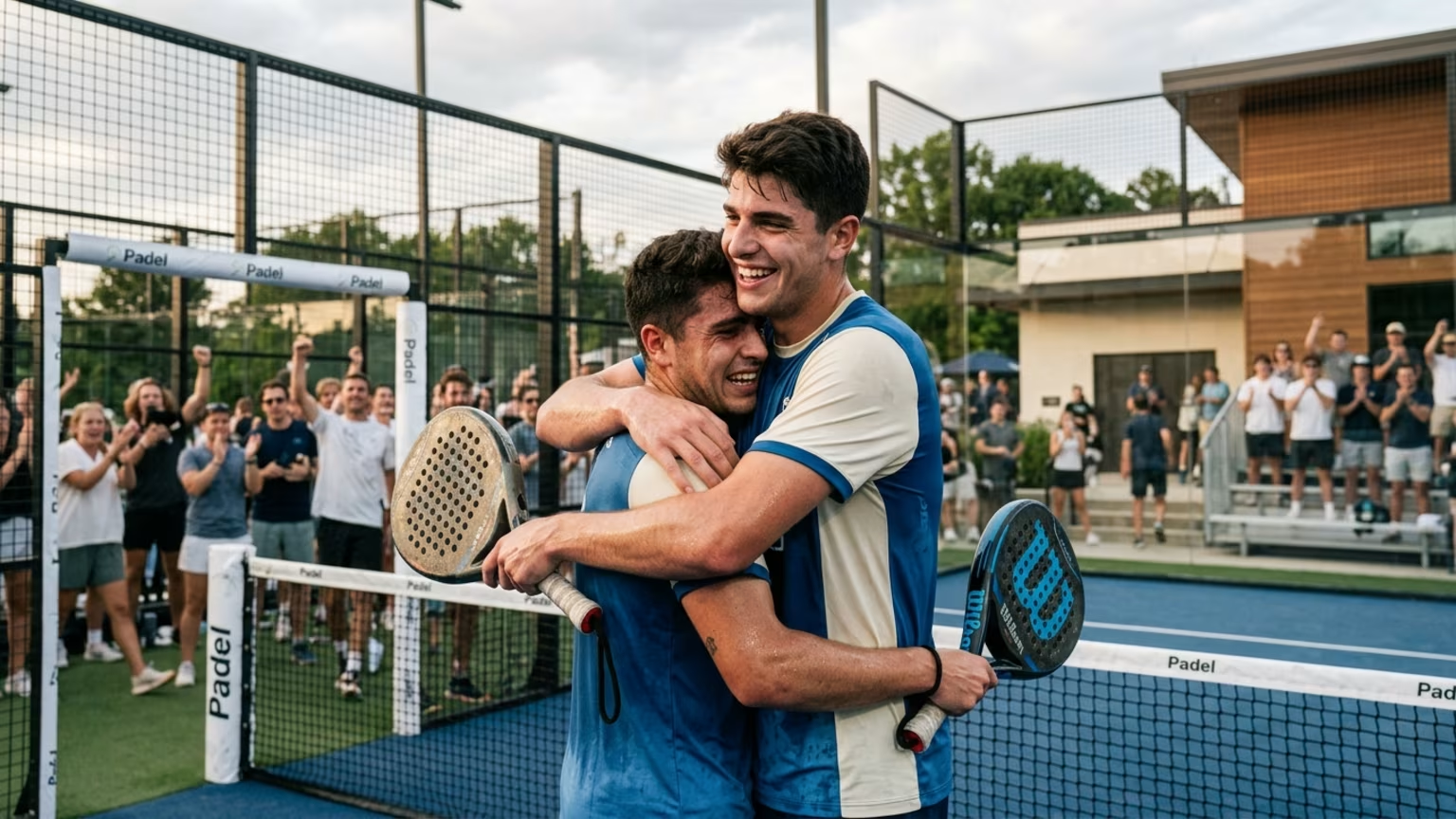

Agustín Tapia and Arturo Coello secured their fourth consecutive Paris Major title. We break down the match statistics and tactical lessons for club players.




On September 13, 2026, Agustín Tapia and Arturo Coello won the Premier Padel Paris Major at Roland Garros. The world's top-ranked men's pair defeated the second-seeded team of Alejandro Galán and Federico Chingotto in a highly competitive match that ended 6 to 3, 4 to 6, and 7 to 6. The victory required a massive effort in the deciding set. Tapia and Coello trailed late in the match before saving the tournament and winning the final tiebreak.
The impressive result secured a fourth consecutive Paris Major title for Tapia and Coello according to Relevo. It also marked their ninth championship of the year according to TyC Sports. This highly anticipated final was the 40th meeting between the two dominant pairs on the tour. Tapia and Coello have now won 27 of those encounters, including their six most recent matchups.
Marca reported that Galán and Chingotto came incredibly close to serving for the championship. Chingotto used varied angles and pace to thoughtfully disrupt Coello throughout the match. However, the top seeds increased their aggression at the exact right moment. They held their nerve to force a tiebreak and methodically controlled the final points to secure the prestigious trophy.
A match-tracking report from PadelTalk quantified the incredibly tight margins of the final. The contest lasted three full sets and spanned 32 games across 178 total points. The tracking data estimated a strong 71 percent serve figure for Tapia and Coello. This compared favorably to a 66 percent figure for Galán and Chingotto.
This year's final was significantly closer than recent Paris encounters between the two teams. Marca noted that Tapia and Coello defeated the exact same opponents in the 2024 and 2025 Roland Garros finals. Those previous championship matches were highly one-sided affairs. The top seeds won 6 to 2, 6 to 1 in 2024 and completely controlled the court for a 6 to 1, 6 to 4 result in 2025.
The strong serving performance from the champions started much earlier in the tournament. Mundo Deportivo reported on their impressive semifinal victory over Juan Lebrón and Leo Augsburger. That report described Tapia and Coello as particularly strong on serve and highly aggressive from the volley. They won that semifinal match 7 to 5, 6 to 3 to confidently set up the decisive clash.
Professional padel tactics rarely transfer directly to local amateur club courts. Elite players possess movement, anticipation, and technical skills that recreational players simply do not have. However, the structural discipline shown in this final offers valuable lessons for everyday competitors. The focus should be on building repeatable patterns rather than attempting low-percentage highlight shots.
The importance of smart court positioning is something our team understands well. In my own experience, I remember finishing a tough two hour padel match on a cold Tuesday night and waking up the next morning feeling like my lower back was locked in concrete. For a long time, I just accepted this as the price of playing hard in my forties. But once I started spending just ten minutes on targeted hip mobility before heading to the club, the stiffness almost completely vanished.
It taught me that we do not have to accept pain as a default state of aging. Combining better physical preparation with smarter tactics makes a massive difference for athletic longevity. When we hit deep returns and use defensive lobs properly, we avoid lunging desperately out of position. This proactive approach to adapting your movement reduces joint strain and keeps us playing comfortably for years.
Club players should focus on a reliable first serve pattern instead of chasing maximum speed. Serving with enough margin creates a highly predictable return from your opponent. This allows you to position yourself perfectly for the next incoming ball. You can practice this by serving to a specific target and recovering to the correct court position immediately.
Once your basic serve pattern is reliable, you can carefully begin adding tactical variation. The primary goal is to establish pressure early in the point. The strong serve figures from the Paris final reinforce how important this initial advantage is. A consistent serve prevents opponents from taking immediate control of the rally.
Hitting deep cross-court returns is a practical way to safely push opponents away from the net. This creates time for you to establish essential footwork skills and move forward safely. A controlled deep return is always better than forcing a risky winner from a poor defensive position. Managing the court with depth helps adult players dictate the pace of the entire point.
The lob is another critical tool for maintaining composure and control during difficult rallies. A higher lob buys you essential recovery time when you are defending or late to the ball. Its main purpose is to force opponents backward and completely restore a balanced court position. Using the lob as a reliable reset tool prevents unnecessary scrambling and awkward physical extensions.
The massive comeback in the third set of the Paris Major highlights the immense value of emotional control. Tapia and Coello miraculously recovered from a severe deficit by trusting their basic fundamental patterns. Recreational players can benefit greatly from running score-pressure training during weekly practice sessions. Rehearsing stressful situations makes your tactical decisions much clearer during real competitive matches.
Try starting practice games with a simulated score of 4 to 5 or playing practice tiebreaks from a 3 to 3 tie. Defending break points in practice removes the panic when it actually happens in a real tournament. The objective is to make the next decision simple, safe, and entirely automatic. A safe serve or a neutralizing volley is often all you really need to survive a high-pressure moment.
The tactical depth of professional padel will rapidly continue to expand as the season progresses. Teams across the premier circuit are constantly studying serve patterns and defensive structures. We expect to see more professional pairs heavily prioritizing score-pressure training to calmly handle these incredibly tight deciding sets. The ongoing rivalry between these top two pairs will likely define the rest of the competitive calendar.
For recreational competitors, the tactical evolution of the sport brings a very welcome shift in coaching advice. The emphasis is moving clearly away from purely offensive aggression and toward highly sustainable point construction. Players who focus on repeatable technique and pair it with selecting forgiving padel racket geometries will see the biggest long-term improvements. Smart tactics and adequate physical recovery are the true foundations of a long and healthy playing career.
Follow Evercourts for practical insights on tennis, pickleball and padel performance, movement, recovery and healthy ageing. Stay connected for new articles, research-led guidance and ideas to help you play well and keep playing for years.


An evidence check on sports supplements like tart cherry juice. Learn why racquet sports players should prioritize core nutrition over functional foods.
In late 2026, Oura analyzed wearable data to see how recreational tennis impacts heart health and recovery. Learn what this means for your athletic longevity.
Recent guidelines emphasize gradual progression, dynamic warm-ups, and scheduled recovery to help adult racquet sports players maintain athletic longevity.
Read practical guidance for better movement, smarter preparation and a game that keeps working for you.
explore the Blog
