

A new study reveals that matching upper-body stability tests to arm length removes body-size bias and provides fairer tracking for racquet sports.




During a 15-second stability trial, matching hand placement to individual arm length increased performance to an average of 23.9 taps while reducing body-size bias. For years, the standard assessment forced every player to place their hands exactly 36 inches apart. This fixed measurement meant shorter competitors faced a significantly harder mechanical challenge than their taller peers. A study of 154 athletes published in the International Journal of Sports Physical Therapy demonstrated that adjusting this gap creates a more equitable test for athletic longevity.
The Closed Kinetic Chain Upper Extremity Stability Test measures how well an athlete controls their upper body. Participants hold a push-up position and tap the opposite hand as many times as possible during a 15-second trial. This rapid weight shifting forces the shoulder stabilizers to manage dynamic loads. For athletes who constantly execute overhead motions, this mirrors the physical demands placed on the shoulder joint.
Racquet sports place enormous asymmetrical stress on the dominant shoulder over thousands of repetitions. Serving and overhead hitting require the shoulder joint to accelerate forcefully and then decelerate just as rapidly. The shoulder relies on a network of muscles to maintain stability during these explosive movements. If those stabilizers lack endurance, the risk of joint irritation increases significantly during long matches.
Testing shoulder stability helps identify players who might lack control during forceful movements. A standard testing setup has historically required all athletes to keep their hands 36 inches apart. This fixed distance applies the exact same structural challenge to a tall adult and a much shorter player. Over time, sports medicine professionals noticed that this approach might unfairly favor players with longer limbs.
A normalized test attempts to fix this by adjusting the distance for every individual. Researchers wanted to know if this small change would make the assessment fairer for diverse body types. The goal was to make the mechanical demand proportional to the athlete rather than using a static measurement. Finding an equitable way to assess stability provides better insights for players striving for athletic longevity.
The study investigated healthy athletes between 14 and 18 years old. The group included 120 males and 34 females with an average age of 16.5 years. The average body mass was 75.8 kilograms, and the average arm length was 90.4 centimeters. Researchers measured arm length precisely from the seventh cervical vertebra to the tip of the middle finger.
Each participant completed two trials at the standard distance and two trials at the normalized distance. They received 45 seconds of rest between trials to ensure recovery. Researchers used the best score from each condition to evaluate performance differences. This careful methodology revealed good group-level agreement between the two different testing setups.
The average performance was 23.0 taps under the standard setup. When the distance was normalized to arm length, performance increased slightly to 23.9 taps. The normalized condition therefore produced roughly one additional tap on average. The researchers noted that 53.9% of the participants performed better under the normalized condition.
The most important finding involves the reduction of body-size bias. Under the standard testing condition, performance correlated weakly but significantly with both body mass and arm length. The standard test inherently favored heavier and longer-limbed participants. In the normalized condition, neither body mass nor arm length showed a statistically significant relationship to performance.
Both test versions demonstrated excellent trial-to-trial reliability. The standard condition had an intraclass correlation coefficient of 0.921. The normalized condition performed slightly better with a reliability score of 0.931. This shows that both setups are consistent tools for measuring dynamic upper-body control.
However, players should not confuse a tiny score bump with real physical changes. The standard test showed a minimal detectable change of 4.43 taps at the 95% confidence level. The normalized test showed a minimal detectable change of 4.03 taps. Since the average improvement was about one tap, small score variations do not guarantee actual progress.
The study compared contact athletes against overhead athletes to find broad group differences. Contact athletes averaged 25.0 taps on the standard test and 25.3 taps on the normalized test. Overhead athletes scored noticeably lower on both variations. The overhead group managed only 20.2 taps on the standard setup and 21.9 taps on the normalized setup.
These performance differences were statistically significant in both conditions. The contact and overhead groups did not differ significantly in age, body mass, or arm length. This means the gap cannot simply be explained by the contact group being older or heavier. However, the researchers noted that these results should not be read as a universal ranking of sports.
While tennis players made up only 1% of the sample, the mechanical principles apply across racquet sports. A tennis serve requires massive force generation and joint stability to decelerate the racquet safely. Padel smashes demand similar overhead power, which players must support by building capacity for bandejas and smashes. Pickleball overheads might use a lighter paddle, but the repetitive upper-body stress still adds up rapidly over long matches.
New data continues to highlight the toll that competitive play takes on the upper body. For instance, rising upper-body and arm injuries in professional tennis underscore the need for better monitoring tools. When players test their stability regularly, they can spot early signs of fatigue before serious issues develop. The normalized test offers a practical way to gather this information without requiring expensive lab equipment.
Adult recreational players face different joint stresses than the adolescents in this study. The findings offer a smart framework for standardizing testing rather than direct performance norms for older players. Tracking your physical readiness requires more than just counting hand taps. You need to interpret these scores alongside your specific sport demands and your overall strength training routines.
If you want to track your upper-body control, pick one testing setup and use it consistently. Switching back and forth between a 36-inch gap and an arm-length gap will ruin your long-term data. Arm-length normalization makes the most sense if you train with partners of different heights. It ensures the mechanical demand matches your body dimensions fairly.
Treat this test as a simple monitoring tool for athletic longevity rather than a diagnostic device. The researchers recommend using this test as part of a broader physical assessment battery. It should be combined with tests for shoulder-stabilizer strength and posterior-shoulder endurance for a complete picture. Do not use this single measurement to diagnose an injury or clear a player for competition.
If your score drops by more than four taps, you might need to adjust your recovery routine. A declining score could signal fatigue, poor scapular control, or a need for focused morning exercises for court stability. Use this data to inform your habits and keep your shoulders strong for the next match.
Follow Evercourts for practical insights on tennis, pickleball and padel performance, movement, recovery and healthy ageing. Stay connected for new articles, research-led guidance and ideas to help you play well and keep playing for years.


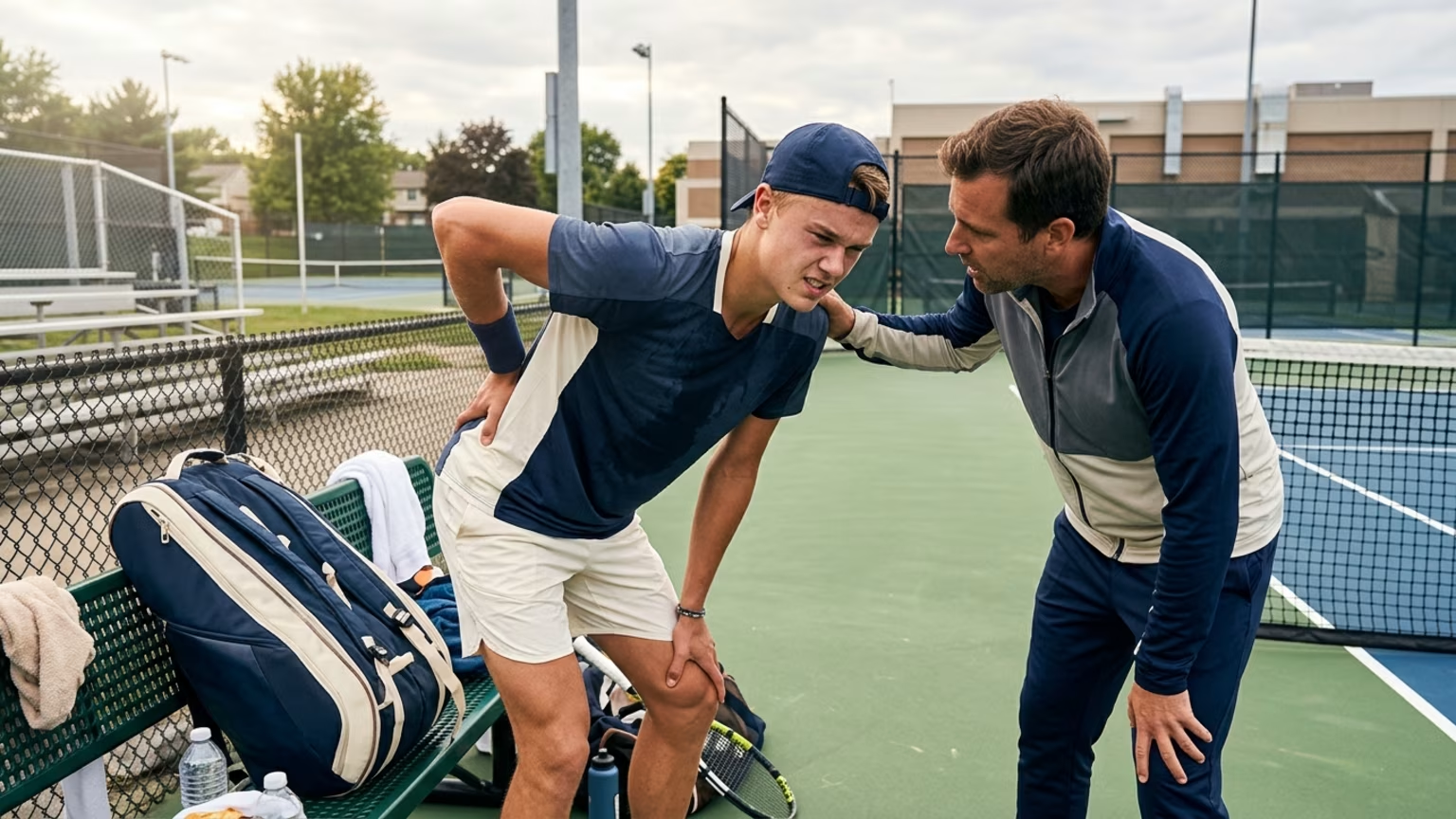
Holger Rune withdrew from the European Open with a back problem. The facts behind his decision and a grounded perspective for recreational players.

The Dink’s October 17 guide emphasizes deep returns, ball-height decisions and positioning against faster pickleball opponents.

A new report outlines padel and tennis gear trends. Learn how to assess adjustable rackets, sensor feedback and smart-court claims.
Read practical guidance for better movement, smarter preparation and a game that keeps working for you.
explore the Blog
